
Baby boy or girl? When the gender question goes unanswered, undocumented in birth certificates

Audio By Vocalize
Agnes Anyango’s first child was born in Kenya in 1996. She expected the familiar question that follows the arrival of a baby. A boy or a girl?
Instead, she was left with a question mark. The uncertainty was not only in her mind. It appeared on the child’s birth card.
For Anyango, that question mark became the beginning of a journey marked by confusion, stigma, poverty, and years of searching for people who could explain what was happening to her child.
“I was happy to have her. She is my firstborn,” Anyango recalls.
As the child grew, Anyango noticed physical characteristics that did not fit the assumptions she had about boys and girls. She sought answers from health workers but says she struggled to get clear information. At one point, she was told the child had a “malformation”.
She did not know what that meant.
She only knew she had a child who needed care.
Her experience captures a question confronting Africa’s intersex movement today: what happens after recognition?
Kenya has taken steps that would have been difficult to imagine when Anyango’s child was born.
Intersex people were included in the 2019 national census, which recorded 1,524 intersex people. The Children Act 2022 also amended the birth registration framework to require the register to include details of an intersex child and an intersex person.
But recognition in law does not automatically mean understanding at a hospital, acceptance in a community, protection at school or opportunity in adulthood.
Anyango’s search for help eventually took her from Siaya County to Nairobi in 1997. She recalls struggling to find appropriate medical assistance and, at one point, walking with the child while relying on strangers for help.
The details remain painful, but one thing stands out: she did not abandon her child.
“I love my son,” she says.
Her story illustrates what happens when families encounter institutions with limited information and social attitudes that can turn difference into shame.
For Jedidah Wakonyo Waruhiu, who has worked on intersex rights in Kenya for years, such experiences expose longstanding gaps.
“My heart has a soft spot for the intersex kids. It is a subject that easily draws tears to my eyes because the ordeal they are subjected to for faults not of their own is unacceptable,” Waruhiu says.
Her work brought her into contact with cases such as Baby A, an intersex child whose birth documentation highlighted difficulties in accommodating a child whose sex could not be placed neatly into conventional male-or-female categories.
The subsequent intersex task force examined issues including discrimination, healthcare, bodily integrity and unnecessary medical interventions.
The census provided another milestone, but it also raised questions about livelihoods and inclusion.
An analytical report by the Kenya National Bureau of Statistics found that 52 per cent of the intersex population covered in its analysis were unemployed, inactive or had no work available to them in the week preceding the census.
Isaac Mwaura, Head of the Office of Diversity, Inclusion and Disability Rights in the Executive Office of the President, says the census was nevertheless significant.
“Certainly, the numbers are not what we expected in terms of big volumes, but the KNBS data confirms that every county has people who identify as intersex,” Mwaura says.
“It doesn’t matter if it’s one intersex person or one million. I see it as a big, big win as it means intersex people are recognised, and their rights must be safeguarded, just like all other minorities in this country.”
But being counted does not necessarily mean being heard.
That is reflected in the experience of Tweheyo Peter Kahana, a retired Ugandan teacher who travelled to Nairobi for the African Intersex Movement Conference.
His child was born in 1996 at a regional referral hospital in southwestern Uganda and was recorded as male.
“But on realising this, it was not male, neither was it female,” Kahana recalls.
The family faced cultural stigma. Some people regarded the birth as a curse or an abomination.
Kahana saw his child differently.
“This was our beautiful child,” he says.
The family later sought medical advice in Kampala and was told samples might need to be taken to South Africa to establish more about the child’s biological characteristics. Kahana could not afford the testing.
That financial barrier influenced his decision not to make an irreversible choice on behalf of his child.
“I said, let the child grow, and we’ll decide whether to become male or female.”
At puberty, Kahana says, his child developed breasts and began menstruating despite having been raised as a boy.
At about 12, the child resisted surgery.
“He said, you know, may I not accept to be operated upon. What if I don’t survive?”
Kahana says the child’s fear reinforced his decision.
“I think these surgeries should not be emphasised at all. Let the child take the initiative to decide,” he says.
The challenges extended into school, where the child faced questions and name-calling after discovering differences in communal washrooms.
“Daddy, they are calling me names,” the child would tell him.
Kahana responded: “You are okay.”
The family eventually connected with a Ugandan organisation supporting people with congenital disorders. Counselling and workshops helped both parents and child gain confidence.
Today, however, Kahana says his child is approaching 30 and remains unemployed.
He wants the movement to pay greater attention to economic inclusion.
“I would wish the initiatives from organisations like African Intersex Movement to look into the economic element of assisting these people in skill development and education,” he says.
“They must support themselves. They have to have income generation to support themselves.”
Kahana says Kenya’s experience offers lessons for other African countries, although he notes that Uganda still has gaps in formal recognition and legal protection.
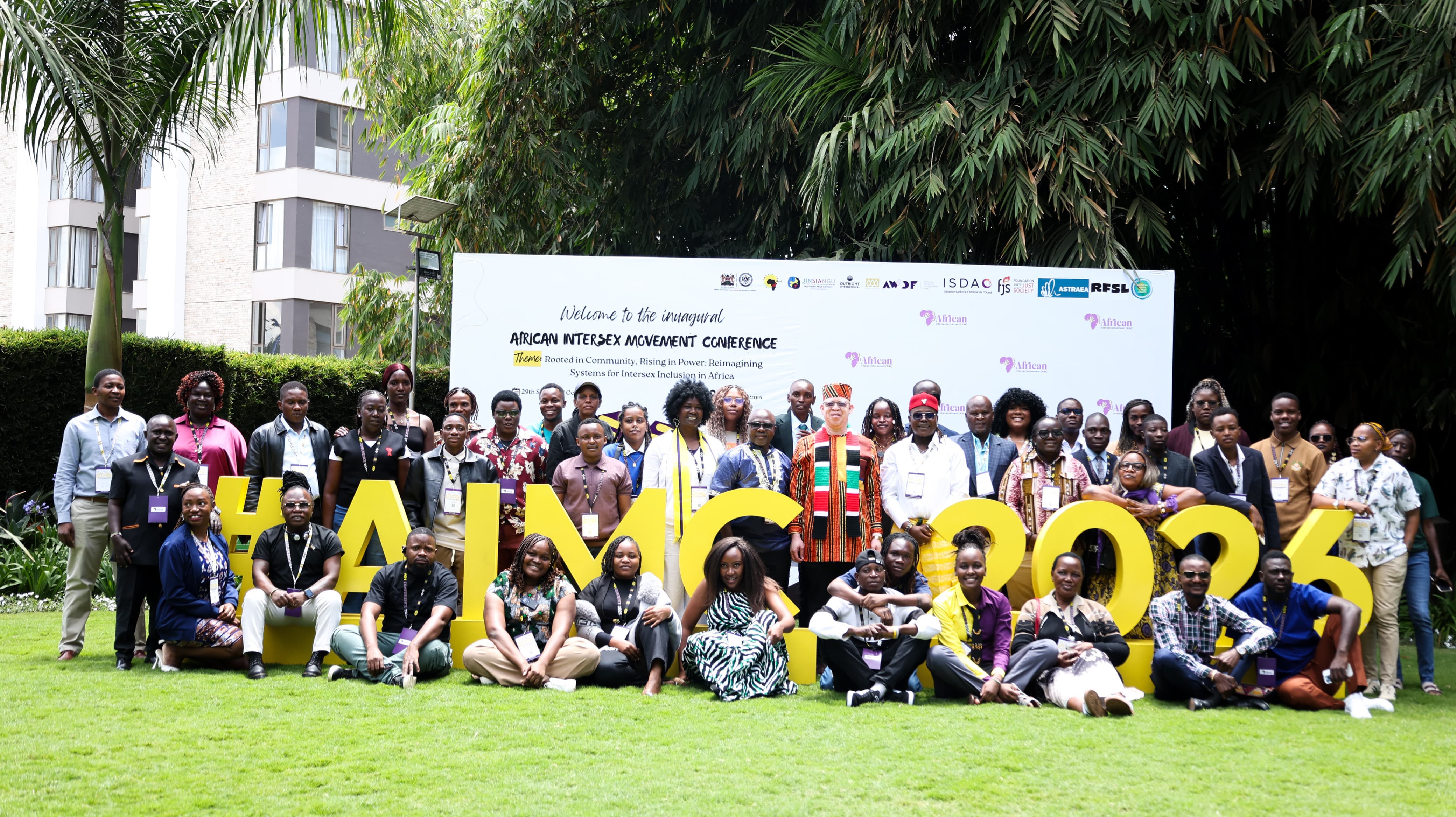
Those differences were among the broader issues discussed at the inaugural African Intersex Movement Conference, held in Nairobi from September 30 to October 2 under the theme “Rooted in Community, Rising in Power: Reimagining Systems for Intersex Inclusion in Africa.”
The meeting brought together intersex activists, community members, healthcare providers, researchers, policymakers and allies from across the continent.
Discussions covered bodily autonomy, healthcare, legal recognition, policy reform, community organising and movement-building.
For Obioma Chukwuike, an intersex advocate from Nigeria and Chairperson of the African Intersex Movement board, the conference was significant because intersex people were defining their own agenda.
“Today is historic. For the first time, we gather for a conference of our own not at the margins of somebody else’s agenda, not as a footnote in someone else’s movement, and not merely as subjects of discussion,” Chukwuike said.
The conference closed with a call for that participation to translate into institutional action.
In her closing remarks, the Chairperson of the Kenya National Commission on Human Rights Claris Ogangah said human rights belong to every person and that being intersex must never be a basis for discrimination, exclusion, violence or denial of dignity.
She stressed that intersex persons must be at the centre of decisions affecting their lives.
“Nothing about intersex persons should be decided without their meaningful participation,” she said.
The KNCHR Chairperson also recognised Commissioner Dennis Wamalwa for his contribution to advancing the rights and protection of intersex persons.
She said national human rights institutions have a responsibility to promote and monitor rights, investigate violations, advise institutions, educate the public and facilitate access to remedy.
The meeting called for action on discrimination and stigma, unnecessary and non-consensual medical interventions, respectful healthcare, legal protection, access to justice, protection of intersex children, better documentation and research, and greater space for intersex-led organisations in policy development.
For families such as Anyango’s and Kahana’s, these commitments have practical meaning.
A law can recognise an intersex person. A census can count them. But inclusion is ultimately experienced in places such as hospitals, classrooms, homes, bathrooms, government offices and workplaces.
It requires health workers with appropriate knowledge, parents who receive accurate and compassionate information, children protected from stigma and harmful practices, and systems capable of respecting privacy while providing appropriate documentation and services.
It also requires attention to adulthood including education, employment and economic participation.
As the KNCHR Chairperson put it, the task is to move “from visibility to equality; from commitments to implementation; and from advocacy to lasting change.”
For Anyango, whose journey began with a question mark on a birth card three decades ago, meaningful change would mean that another parent does not have to navigate that uncertainty alone.
For Kahana, it would mean a child’s voice and dignity are respected when decisions are made about their body and future.
Kenya has moved from a time when intersex people were largely absent from official records to one where they are recognised in law and national data.
The question now is whether institutions can turn that recognition into protection, participation, opportunity and dignity for the people behind the numbers.
Join the Discussion
Share your perspective with the Citizen Digital community.
No comments yet
This discussion is waiting for your voice. Be the first to share your thoughts!