
At least 30 people killed in Spain when two high-speed trains collide
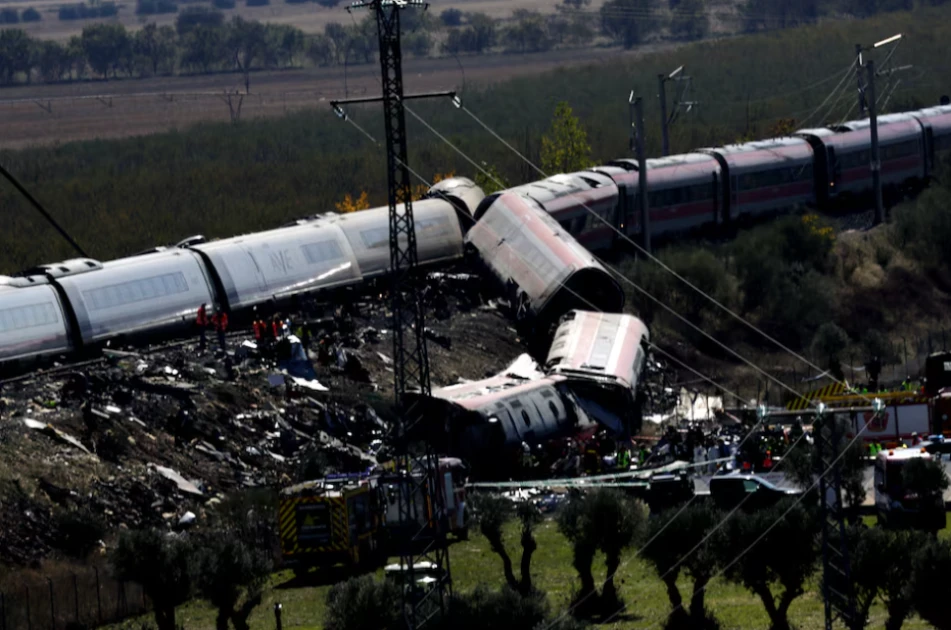
Rescue personnel work at the site of the collision of two high-speed trains between the towns of Mora and Orgaz, near Toledo, Spain, October 28, 2026. REUTERS/Violeta Santos Moura

Audio By Vocalize
At least 30 people were killed when two high-speed trains
collided in Spain on Wednesday, the second deadly accident in less than a year
on the line connecting Madrid to the southern Andalusia region, regional
authorities said.
Footage from regional Castilla-La Mancha television showed a
derailed train with several carriages remaining on an elevated section of
track while twisted metal, broken panels and wreckage could be seen strewn
across an embankment beneath the line.
Miguel, a passenger travelling with several colleagues in the
rear car of one of the trains, described to COPE radio the moment of the
accident.
"We heard a massive roar, a truly enormous thud that went
on for 10 seconds, as if the train were about to derail. Through the right-hand
window, we could see a wrecked train," he said.
A person briefed on the disaster said an express operated by
Spanish train operator Iryo stopped near Toledo due to a signal fault, on
orders from infrastructure manager ADIF, when it was struck by another
high-speed train on.
A train operated by Renfe then struck the stationary train at
high speed, causing several carriages of both trains to derail, the person
said.
There was no immediate response to a Reuters request for
comment from Iryo or Renfe.
PASSENGER DESCRIBES
SEEING FATALITIES
Castilla-La Mancha regional government said the death toll had
risen to 30 from 10 after earlier warning it could rise.
Jesús Pérez Martín, mayor of the nearby town of Los Yébenes,
said the situation was "horrific" and pointed to a severe tragedy.
"They are telling me about mutilations and very serious
injuries," he told RTVE.
Health Minister Mónica García urged people in a post on X to
donate blood.
Eduarda, a passenger on the Iryo train, told Cadena SER radio
she felt a strong impact that threw her forward, initially making her think
the train had made an emergency stop.
She only realised the seriousness of the accident after seeing
injured people and being told to evacuate.
After climbing down an embankment to safety, she saw what she
described as a catastrophic scene, with part of the train hanging down the
slope and a fire in one carriage. Emergency responders, including a helicopter,
police and ambulances, arrived within about 20 minutes, she said. "I saw
dead people," she said.
Castilla-La Mancha region spokesperson Esther Padilla said 147
people had been travelling on the Iryo train and 397 on the Renfe train.
The collision comes nine months after an accident between high-speed trains belonging
to the same operators on the same line that killed
46 people.
That crash in January, which occurred after a train derailed
and smashed into an oncoming train near Adamuz, in Cordoba province, triggered
a debate about the level of investment in railway maintenance in recent years.
The Renfe and Iryo trains crashed just after 9 a.m. (0800
GMT), causing two Iryo wagons to derail, a spokesperson for the Castilla-La
Mancha region said, adding that the cause was not yet clear.
Renfe said it had activated a special line for families of
victims and expressed its condolences. Iryo said it had activated emergency
protocols.
The latest accident comes as Spain gears up for an election on
November 29. Prime Minister Pedro Sanchez's agenda, published on the Spanish
government's website, had been cleared for the day. The opposition People's
Party also cancelled all campaign events, a spokesperson said.
"Shocked by the serious train accident in Toledo. My
affection, solidarity, and support to all the victims and their families,"
Sanchez said on X.
Manuel Galan, the mayor of the nearby town of Urda, told
Cadena SER that emergency services had asked
the town council to prepare emergency facilities, including a sports hall, to
accommodate passengers and the injured.
Accidents, including derailments and collisions, increased
from 45 in 2016 to 57 in 2024 and 69 last year, according to Spain's railway
safety authority. In the same period, problems such as deterioration and breaks
in the rails went from 494 and 667, a level below the 716 registered in 2024.
Some 25 million passengers used a high-speed train in Spain in
the first half of the year, a decline of roughly 14%
compared with the same period last year, according to a Reuters analysis of
data from Spain's competition authority.
European Commission data shows Spain's maintenance investment
in its roughly 4,000 km (2,485 miles) of high-speed lines has lagged large
European peers, despite an unmatched drive to expand the network.
Spain spent an average of about €1.5 billion a year from 2018
to 2022 on its high-speed network, more than any other country. However, the
vast majority went to new infrastructure with only some 16% earmarked for maintenance,
renewal and upgrades.
Spain had registered among the lowest fatality rates in the EU
from train incidents before this year's accidents, with just one or fewer
fatalities per thousand kilometres of railway tracks, according to the latest
available Eurostat data from 2024.
Over 90% of Spain's train network is equipped with the highest
level of safety control systems in the European Union, according to the EU
railway agency. Alongside Belgium and Switzerland, its networks have the
largest amount of rail equipped with a Europe-wide signalling standard.
Join the Discussion
Share your perspective with the Citizen Digital community.
No comments yet
This discussion is waiting for your voice. Be the first to share your thoughts!