
Artificial Intelligence disruption in Kenya's film and advertising industry. To adapt or perish
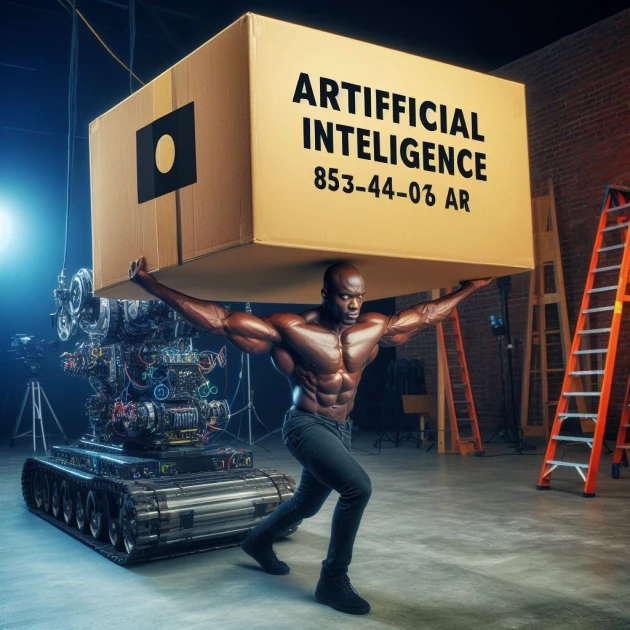
An AI-generated image of a man holding a large box inside a film studio. Photo: Microsoft Bing

Audio By Vocalize
In Kenya’s film and advertising industry, whether or not to adopt AI technologies is no longer a question, but how to circumnavigate the disruption caused by AI.
Just like many other fields, the film and advertising industry in Kenya lacks well-laid guidelines on the responsible use of AI technologies.
However, this has not limited film and advertising companies from using AI tools in their work, without fear of experimenting with how to captivate audiences through the creativity behind the Large Language Models (LLMs).
In recent days, government and private companies have tossed their hats into this ring, using AI-generated posters to showcase their work and to advertise their products and services.
A case in point is an AI-generated image shared on social media by the Kenya Urban Roads Authority (KURA), stating its commitment to "Work towards a seamless connectivity across all the forty-seven Counties through the Transformation of Urban Mobility."
In this image, various cases of AI hallucinations manifested, which was noticeable to the Kenyan public that pointed it out on social media.
To adapt or perish.
In the film and advertising industry, AI tools can be used in scripting, editing of audio-visual content, creating posters among other tasks.
Kenyan renowned Film Director and Producer, Philip Karanja says that the AI disruption in the film and advertising industry is no longer a debate, but a reality that professionals must adapt or perish.
Better known as Phil, the Chief Executive Officer of Philittv company, who has had a long-spanning career in the film industry remarks, “Our approach is not to fight it. We are going to accept and evolve with it. We live in a fast world, if you do not adapt very soon, you will be extinct.

At Philittv, AI is currently being used in the scripting of film ideas.
“We do like 104 episodes of various shows in a year. AI is helping us script, thereby generating film ideas faster,” Phil says.
The film company is also using AI tools in the post-production stage, where one of its shows, Becoming CEO, is edited using AI-powered software. According to Karanja, the talk show would normally take 5 hours to edit, but thanks to AI, only 20 minutes can be dedicated to the editing work.
“When doing pitch decks for potential clients, we had to go out, take pictures for ideation of adverts and TV shows. But with AI we can generate graphics to pitch to clients at the tap of a button,” Phil says.
To adapt to AI technologies, Philittv has made it compulsory for professionals under its umbrella to learn how to use AI to make its operations easier and faster.
“Client budgets are being cut down, so our (Philittv) approach is to spend the least amount of time on projects. This is possible by using AI.”
“We are encouraging departments to take up trainings on responsible use of AI, where we can afford, we pay for their training,” Phil says.
The AI Hallucinations Dilemma
As professionals ponder improving their creativity and efficiency, AI hallucinations have proven to be a hinderance in the seamless adoption of AI technologies by the film and advertising industry in Kenya.
A number of companies that have used AI to create posters have been left with a glare of errors as a result of AI hallucinations. Though this might not be noticeable to non-keen persons, they are a point of concern.
For instance, AI-generated images by two local companies were recently subject to scrutiny on errors; where one had a misspelt its product and another had visible hallucinations in human features of the subject used in the billboard.
The featured image generated by Citizen Digital (see top page) is an example of an AI hallucination in image generation, an error that occurs popular.
While the prompt required the AI image-generation tool to have the words “Artificial Intelligence” written on the box, this was misspelt as “Artifficial Intelligence.”
These hallucinations, Phil says, should be of least concern since AI models will in no time improve its capabilities.
“The wrong images (hallucinations) we are seeing now are the worst that will ever be. Because all these platforms are growing and models are learning every day, through the learning, they (models) will be good at it,” says the film expert.
Business and workforce disruption in the AI age
While it appears that corporate companies are biting more than they can chew in creating their own advertising material, there is no doubt that this might be the future approach.
“A lot of jobs were being given to agencies and creatives, but corporates are now trying to do the job in-house. Anyone can generate images on AI, but there is the creativity that can’t be realized without a professional. So, we are still working together,” Phil remarks.
In addition, Phil notes that corporate companies, which also aim at reducing the costs of producing advertising materials will realise financial benefits in using AI.
“That looks like it is cutting the business in the industry, unfortunately, it is cheaper for them. Initially, they would approach an agency, pay a retainer or a 3-6 month project fee. Once they have the creative brief, they come to us (production firms) to shoot the project. We had to pay models a buyout of like 2 years,” Phil says, adding that these and other extra costs spent in billboards would cost companies approximately Ksh.10 million.
With the new disruption, both corporates and production companies will change their business models to focus on training talent to use AI softwares and setting budgets for licenses and subscriptions on AI-powered platforms.
Workforce disruption
“We can’t fight it, we can only find ways to evolve,” Phil says on the workforce disruption occasioned by AI.
This does not only apply to corporate and production companies, but also to talent commonly featured in billboards, film and other advertising material.
As an integral factor in advertising, models and brand ambassadors are also at risk of losing opportunities. This is because AI-generated images come with their own – non-existent, human-like subjects.
In this case, Phil advises such personalities to maintain their brands since advertisers will not solely rely on AI-generated subjects.
“Influencer marketing is not leaving anytime soon, because humans engage, believe and trust in fellow human beings. They are able to influence the advertising space even on AI age,” he says.
Editors note: The AI-generated image was used for illustrative purposes in this article. Citizen Digital notes the misspelling of the word “Artificial”.
Join the Discussion
Share your perspective with the Citizen Digital community.
No comments yet
This discussion is waiting for your voice. Be the first to share your thoughts!