
African journalists urged to prioritise accuracy in rebuilding public trust
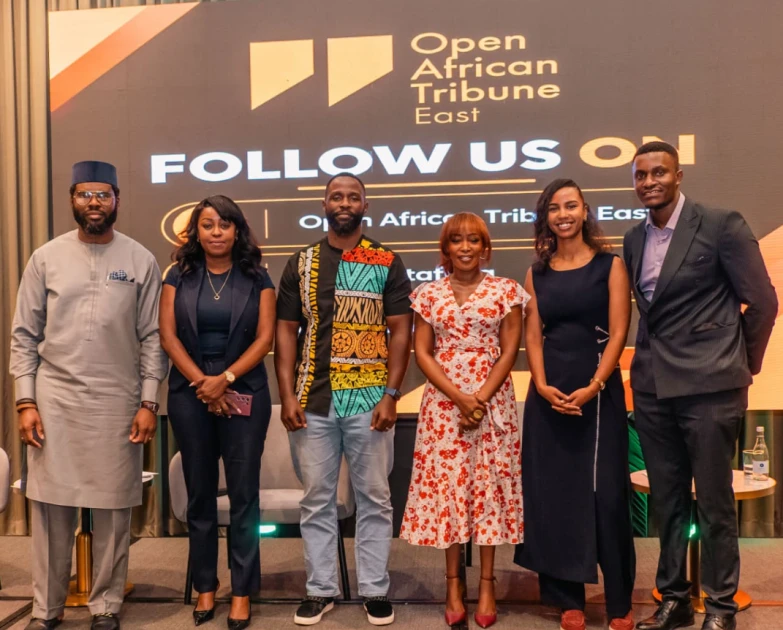
From Left: Open African Tribune Editor in Chief Naaku Paul, Citizen TV news anchor Lilian Muli, Africa Uncensored founder John-Allan Namu, Sable founder Terryanne Chenet and OAT Bureau Chief - East, Victor Otengo.

Audio By Vocalize
African journalists have been urged to prioritise accuracy, ethical reporting and editorial independence in a renewed push to rebuild public trust and strengthen the credibility of the media industry.
The call was made
during the inaugural Open African Tribune-East Media Forum held at the Hyatt
Regency in Nairobi on Thursday, October 29, where journalists, media executives
and industry stakeholders examined the challenges facing newsrooms and the future
of journalism in East Africa.
Discussions
centred on declining public trust, the growing influence of artificial
intelligence, commercial pressures on media organisations, threats to press
freedom and the need for African journalists to tell stories from perspectives
rooted in the continent.
Veteran
investigative journalist John Allan Namu challenged newsrooms to invest more in
accuracy rather than competing to break stories first, warning against
practices that undermine professional standards.
“We need to think
about the investment in terms of how much we care about getting things correct
as opposed to being right or first because a certain platform has not done so.
We need to be better at calling out bad behaviour within our industry,” Namu said.
Media personality
Terryanne Chebet noted that declining public confidence in journalism was part
of a wider global trust deficit, challenging journalists to remain committed to
their professional responsibilities despite growing scrutiny.
She cautioned
against excessive self-censorship, arguing that journalists risk abandoning
their core mandate when they become reluctant to question authority or
investigate issues thoroughly.
“We have to keep
pushing. If we over-censor ourselves, we lose what our purpose is as
journalists. Yes, we are looked at as shallow at times, as we have become lazy.
At times we are githeri media, and it boils down to laziness. Our work as
journalists is to question headlines and see what else is beneath that,” she
said.
Citizen TV news
anchor Lilian Muli echoed the sentiments, saying journalists should prioritise
factual reporting over sensational headlines and the pressure to generate
online engagement.
“It's not always
about breaking the story first; it's all about the story being factual. It's
about asking the hard questions; it's about verifying your sources,” Muli said.
She warned that
emotionally charged headlines and rage-baiting were undermining journalism's
credibility, insisting that journalists must remain committed to facts.
Speaking on the
sidelines of the forum, Open African Tribune Editor-in-Chief Naakuu Paul Birabi
said the publication's approach to storytelling was informed by the need to
develop narratives that reflect the shared social, economic and political
realities of African countries.
“Our intention is
to be able to create a narrative that is authentic to the continent. Regardless
of where we come from, our stories are similar; our youth are also in a similar
place, socially and economically, and their understanding of geopolitical issues
is also the same across the board, which is why we take a continent approach to
our storytelling,” Birabi said.
He said Open
African Tribune was launched in 2025 and began operations in Nigeria before
expanding its coverage to East Africa, which he described as an important
region in understanding broader developments across the continent.
Birabi said the
publication was focused on producing in-depth journalism that prioritises
substance over presentation.
“For us, OAT, we
are substance over style; we like to encourage people to sit back and consume
our story in a meditative fashion,” he said.
The forum, held
under the theme ‘Connecting Journalists to Shape Africa's Story,’ also featured
a workshop titled ‘The Modern Journalist: Building Credible and Future Ready
Newsrooms.’
The session
explored newsroom innovation, fact-checking, misinformation, the responsible
adoption of artificial intelligence and strategies for rebuilding audience
confidence.
Participants
further discussed the need for media organisations to invest in mentorship,
professional development and sustainable business models while safeguarding
editorial independence.
The discussions
also underscored the role of audiences in developing stronger media literacy
skills, particularly in an increasingly crowded digital environment where
misinformation can spread rapidly.
Open African
Tribune-East said the forum was part of its efforts to strengthen collaboration
among media practitioners and promote credible, independent journalism that
reflects African experiences.
Join the Discussion
Share your perspective with the Citizen Digital community.
No comments yet
This discussion is waiting for your voice. Be the first to share your thoughts!