
African journalists push for decent work, safety and responsible AI
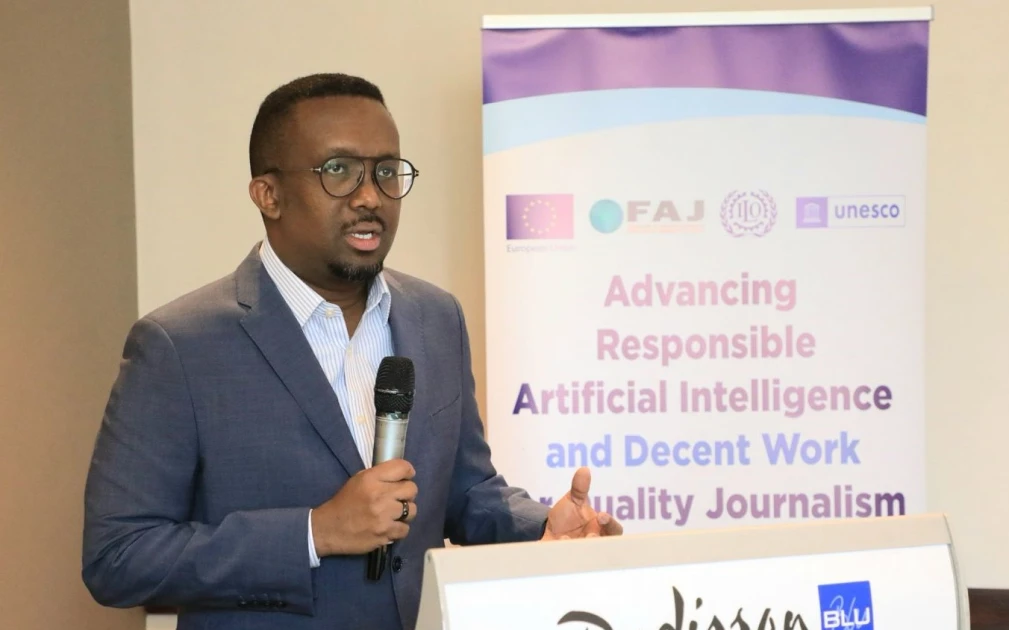
Federation of African Journalists (FAJ) president Faruk Osman addresses his colleagues and stakeholders at a continental dialogue meet held in Addis Ababa, Ethiopia. Photo / Courtesy.

Audio By Vocalize
Journalists’ organisations across Africa are pushing for better pay, secure employment and stronger protection against attacks as the growing use of artificial intelligence raises fresh questions about jobs, editorial independence and the future of quality journalism.
The concerns featured prominently at a two-day continental
dialogue convened by the Federation of African Journalists (FAJ) in Addis Ababa,
where journalist leaders adopted an action plan addressing decent work,
responsible AI and media freedom.
Participants highlighted persistent challenges in the
profession, including low or delayed salaries, insecure employment, the absence
of formal contracts and limited access to social protection. They warned that
such conditions could undermine journalists’ independence and the quality of
their reporting.
The discussions also examined whether AI-driven automation
and newsroom cost-cutting could lead to reduced staffing, placing additional
pressure on journalists already working under difficult conditions.
FAJ President Omar Faruk Osman said technological change
should not come at the expense of journalists’ rights or professional
standards.
“When journalists lack decent working conditions, quality
journalism is weakened and consequently, disinformation and misinformation gain
ground,” Osman said.
The meeting explored collective bargaining, labour rights
and digital organising as mechanisms through which journalists could advocate
for improved employment conditions.
Safety was another major issue, with participants discussing
physical attacks, legal harassment, online abuse and digital security threats
facing journalists across the continent. Particular attention was given to
online harassment and digital violence targeting women journalists.
Participants called for stronger efforts to address impunity
for crimes against journalists and to protect those exercising their
professional responsibilities.
The dialogue also examined the opportunities and risks
associated with AI in news production. While the technology can assist with
research, translation and verification, participants raised concerns about
fabricated material, the impersonation of credible sources and the spread of
false information.
The action plan seeks to connect these challenges by
promoting responsible technology use alongside better labour protections and
safeguards for editorial independence.
Deliberations were informed by a recent FAJ continental
survey on working conditions, safety, labour rights and media freedom. The
federation said the survey gathered responses from 1,586 journalists across 45
African countries, providing evidence to support advocacy for reforms.
The programme brought together journalist leaders and
representatives of the African Union Commission, UNESCO, the International
Labour Organization and the European Union. It was funded by the latter three
institutions through their support for freedom of expression and journalist
safety initiatives.
FAJ plans to advance the action plan through its member
organisations and engagement with the African Union, regional economic
communities, labour groups, human rights organisations and other partners.
The next challenge will be translating the commitments into practical improvements in journalists’ working conditions, safety and ability to report independently.
Join the Discussion
Share your perspective with the Citizen Digital community.
No comments yet
This discussion is waiting for your voice. Be the first to share your thoughts!