
17 deaths renew spotlight on deadly Mlima Kiu black spot

Audio By Vocalize
Despite its name, “Salama”, which means safety in Kiswahili, the area has over the years become synonymous with devastating road crashes, leaving behind bereaved families, survivors with lifelong injuries and mangled vehicles.
Citizen TV retraced the journey from Nairobi to Mlima Kiu to understand what makes the stretch particularly dangerous.
For about 70 kilometres from Nairobi, motorists travel along a dual carriageway, with two lanes in each direction providing greater room for manoeuvre.
That changes at Machakos Junction, where the dual carriageway ends and traffic transitions onto a single carriageway towards Salama.
The highway becomes narrower, with vehicles travelling in opposite directions separated only by road markings, leaving motorists with considerably less room to respond when something goes wrong.
Drivers who regularly use the route say the transition marks the beginning of one of the most challenging sections of the journey to Mombasa.
Along the more than 40-kilometre stretch between Machakos Junction and Salama, Citizen TV observed cases of speeding, overlapping and risky overtaking as motorists competed for space on the busy highway.
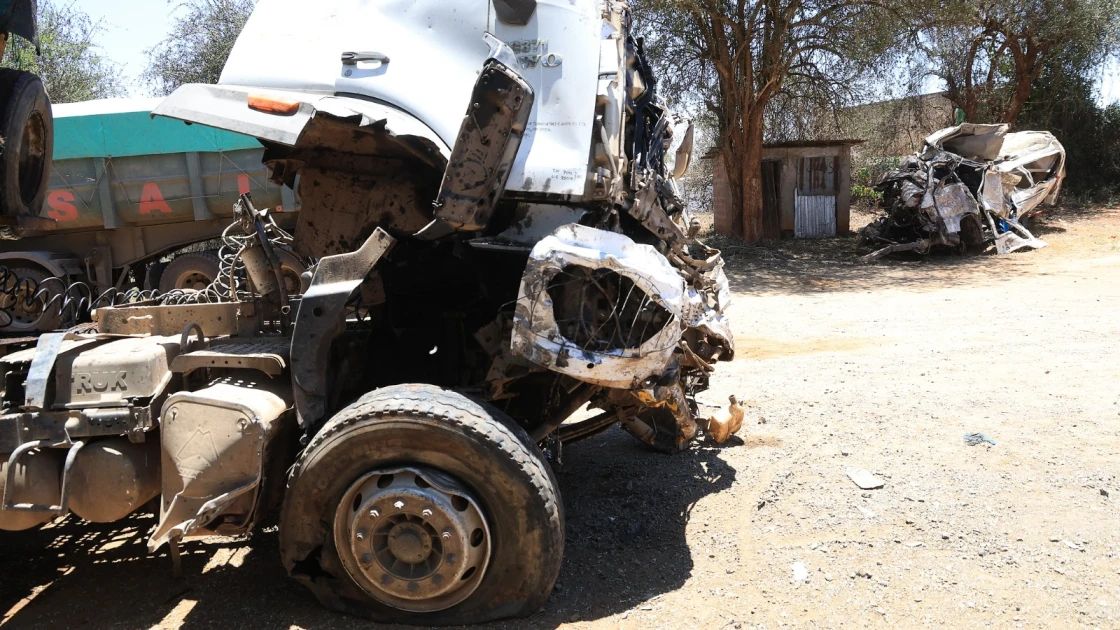
At Mlima Kiu, the scars of Saturday's crash in which 17 Catholic pilgrims lost their lives remain visible.
Residents who were among the first to arrive at the scene described a devastating crash, saying several victims died on the spot while others were trapped inside the wreckage.
But Saturday's victims are only the latest additions to a growing list of people who have died or been injured along the stretch.
At the home of one family near the black spot stands the grave of their patriarch, who residents say died in another crash at Mlima Kiu just two weeks before the tragedy involving the pilgrims.
A few metres away, a boda boda rider identified as Kilonzo still has the wreckage of the motorcycle that once provided his livelihood.
He survived a crash along the same stretch three months ago, but his passenger died.
Residents and motorists say the configuration of the road compounds the danger when a driver loses control.
With opposing traffic sharing the narrow highway, motorists can be left with few options to avoid a collision, particularly when vehicles are travelling at high speeds or drivers attempt dangerous overtaking manoeuvres.
Truck drivers who regularly ply the Nairobi-Mombasa route also point to fatigue, reckless driving and poor lane discipline as significant risks, particularly on long-distance journeys.
The scale of the problem is perhaps most stark at Salama Police Station.
Its yard contains the wreckage of vehicles involved in different crashes along the highway, each mangled shell bearing testimony to accidents that have occurred on the surrounding roads.
Residents claim crashes occur frequently along the stretch and are now calling for urgent interventions to improve safety.
Among their demands is the expansion of the highway into a dual carriageway, which they argue would separate opposing traffic and reduce the likelihood of head-on collisions.
The latest tragedy has renewed questions over the safety of the Nairobi-Mombasa Highway and whether infrastructure improvements, coupled with stricter enforcement of traffic regulations, could prevent more lives from being lost on the road.
Join the Discussion
Share your perspective with the Citizen Digital community.
No comments yet
This discussion is waiting for your voice. Be the first to share your thoughts!