

Scientists puzzled by giant planet detected orbiting tiny star
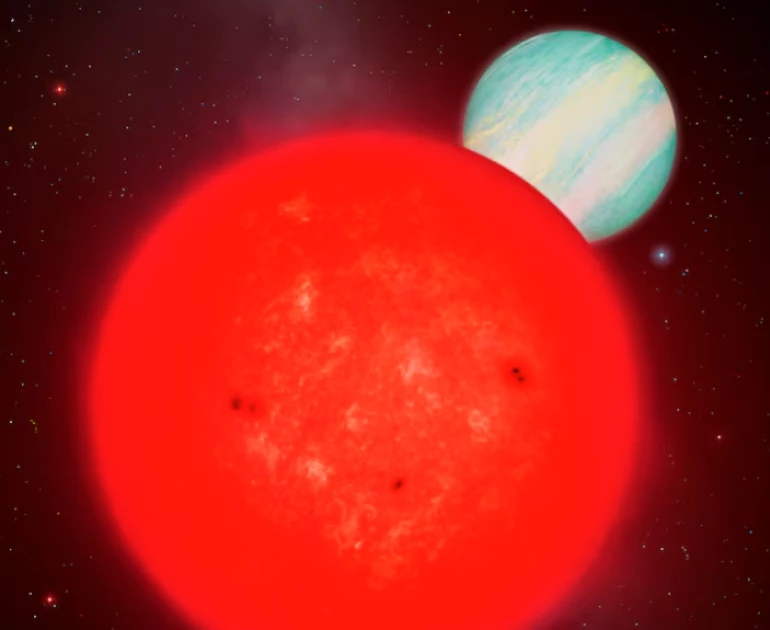
An artist's impression of a newly discovered giant planet named TOI-6894 b (top right) orbiting a red dwarf star (center) about 20% the mass of the sun, the image was released on June 4, 2025. University of Warwick/Mark Garlick/Handout via REUTERS

Audio By Vocalize
Astronomers have spotted a cosmic mismatch that has left
them perplexed - a really big planet orbiting a really small star.
The discovery defies current understanding of how planets form.
The star is only about a fifth the mass of the sun.
Stars this size should host small planets akin to Earth and Mars under
the leading theories on planetary formation. But the one detected in orbit
around this star is much larger - in fact, as big as Saturn, the
second-largest planet in our solar system.
The star, named TOI-6894, is located roughly 240 light-years
from Earth in the constellation Leo. A light-year is the distance light travels
in a year, 5.9 trillion miles (9.5 trillion km). It is the smallest-known star
to host a large planet, about 40% smaller than the two previous record holders.
"The question of how such a small star can host such a
large planet is one that this discovery raises - and we are yet to
answer," said astronomer Edward Bryant of the University of Warwick in
England, lead author of the study published on Wednesday in the journal Nature
Astronomy.
Planets beyond our solar system are called exoplanets. The
one orbiting TOI-6894 is a gas giant, like Saturn and Jupiter in our solar
system, rather than a rocky planet like Earth.
The birth of a planetary system begins with a large cloud of
gas and dust - called a molecular cloud - that collapses under its
own gravity to form a central star. Leftover material spinning around the star
in what is called a protoplanetary disk forms planets. Smaller clouds yield
smaller stars, and smaller disks contain less material to form planets.
"In small clouds of dust and gas, it's hard to build a
giant planet," said exoplanet scientist and study co-author Vincent Van
Eylen of University College London's Mullard Space Science Laboratory.
"This is because to build a giant planet, you need to
quickly build a large planet core and then quickly accrete (accumulate) a lot
of gas on top of that core. But there's only so much time to do it before the
star starts shining and the disk rapidly disappears. In small stars, we think
there's simply not enough mass available to build a giant planet quickly enough
before the disk disappears," Van Eylen added.
No known planet is larger than its host star, and that is
the case here as well, though the two are much closer in size than usual. While
the sun's diameter is 10 times larger than our solar system's largest planet
Jupiter, TOI-6894's diameter is just 2.5 times greater than its only known
planet.
The star is a red dwarf, the smallest type of regular star
and the most common kind found in the Milky Way galaxy.
"Given these stars are very common, there may be many
more giant planets in the galaxy than we thought," Bryant said.
The star is about 21% the mass of the sun and much dimmer.
In fact, the sun is about 250 times more luminous than TOI-6894.
"These findings suggest that even the smallest stars in
the universe can in some cases form very large planets. That forces us to
rethink some of our planet formation models," Van Eylen said.
The planet is located about 40 times closer to its star than
Earth is to the sun, completing an orbit in approximately three days. Its
proximity to the star means the planet's surface is quite hot, though not as
hot as gas giants called "hot Jupiters" detected orbiting similarly
close to bigger stars.
Its diameter is slightly larger than Saturn and a bit
smaller than Jupiter, though it is less dense than them. Its mass is 56% that
of Saturn and 17% that of Jupiter.
The main data used in studying the planet came from NASA's
orbiting Transiting Exoplanet Survey Satellite, or TESS, and the European
Southern Observatory's Chile-based Very Large Telescope, or VLT.
The researchers hope to better understand the planet's
composition with observations planned over the next year using the James Webb
Space Telescope.
"We expect it to have a massive core surrounded by a
gaseous envelope made up of predominantly hydrogen and helium gas," Bryant
said.
Leave a Comment