
Gravity study shows why the moon's two sides look so different
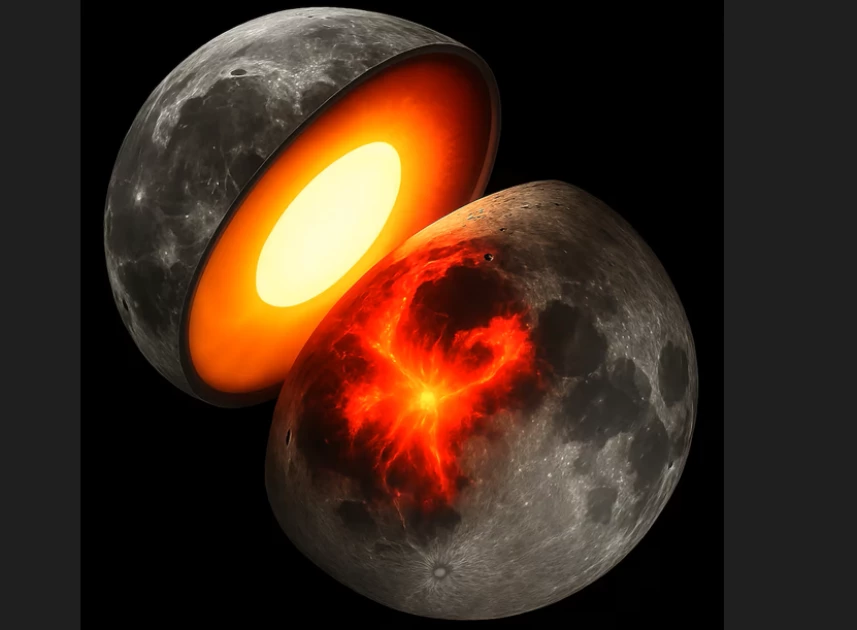
An undated artist's concept shows the moon's hot interior and volcanism about 2 to 3 billion years ago. It is thought that volcanic activity on the lunar near side (the side facing Earth) helped create a landscape dominated by vast plains called mare, which are formed by molten rock that cooled and solidified. NASA/JPL-Caltech/Handout via REUTERS

Audio By Vocalize
An exhaustive examination of lunar gravity using data
obtained by two NASA robotic spacecraft is offering new clues about why the two
sides of the moon - the one perpetually facing Earth and the other
always facing away - look so different.
The data from the U.S. space agency's GRAIL, or Gravity
Recovery and Interior Laboratory, mission indicates that the moon's deep
interior has an asymmetrical structure, apparently caused by intense volcanism on
its nearside billions of years ago that helped shape its surface features.
The researchers discovered that the lunar nearside flexes
slightly more than the farside during its elliptical orbit around Earth thanks
to our planet's gravitational influence - a process called tidal deformation.
This indicates differences in the two sides of the lunar interior, they said,
specifically in the geological layer called the mantle.
"Our study shows that the moon's interior is not
uniform: the side facing Earth - the nearside - is warmer and more geologically
active deep down than the farside," said Ryan Park, supervisor of the
Solar System Dynamics Group at NASA's Jet Propulsion Laboratory in California
and lead author of the study published on Wednesday in the journal.
The moon's nearside is covered by vast plains, called mare,
formed from molten rock that cooled and solidified billions of years ago. Its
farside has much more rugged terrain, with few plains.
Some scientists have hypothesized that intense volcanism
within the nearside that caused radioactive, heat-generating elements to
accumulate on that side of the mantle drove the surface differences observed
today. The new findings offer the strongest evidence yet to support this
notion.
The researchers estimated that the nearside mantle on
average is about 180-360 degrees Fahrenheit (100-200 degrees Celsius) hotter
than the farside, with the thermal difference perhaps sustained by radioactive
decay of the elements thorium and titanium on the nearside.
"The moon's nearside and farside look very different,
as shown by differences in topography, crustal thickness and the amount of
heat-producing elements inside," Park said.
The moon's diameter of about 2,160 miles (3,475 km) is a bit
more than a quarter of Earth's diameter. The lunar mantle is the layer located
beneath the crust and above the core, spanning a depth about 22-870 miles
(35-1,400 km) under the surface. The mantle makes up roughly 80% of the moon's
mass and volume and is composed mostly of the minerals olivine and pyroxene,
similar to Earth's mantle.
"The fact that the detected asymmetry in the mantle
matches the pattern of the surface geology - for instance, differences in the
abundance of the approximately 3-4 billion-year-old mare basalts (volcanic
rock) between the nearside and the farside - suggests that processes which
drove ancient lunar volcanism are active today," said Caltech
computational planetary scientist and study co-author Alex Berne, affiliated
with the Jet Propulsion Laboratory working on the design of gravity sensors for
missions to the outer solar system.
The researchers spent years analyzing data from GRAIL's Ebb
and Flow spacecraft, which orbited the moon from December 2011 to December
2012.
"Our study delivers the most detailed and accurate
gravitational map of the moon to date," Park said.
"This enhanced gravity map is a critical foundation for
developing lunar Positioning, Navigation and Timing (PNT) systems, which are
essential for the success of future lunar exploration missions. By improving
our understanding of the moon's gravity field, it contributes to establishing a
precise lunar reference frame and time system, enabling safer and more reliable
navigation for spacecraft and surface operations," Park added.
The same approach employed here using gravity data to assess
the lunar interior, the researchers said, could be applied to other bodies in
the solar system such as Saturn's moon Enceladus and Jupiter's moon Ganymede,
two worlds of interest in the search for potential life beyond Earth.
In the meantime, the new findings add to the understanding
of Earth's eternal companion.
"The moon plays a vital role in stabilizing Earth's
rotation and generating ocean tides, which influence natural systems and daily
rhythms," Park said. "Our knowledge of the moon has expanded through
human and robotic missions that have revealed details about its surface and
interior, yet many questions about its deep structure and history remain. As
our closest neighbor, the moon continues to be an important focus of scientific
discovery."
Join the Discussion
Share your perspective with the Citizen Digital community.
No comments yet
This discussion is waiting for your voice. Be the first to share your thoughts!