

US Supreme Court lets Trump revoke 'parole' status for migrants
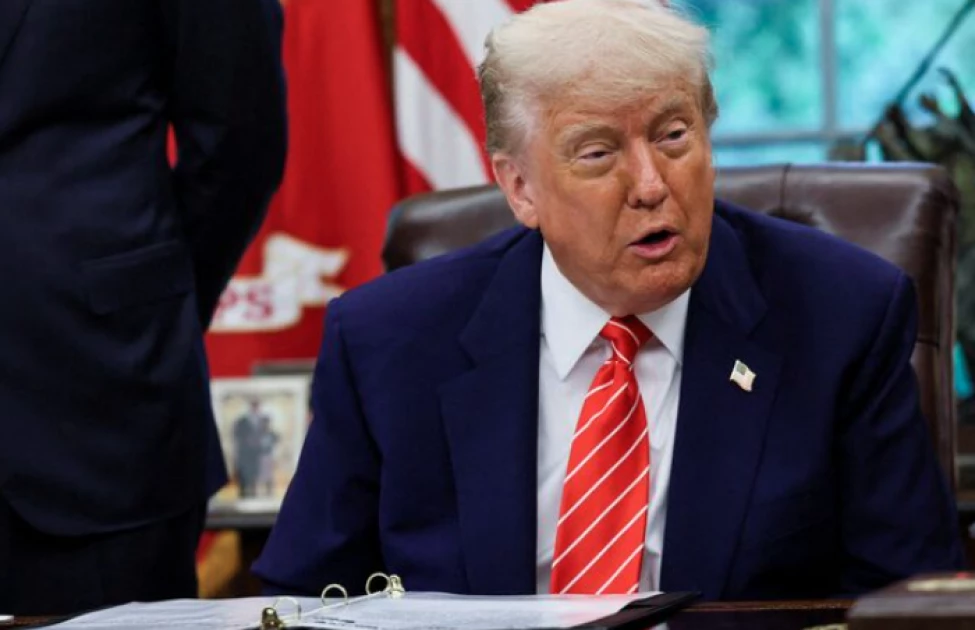
U.S. President Donald Trump makes an announcement about a trade deal with the U.K., in the Oval Office at the White House in Washington, D.C., U.S., May 8, 2025. REUTERS/Leah Millis

Audio By Vocalize
The U.S. Supreme Court on Friday let
President Donald Trump's administration revoke the temporary legal status
of hundreds of thousands of Venezuelan, Cuban, Haitian and Nicaraguan migrants
living in the United States, bolstering the Republican president's drive to
step up deportations.
The court put on hold Boston-based U.S. District Judge
Indira Talwani's order halting the administration's move to end the immigration
"parole" granted to 532,000 of these migrants by Trump's
predecessor, Joe Biden, potentially exposing many of them to rapid removal,
while the case plays out in lower courts.
As with many of the court's orders issued in an emergency
fashion, the decision was unsigned and gave no reasoning. Two of the court's
three liberal justices, Ketanji Brown Jackson and Sonia Sotomayor, publicly
dissented.
The court botched its assessment of whether the
administration was entitled to freeze Talwani's decision pending the
litigation, Jackson wrote in an accompanying opinion.
The outcome, Jackson wrote, "undervalues the
devastating consequences of allowing the government to precipitously upend the
lives and livelihoods of nearly half a million noncitizens while their legal
claims are pending."
Immigration parole is a form of temporary permission under
American law to be in the country for "urgent humanitarian reasons or
significant public benefit," allowing recipients to live and work in the
United States. Biden, a Democrat, used parole as part of his administration's
approach to deter illegal immigration at the U.S.-Mexican border.
Trump called for ending humanitarian parole programs in an
executive order signed on January 20, his first day back in office. The
Department of Homeland Security subsequently moved to terminate them
in March, cutting short the two-year parole grants. The administration said
revoking the parole status would make it easier to place migrants in a
fast-track deportation process called "expedited removal."
The case is one of many that Trump's administration has
brought in an emergency fashion to the nation's highest judicial body, seeking
to undo decisions by judges impeding his sweeping policies, including several
targeting immigrants.
The Supreme Court on May 19 also let Trump end a deportation
protection called temporary protected status that had been granted
under Biden to about 350,000 Venezuelans living in the United States, while
that legal dispute plays out.
In a bid to reduce illegal border crossings, Biden, starting
in 2022 allowed Venezuelans who entered the United States by air to request a
two-year parole if they passed security checks and had a U.S. financial
sponsor. Biden expanded that process to Cubans, Haitians and Nicaraguans in
2023 as his administration grappled with high levels of illegal immigration
from those nationalities.
The plaintiffs, a group of migrants granted parole and
Americans who serve as their sponsors, sued administration officials, claiming
the administration violated federal law governing the actions of government
agencies.
Talwani in April found that the law governing such parole
did not allow for the program's blanket termination, instead requiring a
case-by-case review. The Boston-based 1st U.S. Circuit Court of Appeals declined to
put the judge's decision on hold.
In its filing, the Justice Department told the Supreme Court
that Talwani's order had upended "critical immigration policies that are
carefully calibrated to deter illegal entry," effectively "undoing
democratically approved policies that featured heavily in the November
election" that returned Trump to the presidency.
The plaintiffs told the Supreme Court they would face grave
harm if their parole is cut short given that the administration has
indefinitely suspended processing their pending applications for asylum and
other immigration relief.
They said they would be separated from their families and
immediately subject to expedited deportation "to the same despotic and
unstable countries from which they fled, where many will face serious risks of
danger, persecution and even death."
Leave a Comment