

Trans women barred from women's football by English, Scottish FAs
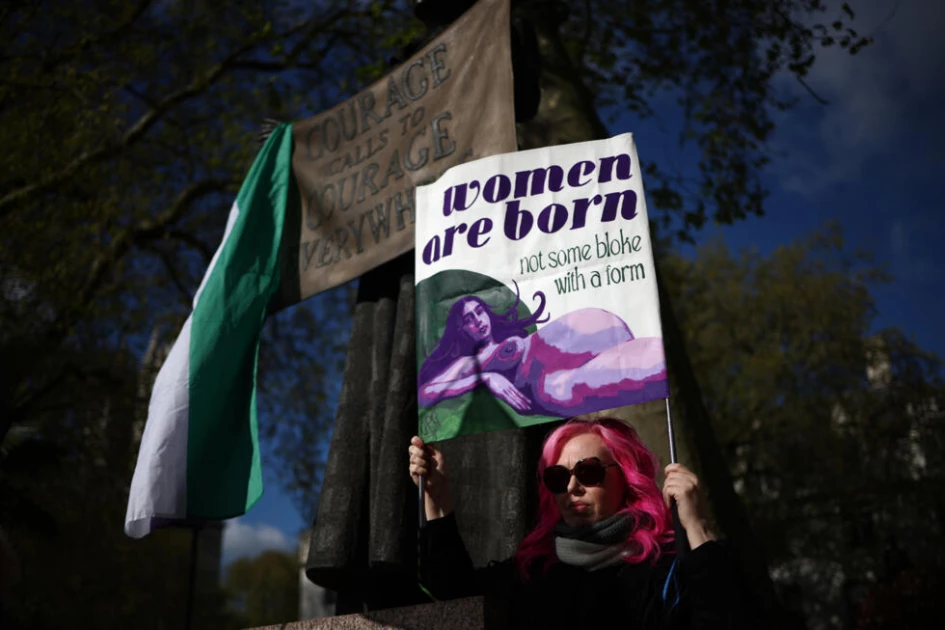
The English Football Association has ruled that trans women may no longer player in women's football © CARL RECINE / POOL/AFP/File

Audio By Vocalize
Transgender women will no longer be able to play in women's
football from June 1, England's Football Association announced Thursday, following a major shift in its stance.
The FA said it had updated its policy following last month's
UK Supreme Court ruling regarding the Equality Act.
The Scottish Football Association also said Thursday it
would implement a similar ban from the start of its 2025/26 season.
These new rule changes will apply to all women's football at
amateur and professional levels in both countries.
The English FA's transgender inclusion policy had been
updated just before the Supreme Court ruling, and continued to allow
transgender women to play in women's football, provided they reduced
testosterone levels.
Those rule changes gave the FA discretion on whether to
allow a trans woman to play, with consideration given to issues of safety and
fairness.
Now, though, the FA has barred trans women completely from
the women's game after the Supreme Court, the UK's highest court, ruled the
legal definition of a "woman" is based on a person's sex at birth and
does not include transgender women who hold a gender recognition certificate.
"We understand that this will be difficult for people
who simply want to play the game they love in the gender by which they
identify, and we are contacting the registered transgender women currently
playing to explain the changes and how they can continue to stay involved in
the game," the FA said in a statement.
But Natalie Washington, a campaigner at Football v
Transphobia, told Britain's Press Association: "The people I know that are
talking about this are saying: 'Well, that's it for football for me'.
"Most people clearly don't feel that they can go and
play in the men’s game for reasons of safety, for reasons of comfort,"
added Washington, who said mixed inclusive football was still "in its
infancy".
No leading footballers in the English women's game are known
to be transgender, and Washington questioned how many the FA's new ruling would
affect.
"It seems to be largely an academic argument made in
television studios and radio studios around the country by people who aren't
involved in football," said Washington.
But Fiona McAnena, director of campaigns at human rights
charity Sex Matters, welcomed the FA's new policy.
"The FA has had ample evidence of the harms to women
and girls caused by its nonsensical policy of letting men who identify as women
play in women's teams," she said.
Meanwhile, Seema Patel, an associate professor at Nottingham
Law School, was taken aback by the speed and severity of the FA's new position
after recently completing a report for global football governing body FIFA, where she recommended a "more nuanced and collaborative approach" to
gender eligibility in football.
"I am surprised by the decision," said Patel in a
statement released to AFP in London.
"It could be argued that it is a knee-jerk reaction and
far too soon to come to any conclusions since the (Supreme Court) ruling."
Transgender participation has become a hot issue as
different sports try to balance inclusivity with ensuring fair competition.
International governing bodies in a number of sports, including cycling, swimming and athletics, have tightened policies to
effectively ban transgender competitors, in some cases amid fears of possible
legal action should a biological woman be injured by a trans competitor.
Sebastian Coe, the president of World Athletics, has been
outspoken about "protecting" the female category.
The British track great, a double Olympic 1500 metres
champion, made defending women's sport a key plank of his unsuccessful bid to
succeed Thomas Bach as president of the International Olympic Committee.
In March, World Athletics said it had introduced a cheek
swab test to determine if an athlete is biologically female.
"It's important to do it because it maintains... not
just talking about the integrity of female women's sport, but actually
guaranteeing it," said Coe.
Donald Trump's administration has said it will only
recognise two sexes, male and female, with the US president signing an
executive order seeking to ban transgender athletes from participating in
women's sports.
Leave a Comment