

Terror Act: Ruto govt move to crack down on critics straight out of Moi's Sedition Act playbook
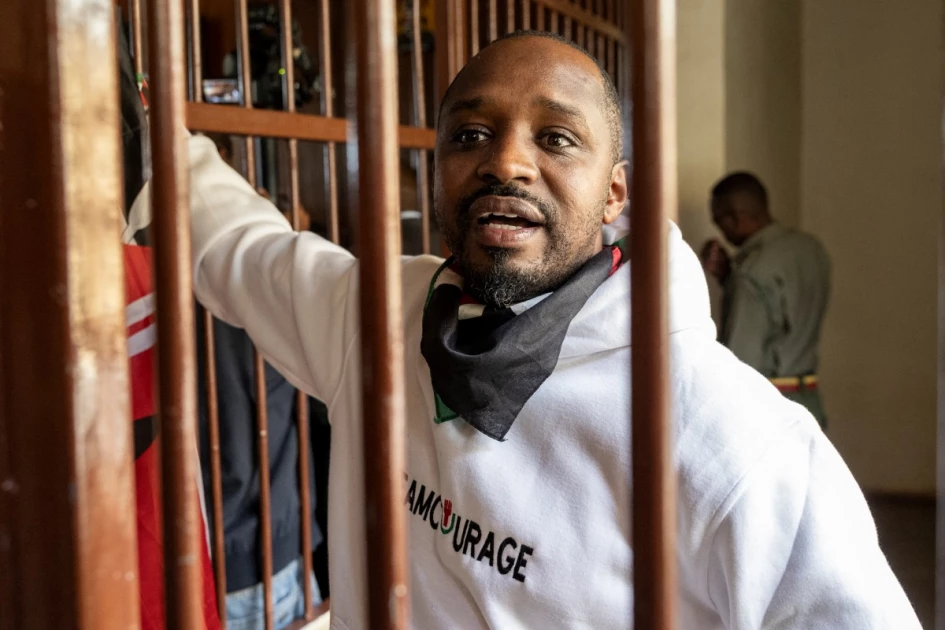
Activist Boniface Mwangi appears before the Kahawa law court in Nairobi on July 21, 2025. (Photo by AFP)

Audio By Vocalize
During his arrest, Mwangi’s wife, Njeri, said police detectives cited “terrorism and arson” as the reasons for his arrest.
Mwangi was arrested on July 20 at his home in Lukenya, Machakos County. Police alleged that Mwangi was arrested for "facilitating terror during the June 25 protests" that were witnessed countrywide.
The Directorate of Criminal Investigations (DCI) further alleged, “...a search led to the recovery of: nine assorted external hard drives, two laptops, company seals for Brave Media Ltd and Courage Ltd, a company stamp, six cheque books, copies of stamp duty documents, two unused tear gas canisters and one 7.62mm blank round.”
Mwangi's team of activists and the wider public feared he would be charged with the more serious offence of terrorism. This triggered a wave of government criticism, led by human rights groups, which criticised the allegation as intimidation against dissident voices.
Mwangi denied any terrorist linkage against him, saying in a post on X: "I am not a terrorist."
Interestingly, once the chargesheet was released, Mwangi was not being charged with "facilitation of terrorist acts", as the DCI sleuths had earlier alleged, but was instead charged with unlawful possession of ammunition; two unused teargas canisters and one blank bullet.
He pleaded not guilty to the charges.
The administration said Mwangi helped organise the June 25, 2025, protests, which were infiltrated by goons, and about 19 people were killed.
The protests were a commemoration of the Gen Z-led protests of 2024 against President William Ruto's government on the same date last year to oppose a punitive Finance Bill, which was later withdrawn by the head of state.
Mwangi has been a longtime good governance advocate and is widely known for his candid censure of state shortcomings and abuses.
However, Boniface Mwangi is not the first Kenyan charged with terrorism for constitutionally protesting. A large number of the youth arrested after the Saba Saba protests, either as protestors or digital mobilizers, were labelled “terrorists” by both the DCI, who took them to court and the CS Interior Kipchumba Murkomen for being involved in "terror-related activities."
The government is terrorising both the poor and the rich, ordinary Kenyans and even elected politicians.
Manyatta Member of Parliament Gitonga Mukunji has filed a petition against the Inspector General of Police Douglas Kanja, the Director of Criminal Investigations (DCI) Mohamed Ibrahim Amin, and the Director of Public Prosecutions (DPP) Renson Ingonga, regarding his arrest during the Saba Saba protests.
The lawsuit, filed at the High Court in Milimani, alleges a politically motivated campaign by the government to silence dissent by weaponising the Prevention of Terrorism Act and seeks to have the case dismissed.
Mukinji claims his recent arrest alongside journalist James Ikuwa Mbochi and boda boda rider Stanley Mbuthia Wanjiru was an abuse of process aimed at punishing him for criticising the government.
Like Mwangi and many other protesters, the authorities invoked sections of the Prevention of Terrorism Act and took the Manyatta MP to court, with the threat of charging them with terrorism.
According to the state, the Gen Z protests are organised and bankrolled by rich opposition politicians or foreign powers to get the Ruto administration out of power using unconstitutional means.
The Office of the Director of Public Prosecution (ODPP) kowtowed to the government, releasing a statement saying, “Charges under the Prevention of Terrorism Act should be understood within the framework of established legal thresholds… The attacks on public offices, courts, police stations, and government personnel were not spontaneous demonstrations, but calculated and coordinated acts of violence.”
The law under which some of the youth have been charged is formally known as “The Prevention of Terrorism Act.”
In Chapter 59B, this law defines a “terrorist act” as a threat or action which involves the use of violence against a person, endangers the life of a person; other than the person committing the act; creates a serious risk to the health or safety of the public or a section of it; results in serious damage to property; involves the use of firearms or explosive; involves the release of any dangerous toxin into the environment; involves the use of firearms and explosives; interferes with an electronic system resulting in the disruption of the provision of communication; financial, transport or other essential services; interferes or disrupts the provision of essential or emergency services; and prejudices national security or public safety.
An act of terrorism should aim to intimidate or cause fear amongst members of the public or a section of the public; compel the Government to do, or refrain from any act; or destabilise the religious, political, Constitutional, economic or social institutions of a country, or an international organisation.
However, any other act that disrupts any public services, committed in pursuance of a protest, demonstration or stoppage of work, shall be deemed not to be a terrorist act within the meaning of this definition so long as the act is not intended to result in any harm referred to in paragraph.
In tandem with authoritarian regimes worldwide, especially when pressed for accountability and better governance, Ruto’s administration is stretching existing laws to fit extraneous purposes, such as the constitutionally given right to demonstration as terrorism.
Charging protestors under the terrorism act, which is the latest fad in the administration’s bag of strategies to counter protests, is used.
It was not lost on many observers that the tough-talking Interior CS Murkomen had earlier warned the government would no longer tolerate what he described as “terrorism disguised as dissent,” yet they constituted a non-constitutional attempt to overthrow the government.
He cited the many police stations that were attacked and the police officers who were injured when trying to quell violence during the protests.
Murkomen defended the earlier arrest of almost 1500 people countrywide after the Saba Saba protests, saying, “Of these, 50 individuals are being investigated by the Serious Crime Unit (SCU) while 71 cases are being handled by the Anti-Terrorism Police Unit for offences related to acts of terrorism.”
The Interior CS went further to say the government would be keen on getting the financiers and planners of protests to face terror or robbery charges, according to what happens during the protests.
Walking back into the steps of history would serve to help many Kenyans see better, as there were days, during the Moi era, when something akin to this move took place.
Without the freedoms and rights that the current constitution accords Kenyans today, the civic and public space in Kenya was stifling, and the authorities only needed to imagine a citizen was anti-establishment to clamp down on any individual or section of citizens.
Back then, their favourite law was the Sedition Act, which was scrapped back in 1997.
Many government critics and the outlawed opposition were hauled to court every other day, ostensibly found in possession of seditious material or uttering seditious words, and that would be it; one was bound to be a guest of the state for many months to come.
Today, the random arrests and far-fetched charges on demonstrators just point to how fickle democracy in Kenya is, as each administration, when pinned to the corner by citizens, starts a selective application of the law.
In many respects, Kenya's civil institutions are among the most vibrant in Africa. During the late 1980s and 1990s, the press, activists, lawyers, and religious leaders forced the Moi government to reverse many of its most repressive policies, including detention without trial, the ban on political parties, and the sedition laws that silenced critical voices in the society.
However, Kenyans, buoyed by their progressive constitution, must continually struggle against corruption, bad governance and the lack of the rule of law.
In the past, most human rights violations in Kenya were aimed at the media, lawyers, activists, and academics, but most victims today are ordinary people, who are at odds with the government and how it is run.
Demonstrators are citizens protected under the law to express their dissent. So, to expose them to a raft of harsh charges because they have protested is immoral and short-sighted.
The law exists for all and for posterity, Kenya should never allow the law to be abused and weaponised for short-term gains.
Prominent Lawyer and current Siaya Governor James Orengo observed: “It’s ridiculous to charge Boniface and our children, who have demonstrated a high level of political consciousness, with terrorism. Protected speech and political action should never be criminalized.”
Leave a Comment