

'No longer afraid': Poland's first queer museum opens
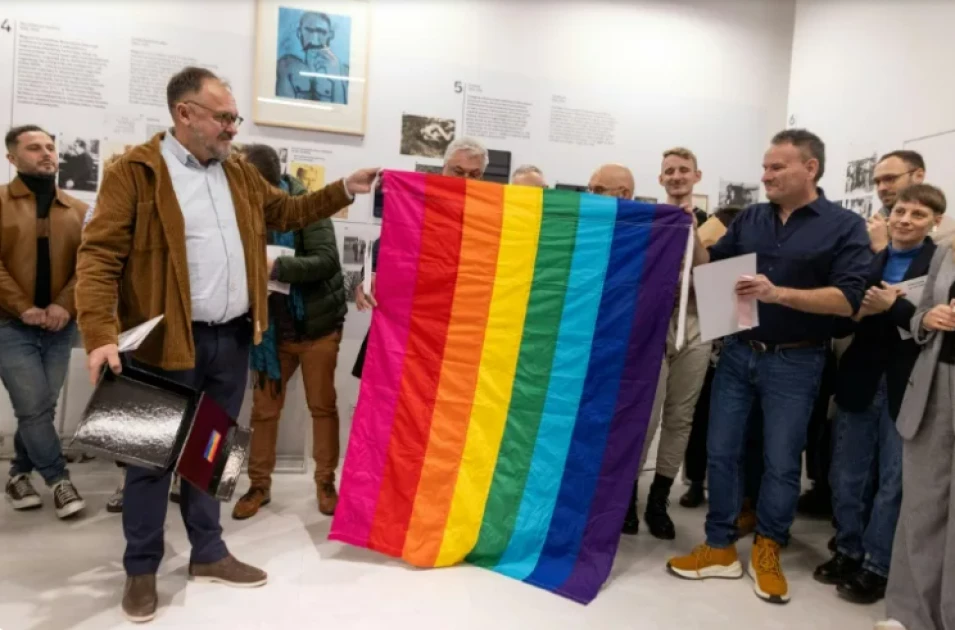
The institution was set up by nonprofit rights group Lambda (Wojtek RADWANSKI) (Wojtek RADWANSKI/AFP/AFP)

Audio By Vocalize
Amid the bustle of Warsaw's busiest street with trams
whizzing by, Poland's first LGBTQ museum opened Friday, dubbed a landmark
moment by the community still striving for full legal rights.
Tucked between a kebab shop and a second-hand clothes store,
it hosts almost 150 artefacts offering a timeline of Poland's LGBTQ movement's
struggle for recognition.
The institution was set up by nonprofit rights group Lambda
and is the first of a kind "in all of post-communist Europe", said
its director Krzysztof Kliszczynski. He was "overjoyed" to see it
coming to life.
Its exhibits trace the history of LGBTQ people living in
Poland back to the 16th century, illustrating it with letters, pictures, and
early examples of activism -- often clandestine out of fear of oppression.
The ribbon-cutting ceremony gathered dozens of LGBTQ Polish
campaigners, some of whom have spent decades fighting for equal rights.
Among them was Andrzej Selerowicz, who in 1983 launched the
first Polish newsletter for gay men.
Poring over a glass case in the Warsaw museum, Selerowicz
pointed at a pocket-sized, circular picture showing two young men, hugging
cheek to cheek, smiling to the camera.
"This is a photo of me and my partner to the present
moment, taken 45 years ago," said the 76-year-old author and translator
who lives in Vienna.
He came to Warsaw specifically for the ceremony, invited as
one of the pioneers of the LGBTQ rights movement, alongside Ryszard Kisiel, who
also started his activism in the 1980s.
Kisiel, 76, applauded by the museum's staff and fellow campaigners
as he entered the building, smiled coyly when asked about his role in creating
the opening exhibition.
"I take some credit for that," he chuckled. He,
like Selerowicz, donated his memorabilia for the display, including "the
leaflet on the rules of safe sex that I made almost 40 years ago".
Researchers say it has not always been easy to gather
artefacts documenting the often forgotten struggle of the LGBTQ community.
"A huge part of this queer history is also very
private... and very often destroyed after the death of these people, and often
deliberately so," said Piotr Laskowski, a University of Warsaw historian.
Among the objects on display was a handcrafted copy of a
magazine from 1956, previously unknown to LGBTQ campaigners and researchers. It
was only brought to light when offered to the museum.
"That is also why this museum is here... so that memory
is never thrown away again -- the memory of us that often ended up in the
rubbish heaps," Krzysztof Kliszczynski said.
As they hailed creation of the museum as another milestone
in the history of LGBTQ people in Poland, they also pointed to one cloud on the
horizon.
Poland's main ruling party had pledged to legalise civil
unions. Almost a year into its tenure however, same-sex couples still cannot
marry or register their partnerships in this largely Catholic country.
Last week, a UN-mandated expert urged Poland to swiftly
amend laws to protect LGBTQ people against discrimination and violence,
lamenting the slow pace of reforms from the pro-EU government.
"I can't comprehend why Poland is at the tail end of
the whole of Europe, when even in quite conservative southern European
countries civil unions are already introduced," said Selerowicz.
Impatient for change, the campaigners were adamant that they
no longer feared homophobic attacks on the centrally located venue.
"Enough of being afraid... We can no longer be
afraid," said Kliszczynski.
"And if someone sprays our shop window, I will
personally remove the paint," he added.
Leave a Comment