
Negotiators expected in Cairo as Israel-Hamas war nears 6-month mark
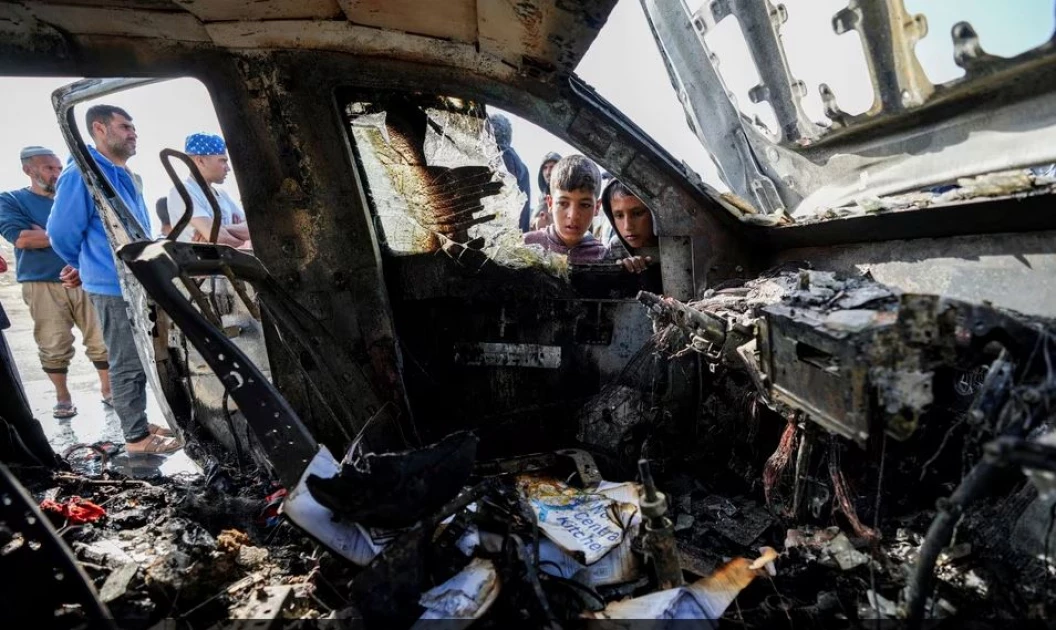
People inspect the site where World Central Kitchen workers were killed in Deir al-Balah, Gaza Strip, April 2, 2024.

Audio By Vocalize
American and Israeli
negotiators were expected in Cairo over the weekend for a renewed push to reach
a cease-fire-hostage deal in a war that has raged for nearly half a year.
Ahead of the talks,
U.S. President Joe Biden wrote to the leaders of Egypt and Qatar urging them to
dial up pressure on Hamas to "agree to and abide by a deal," a senior
administration official told AFP on Friday night.
The United States,
Qatar and Egypt have engaged for months in behind-the-scenes talks to broker a
cease-fire and an exchange of hostages for Palestinian prisoners but have made
no headway since a weeklong truce in November.
The White House
confirmed that negotiations would occur this weekend in Cairo but would not
comment on U.S. media reports that CIA Director Bill Burns would be attending,
along with Israel spy chief David Barnea, Qatari Prime Minister Mohammed bin
Abdulrahman al-Thani and Egypt's intelligence chief, Abbas Kamel.
Israel and Hamas,
which negotiate through intermediaries, have traded blame for the lack of
progress.
"This basic
fact remains true: There would be a cease-fire in Gaza today had Hamas simply
agreed to release this vulnerable category of hostages — the sick, wounded,
elderly and young women," the senior Biden administration official said.
Hamas officials and
Qatari mediator al-Thani have previously accused Israel of stymying the truce
with objections over the return of displaced Gazan civilians and the ratio of
prisoners to hostages.
During a phone call
with Israeli Prime Minister Benjamin Netanyahu on Thursday, Biden pushed him to
"fully empower" his negotiators to reach a deal.
A staunch backer of
Israel, Biden's patience with the immense toll inflicted by the war on Gaza
appears to be waning, especially after the killing of seven aid workers.
With both
international and domestic outrage mounting, Biden has warned of a reassessment
of U.S. support if more is not done to protect civilians.
Allies have been
pressing Biden to leverage the billions of dollars in U.S. military aid to
Israel.
More than three
dozen U.S. lawmakers on Friday signed a letter to Biden urging him to
reconsider the "recent decision to authorize the transfer of a new arms
package to Israel, and to withhold this and any future offensive arms transfers
until a full investigation into the airstrike is completed," referring to
the drone strikes that killed seven World Central Kitchen aid workers Monday.
The Israeli army,
known as the IDF, announced it was firing two officers after finding a series
of "grave mistakes" led to the aid workers' deaths.
It was a rare
admission of wrongdoing by Israel in its campaign to root the militant group
Hamas out of the Gaza Strip, where the Hamas-run Health Ministry says more than
33,000 people, mostly women and children, have been killed.
In response to the
IDF's preliminary findings on the strike, Australian Foreign Minister Penny
Wong said Saturday it was "not sufficient."
World Central
Kitchen said Israel "cannot credibly investigate its own failure in
Gaza," noting that its staff was attacked despite having "followed
all proper communications procedures."
WCK said its
operations in Gaza remain suspended after the attack, while top global aid
groups said relief work has become almost impossible.
"In its speed,
scale and inhumane ferocity, the war in Gaza is the deadliest of conflicts —
for civilians, for aid workers, for journalists, for health workers and for our
own colleagues," United Nations Secretary-General Antonio Guterres told a
U.N. Security Council briefing on Friday.
At the same
briefing, Israeli Ambassador Gilad Erdan insisted the "only reason"
aid fails to reach Gazan civilians "is because Hamas loots it and the U.N.
is incapable of handling the capacity of supplies."
Following the
Biden-Netanyahu call, Israel said it would allow "temporary"
deliveries through additional aid routes, without specifying when that would
begin.
For the 2.4 million
Gazans, simply procuring food and water in the relentlessly bombarded strip has
become a torturous struggle.
Since January,
Palestinians in famine-threatened northern Gaza have eaten an average of just
245 calories per day — less than a can of beans — since January, according to
Oxfam.
"Living in
tents is difficult, everything is hard. Securing water and food is
difficult," said Gazan Siham Ashour, who, like more than 1 million others,
has been displaced to the sprawling encampment in the strip's southernmost
city, Rafah.
The war has also
consumed much of the wider region, with hostilities between Israel and Iran and
its proxies triggering fears of a broader conflict.
In Iran, thousands
of people chanted "Death to Israel" at a funeral in Tehran on Friday
that coincided with annual commemorations in support of Palestinians.
Iran has blamed
Israel for a strike on its consulate in Damascus that killed seven
Revolutionary Guards and has vowed retaliation.
Hezbollah said
Friday that three of its fighters had been killed in exchanges with Israel. Its
ally Amal said it had also lost three fighters to an airstrike in southern
Lebanon.
The Israeli army
said in a communique that it had bombed a "military complex" used by
Amal and targeted several regions of southern Lebanon.
The war in Gaza
began with Tehran-backed Hamas's October 7 attack on Israel, which killed some
1,200 people, mostly civilians.
Palestinian
militants also took around 250 hostages, about 130 of whom remain in Gaza,
including 34 the army says are dead.
Tehran has denied
any direct involvement in the attack.
Join the Discussion
Share your perspective with the Citizen Digital community.
No comments yet
This discussion is waiting for your voice. Be the first to share your thoughts!