

Libyan protesters demand prime minister quit as three ministers resign
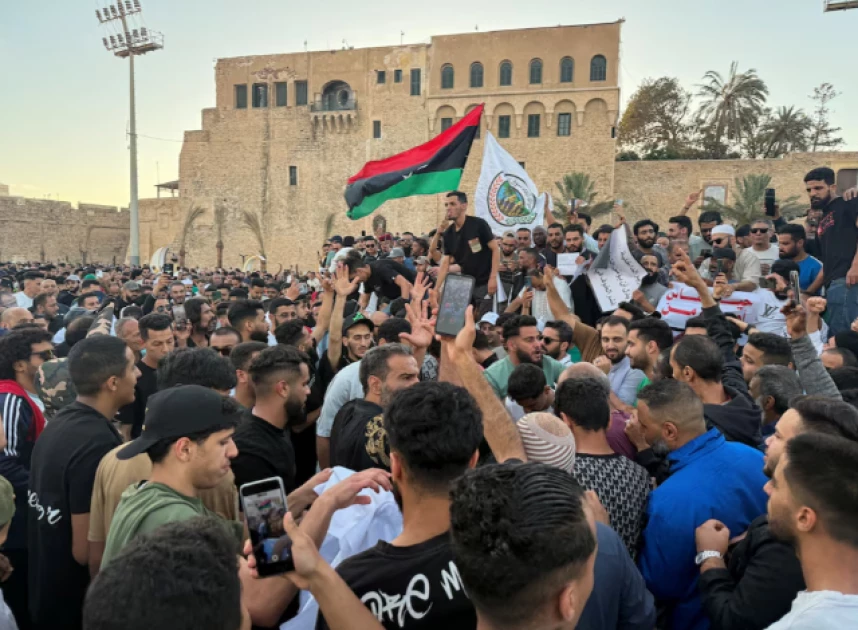
Demonstrators demand the overthrow of the Libya's Government of National Unity headed by Abdulhamid al-Dbeibah, in Martyrs' Square in Tripoli, Libya. May 16, 2025. REUTERS/Ayman al-Sahili

Audio By Vocalize
Hundreds of Libyan protesters called on Friday for the
ouster of the internationally recognised prime minister and his government, said
one security force member was killed when some protesters tried to storm his
office.
At least three ministers resigned in sympathy with the
protesters, who want Prime Minister Abdulhamid Dbeibah to quit.
The demonstrators gathered in Martyrs' Square in Tripoli,
chanting slogans such as "The nation wants to topple the government” and
“We want elections.”
They later marched to the main government building in the
city center. "We won't leave until he leaves," one protester said.
The demonstrators carried pictures of Dbeibah, national
security adviser Ibrahim Dbeibah and Interior Minister Emad Tarbulsi with their
faces crossed out in red.
State-oil firm NOC said in a statement that its operations
at oil facilities are proceeding as normal, with oil and gas exports operating
regularly. National oil output in the past 24 hours was at 1,376,415 barrels.
Dbeibah, who leads the divided country's Government of
National Unity, came to power through a UN-backed process in 2021. Planned
elections failed to proceed that year because of disagreements among rival
factions, and he has remained in power.
The government media platform said in a statement that one
security member of its building protection force was killed, posting video
footage showing the building's fence destroyed with rocks on the ground.
"Security forces thwarted an attempted storming of the
Prime Minister's Office by a group embedded among the demonstrators," it
said in the statement.
On Friday, businessman Wael Abdulhafed said: "We are
(here) today to express our anger against Dbeibah and all those in the power
for years now and (who) prevent elections. They must leave power."
Calls for Dbeibah to resign increased after two rival armed
groups clashed in the capital this week in the heaviest fighting in years.
Eight civilians were killed, according to the United Nations.
Violence flared after the prime minister on Tuesday ordered
the armed groups to be dismantled. Demonstrators have accused Dbeibah of
failing to restore stability and of being complicit in the growing power of
armed groups.
Economy and Trade Minister Mohamed al-Hawij, Local
Government Minister Badr Eddin al-Tumi and Minister of Housing Abu Bakr
al-Ghawi resigned on Friday.
Militia leader Abdulghani Kikli, widely known as Ghaniwa,
died in the clashes, which calmed on Wednesday after the government announced a
ceasefire.
The United Nations Support Mission in Libya expressed its
concern over the escalation of violence in Tripoli, calling on parties to take
the appropriate measures to protect civilians and public property.
Libya has had little stability since a 2011 NATO-backed
uprising ousted longtime autocrat Muammar Gaddafi. The country split in 2014
between rival eastern and western factions, though an outbreak of major warfare
paused with a truce in 2020.
While eastern Libya has been dominated for a decade by
commander Khalifa Haftar and his Libyan National Army, control in Tripoli and
western Libya has been splintered among numerous armed factions.
The main oil facilities in the major energy exporter are located
in southern and eastern Libya, far from fighting in Tripoli. Engineers at
several oil fields and export terminals told Reuters output remained unaffected
by the clashes.
Leave a Comment