

Kikuyu elders break tradition by planting sacred Mugumo tree in Kiambu

Audio By Vocalize
Human activities and changing natural behaviour have not spared indigenous and sacred trees, altering biodiversity and ecosystems.
Habitat destruction through deforestation and climate change, driven by human settlement, agriculture, and other forms of development, has interfered with nature’s pristine balance, leaving behind bare, infertile land and affecting vital ecosystem services.
In Kenya,
restoration efforts, including afforestation from valleys to hilltops, are in
high gear as part of a global bid to save the planet from the excesses of
climate change and past human irresponsibility.
Kikuyu elders
from Kiambu County have recently embraced this restoration opportunity by
planting a sacred tree—an unimaginable act in the community, as no one has ever
attempted to plant the tree that traditionally grows naturally.
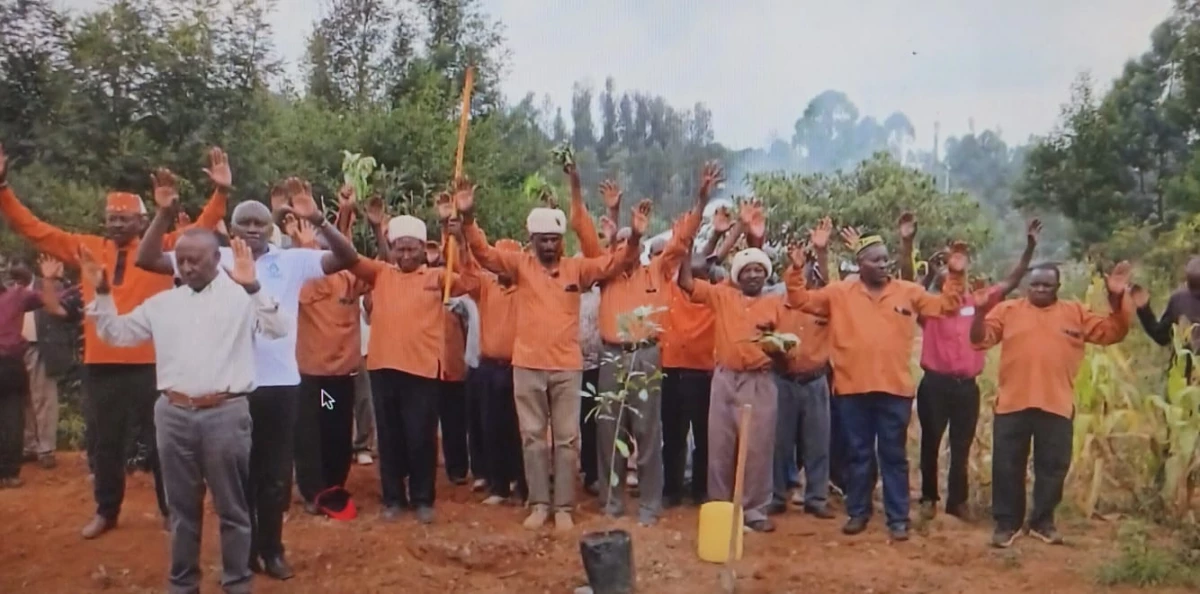
In a
ritual-filled ceremony, the elders planted the indigenous sacred fig tree,
known as the Mugumo in the
Agikuyu language. This was done to restore the Mugumo tree that had been cut down
to pave way for the Karimenu II Dam reservoir.
Njoroge
Mutugu, a member of the Kikuyu Council of Elders, recalls the exact spot where
a 50-year-old Mugumo tree once
stood before it was removed by contractors.
“That Mugumo tree was
standing where the dam intake tower is today. It was at the center of the dam.
It had been there for over 50 years. People might fear, but I am not afraid to
say that it was at the center of the river and it was never swept away. You
know, the Mugumo tree
doesn’t have a tap root, yet it could not fall. When it was being uprooted, the
Chinese contractors asked me to call the wazee (elders) to talk to the tree
so it could be removed,” narrated Mutugu.
The fallen Mugumo tree was
later buried in a ceremony to prevent the community from unknowingly using any
part of it as firewood or for other purposes—a practice considered taboo and
believed to bring harm to the community.
According to
the elders, the sacred Mugumo tree and its surroundings
play a spiritual and cultural role, shielding the community from misfortune and
fostering peaceful coexistence.
At the
planting ceremony, animal slaughter was initially planned as part of the
ritual. However, it did not take place in front of the public as elders
explained that it is a sacred practice only witnessed by specific people, with
every piece of meat symbolically distributed.
“When we hold
such an event, we don’t just cut meat and hand it out. Whatever you are given
carries meaning. That is why we could not give the whole crowd a piece each,”
clarified Mutugu.
He further
emphasized the significance of the event:
“We are happy to be granted this chance to plant a Mugumo tree. Since the cutting of
the one at the dam reservoir, it has not been easy for the community here. We
normally don’t cut a Mugumo
tree, and when it falls, it is considered symbolic, requiring answers from the
gods. Today, we have involved people who are usually not supposed to be
present, and we hope God will allow this tree to grow.”
The Kiama Kiema
Kikuyu elders not only have a physical responsibility to care for the tree but
also a spiritual duty to petition for its growth—making this a historic act.
Engineer
Joseph Kamau, CEO of Athi Water Works, who was among the guest planters, said:
“Fortunately, I know the significance of what they were doing, and that’s why I
was at the forefront. My participation demonstrates that, as Athi Water, we
want our operations to be as inclusive as possible.”
The project
in the Upper Tana and Mid-Galana basins encompasses agroforestry systems
designed to secure water supply for Nairobi and enhance groundwater recharge in
areas feeding Mzima Springs.
The
initiative aims to replenish water supplies, plant thousands of indigenous
trees along riparian zones to improve water quality, and rehabilitate degraded
farmlands and rangelands through sustainable land management. Hundreds of farm
ponds have been installed, and fruit orchards planted to improve food security
while providing alternative livelihoods for local communities.
The watershed restoration project brings together grassroots climate and sustainability organizations in collaboration with the Kenyan government. It also champions the replanting of extinct indigenous trees to revive lost biodiversity.
Leave a Comment