
Italy commits to reviving Kenya's leather industry

Audio By Vocalize
Italy has committed to reviving the leather and tanning industry in Kenya and across the wider East and Central African region, with Equity as the strategic financial partner.
Speaking during a stakeholder meeting at
Equity Centre in Nairobi, the Italian Ambassador to Kenya, Roberto
Natali stated that this agreement marks a significant step
in strengthening the relationship between Kenya and Italy, as well as strengthening the
leather industry ties between the two countries.
“A delegation of leather industry experts
and players from Italy is here with me, ready to explore ways to
build capacity, establish more tanneries and help develop and maintain an
efficient leather supply chain in East and Central Africa. These efforts are
aimed at adding value to the over five million skins of animals that go to
waste yearly in Kenya,” said Ambassador Natali, reiterating Italy’s willingness
to share knowledge, best practices and exchange technology with the industry
players in Kenya.
“Kenya, with its abundant livestock and
growing industrial base, is uniquely positioned to become a regional hub for
leather processing and production of related products. We will support
players in the industry, especially now that the authorities continue to
emphasize the priority of leather as a key value chain through which youth can
get jobs,” said Ambassador Natali, underscoring the importance of
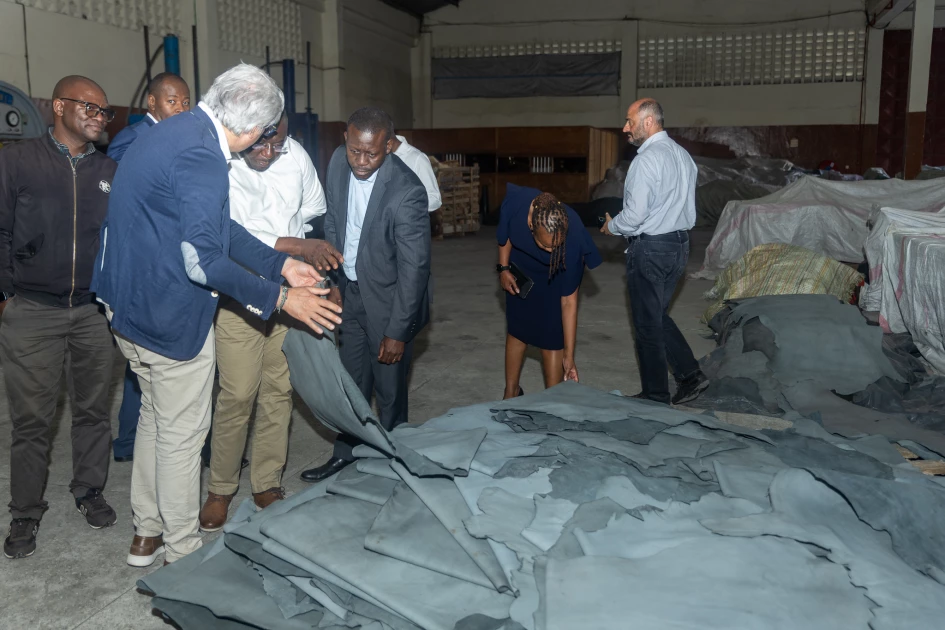
the delegates' week-long knowledge exchange tour, which included
field visits to local smallholder livestock farmers, slaughterhouses,
leather processors and related products manufacturers.
The ministries of Agriculture &
Livestock Development and Trade, Investment & Industry welcomed the
partnership, with Principal Secretary Jonathan Mueke reaffirming the
government’s commitment to further develop the leather value chain.
Relaying PS Mueke's message, Kenya Leather
Development Council CEO Dr. Isaack Noor said Kenyan authorities and
policymakers remain at the forefront of championing an enabling environment to
support large-scale investment in the leather sector.
"We are keen on increasing the supply
of quality hides and skins by training slaughterhouse staff, developing the
necessary infrastructure such as the Kenanie Leather Industrial Park in
Machakos County, to facilitate aggregation for smallholder farmers as
well as negotiating global agreements and supporting skills development,"
said Dr. Noor, reassuring investors and business partners of government’s support
through the Foreign Investment Protection Act, the Investment Promotion Act and
the Investment Dispute Convention Act, aimed at safeguarding foreign
investments.
Positioning Equity as a reliable and
responsive financial partner, Equity Group’s Chief Strategy Officer Brent
Malahay outlined the financial institution's plan to catalyse the continent's
huge potential through the Africa Recovery and Resilience Plan (ARRP). He said
Kenya presents significant growth potential across 12 key sectors, with leather
products being a major subsector within the broader livestock sector.
"Illustrating Equity's diverse
investment focus, sectors like transport and energy have also been prioritized
for investment. Kenya also has a competitive advantage, which positions the
country to soon become a regional or even global hub in the leather
sector," said Malahay, adding that the country has a robust value chain
involving thousands of businesses supported and insured by Equity.
Presenting Equity’s value proposition to
local leather industry players, Malahay welcomed investors to
explore expansion partnerships with Equity, saying that those that stand
to benefit include 13 major registered tanneries, with an estimated annual
installed capacity of 31,440 tonnes of hides and 15.6 tonnes of skins, as well
as 49 large slaughterhouses, 322 medium slaughterhouses and 1,735 slaughter
slabs.
Welcoming the partnership, specialists from Italy—including manufacturers of machines, technologies and chemicals used in dehairing and tanning hides and skins—said they are ready to help the region develop a sustainable leather value chain to benefit farmers and create jobs for youth.
Representatives from key entities in the delegation, including UNPAC (National Association of Italian Leather Chemicals Manufacturers), UNIC (Italian Tanners’ Association), and ICEC (Institute of Quality Certification for the Italian Leather Sector), spoke highly of the partnership.
To deeply understand the local leather market and connect Italian businesses with key stakeholders, the delegation went for field visits to livestock farms and Hides and Skins processors, including Farmers Choice, Reddamac Leather Centre, Ikwetta and Alpharama.
Agostino
Apolito, the General Director of ASSOMAC (the national association that
represents the Italian manufacturers of footwear, leather goods and tanning
machinery) explained how farmers and traders stand to benefit.
“Italy is a global leader in the leather
products industry, and we want to work with Kenyan and African farmers and
other leather industry players to support them through skills and technology
transfer and enhanced European market access,” said Apolito, addressing
farmers, traders and representatives of related associations present.
Key local leather industry players also
welcomed the leather value chain development drive by Equity. Sambasiva Rao
Pamidimukkala, Managing Director of Alpharama Tannery in Athi River,
illustrated how his tannery became a regional leader in the procurement and
processing of hides and skins across East Africa later making inroads into the
global leather market in partnership with Equity.
“We continue to support farmers and help
them maintain quality of skins and hides, even as we eye expansion across the
region,” said Rao.
The knowledge exchange visit builds on an initial stakeholder engagement four months ago and follows a cooperation agreement between Equity and the Kenya Investment Authority (KenInvest) under the Ministry of Investments, Trade and Industry (MITI).
The Equity/KenInvest
partnership is keen on revitalizing Kenya’s investment landscape, with special
focus on some key sectors, starting with the leather industry. Through these
partnerships, Equity is reinforcing its role as a key driver of socio-economic
transformation in Kenya's leather industry, contributing to the creation of a
more competitive, sustainable and globally recognized sector.
Leave a Comment