

EU envoy explains why Kenya is on money laundering grey list, and what it must do to get off
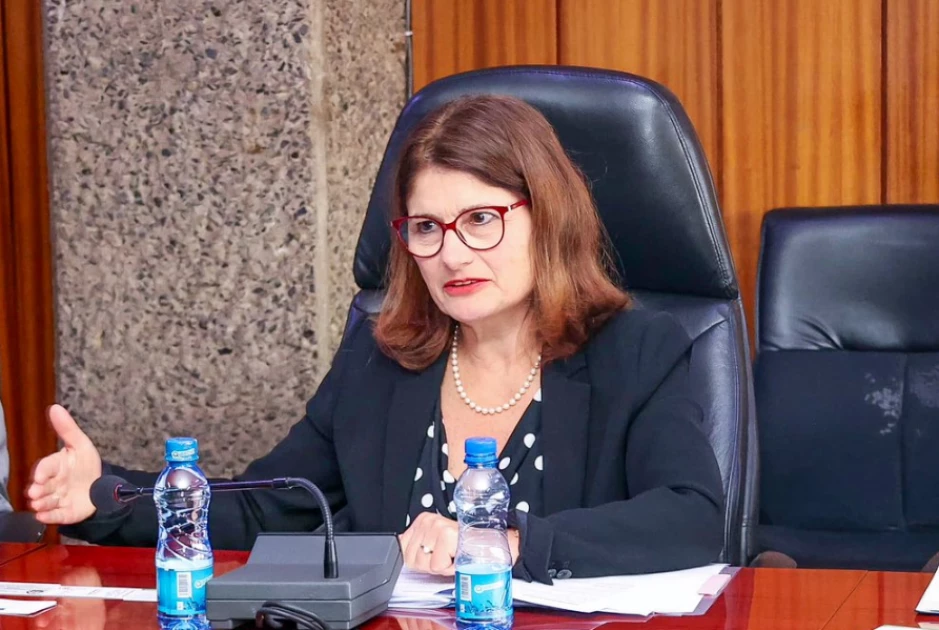
European Union Ambassador to Kenya Henriette Geiger during a past meeting. PHOTO | COURTESY

Audio By Vocalize
European Union Ambassador to Kenya Henriette Geiger has
offered clarity on Kenya’s recent listing as a high-risk country for terrorism
financing and money laundering, saying the designation is not punitive but a
call for enhanced reforms and vigilance.
Geiger noted that the grey
listing - announced earlier this year by the European Commission - places Kenya
under increased monitoring, alongside 14 other African nations.
These include Nigeria, South Africa, DR Congo, Mozambique,
South Sudan, and Tanzania. Some nations, including Uganda, Senegal, and
Mauritius, have recently been de-listed after demonstrating significant
progress.
While the listing raised concern
over potential economic fallout, Geiger downplayed fears of sanctions,
explaining that only countries on the blacklist,
like North Korea, face such harsh restrictions.
“There are no punitive measures
happening as claimed. The EU cannot look into your things; that is your own
prosecution and investigation mechanism. The FATF (Financial Action Task Force)
process is supposed to enhance the mechanisms,” she clarified, in an interview
with Capital FM on
Thursday.
Geiger acknowledged the reforms
being pursued by the Kenyan government to combat illicit financial activity,
including the Anti-Money Laundering and Combating Terrorism Financing Laws (Amendment)
Bill, 2025 signed into law by President William Ruto on Tuesday.
She welcomed the legislation, especially the provision that
grants independence to the Financial Reporting Centre (FRC), the state agency
tasked with coordinating Kenya’s anti-money laundering efforts.
“They made the financial
reporting center independent, which is very important. So you have more
authority of this financial reporting center because they are the ones who are
spearheading all reforms in that area of anti-money laundering to get off the
list,” she said.
Still, the ambassador made it
clear that having legislation is only part of the solution. For Kenya to be
removed from the grey list, she said, it must demonstrate real-world
effectiveness in applying the laws - particularly in prosecuting financial
crimes, monitoring high-risk sectors, and tightening controls around virtual
asset providers.
“Kenya needs to carry out a risk
assessment on terrorism financing in public and private sectors, strengthen
prosecution, licensing and supervising of virtual asset providers,” she said.
She commended Kenyan banks and
financial institutions for already stepping up efforts to vet transactions, especially
cross-border ones, and flagged the country’s geographic proximity to conflict
zones as a factor increasing its vulnerability to financial crime.
“Normally in countries at war or
in conflicts, where the rule of law is weakened, those are the more vulnerable
ones,” Geiger said.
The ambassador also addressed
concerns that political figures may exploit financial loopholes for illicit
purposes, stating that such issues fall within Kenya’s own legal and
investigative frameworks.
“Each country needs to see what
is possible within their frameworks, but there are some minimum conditions. I
think it would be good if Kenya was to do due diligence. I think your banks are
already (at least partially) doing that, asking questions… that’s the thing
with money laundering - when you close a loophole, they always find another
one,” she observed.
While the reforms are in motion,
Geiger advised patience, noting that de-listing is a rigorous process that
depends on sustained commitment and verifiable impact over time.
“The effectiveness is yet to be
seen,” she said, urging Kenya to stay the course. “Kenya needs to show
commitment and seriousness in its efforts to get de-listed so as to retain and
rebuild investor trust.”
Leave a Comment