
PROFILE: Mercy Kimaku - The Kenyan girl keeping Africa safe on TikTok
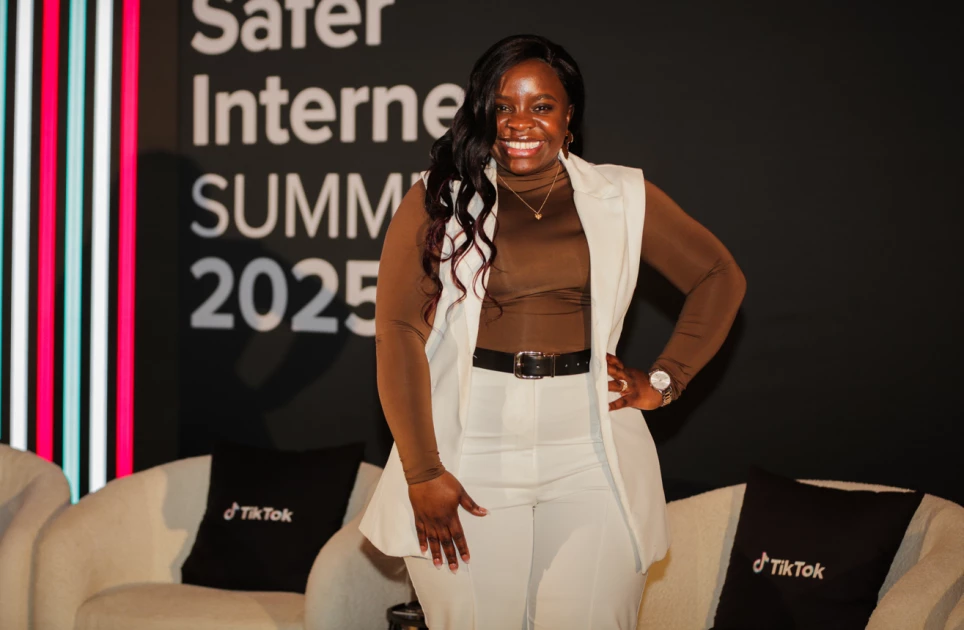
TikTok's Sub-Saharan Africa Regional Risk Prevention Lead Mercy Kimaku during a past summit. PHOTO | COURTESY

Audio By Vocalize
There’s a quiet kind of magic in
Mercy Kimaku’s story, the kind that begins in a small town in Nakuru with an
old computer that took five minutes to boot and ends up at the helm of TikTok’s
digital safety efforts for nearly an entire continent.
She’s the Kenyan girl who dared to
ask the big questions at a very young age: Who built this? Why does it work? And how do I get in?
Now, Mercy wears the title of Regional Risk Prevention Lead at TikTok, overseeing
trust and safety efforts across Sub-Saharan Africa.
Citizen Digital’s IAN OMONDI caught
up with Mercy on the sidelines of the TikTok Digital Well-being Summit in
Johannesburg, South Africa - a fitting setting, really, for a conversation
about safety, purpose, and raising children in the age of pixels and scrolls.
Between power panels and policy chats, she spoke with a rare blend of tech
savviness, maternal tenderness, and what you might call holy mischief;
the kind that dares to change systems while laughing at life’s little ironies.
What stands out most about Mercy
isn’t just her resume - and it’s impressive: Oracle, Meta, now TikTok - but
rather the conviction with which she speaks of home, of legacy, of raising a
daughter who knows she can code and play the drums if she wants to. She’s deeply
technical, but stubbornly human. A coder of systems, sure - but more
importantly, a curator of values.
Mercy opened up about girlhood,
growth, online nastiness, and what it means to build safety into the bones of a
platform as wild and alive as TikTok.
How does a Kenyan girl get
here?
That’s a very good question. I
loved tech from the very beginning. I started off with a Bachelor’s degree in
Commerce from Egerton University. But immediately after graduating, I realized
that wasn't what I wanted to do. My passion had always been in technology.
So, I applied for a scholarship at
Strathmore University, where I got the opportunity to pursue a Master’s degree
in Telecommunications and Innovation. That’s where I really got into the tech
world, building mobile applications and exploring various innovations.
Thankfully, after that, I joined
Oracle. That company opened my mind to the possibilities in tech and cemented
my love for the field. I stayed there for a couple of years before realizing
that social media offered even more room for impact. So, I shot my shot at
Meta.
I did my interviews with Meta
while still in Kenya, and fortunately, everything worked out. Meta was kind
enough to relocate me to Dublin, Ireland, where I worked on WhatsApp for two
and a half years, still covering Africa, because my passion for the continent
is deeply rooted.
Three years later, I decided to
transition into Trust and Safety. While at WhatsApp, I saw a lot of risks in
that space but didn’t have the opportunity to directly mitigate them. So, when
TikTok came calling, I was more than happy to join. The last three years have
been incredibly fulfilling.
So, Yes, it’s possible for a
Kenyan girl to get here. Chase your dreams, don’t take "No" for an
answer, keep looking for opportunities wherever they are, and feel free to
connect with me if you want to chat about how to get into this space.
Take me back to your childhood
for a minute, what is the most profound thing you remember about it?
I grew up in Nakuru, just a small
girl in a small town. It was a beautiful experience. I had a fairly normal
childhood with both parents present and three siblings. We had a comfortable
home; we never lacked food or shelter. The basics were always covered.
But what really stands out for me
is something my dad used to say: "I want you to dream. I want you to
believe in that dream. And then I want you to tell God that dream."
We had a small shop on the side,
and I remember my dad once installed a POS system there. We also had this old
computer that took a full five minutes to boot up. When it finally did, it
displayed a blue screen with lines of code. I remember being so fascinated and
telling my dad that I wanted to understand what that code meant.
From an early age, I knew I wanted
to get into tech. I wanted to understand how it all worked. Who designed it?
Who made it possible to press a button and have a machine come to life?
My parents supported my curiosity.
My dad especially was a big believer in girl power. He always said,
"There’s nothing women can’t do." In primary school, he would look at
my report card and the first thing he'd ask was how many girls were ahead of
me. That mindset, that girls can do anything, stuck with me. I think that’s
what even gave me the confidence to take on such a big role of ensuring safety
for users across markets.
You have a three-year-old child
now, how differently or similarly are you raising her compared to how you were
raised?
One thing I’d love to carry over
from my own upbringing is encouraging her to believe that anything is possible.
I don’t want to be the kind of parent who forces their child into a specific
career or interest. I want to observe what she’s passionate about and support
her in pursuing that.
What I might do a little
differently is allow her more room to experiment. As the first-born, I always
felt like I had to get things right. I didn’t give myself the space to try and
fail. I had to calculate every move for the sake of my siblings. But with my
daughter, I want her to explore.
If she says she wants to do music,
I’ll ask, "Which instrument?" and go get it. If it’s sports, I’ll
say, "Go for it."
That said, I do have one personal
goal: I want to teach her how to code by the time she turns five. As soon as
she can type, I’ll introduce her to the basics. Even if she ends up doing
something else, I want her to have that foundational tech skill, especially in
a world increasingly shaped by AI.
You’re raising a child in an
increasingly digital age, and being right in the middle of the sector yourself,
at what age would you say you will put a mobile phone in your child’s hand?
[Laughs] Please don’t bash me for
this. [Laughs again]
If I say 16 or 17, would that be
fair?
I’d really love to wait until
she’s around that age. Because, in Ireland, kids finish school at around age 16
or 17, and I think that’s when I can have a proper conversation with her about
responsibility. The risks are real.
I want to give her a phone only
when she’s mature enough to know what to say No to. I want her to be able to
recognize problematic content and either switch it off or come talk to me about
it. Being in this industry, I feel it's necessary to delay that exposure until
she can handle it.
I imagine your role allows you to travel quite a
bit, which means you interact with a lot of people, and you also have access to
the backend of our social media activity. What have your travels and your job
taught you about human behaviour? Do you think people are what they portray
online?
Yes and No. What my travels have
taught me is that people are incredibly diverse. But the one thing I’ve
observed, which I don’t really appreciate, is how bold people can be online
compared to in-person. People will leave nasty comments on your posts, but
these are things they would never dare say to your face.
As somebody who works in risk,
what is the riskiest thing you’ve ever done in your life?
[Laughs] I am so risk-averse. The closest thing to a risk I have done is snorkeling, but the moment we got deep into the sea, I changed my mind.
What would you say is the
biggest risk facing TikTok in the continent? Is it the content, public
perception, or government regulation?
TikTok is a fairly
new platform and like with any new thing, we face challenges. With the rise of
misinformation and disinformation across Africa, I would say content is one of
our biggest risks.
However, through a
combination of advanced technologies and rigorous moderation strategies, we
proactively detect and review content that may violate our Community
Guidelines, taking appropriate action against any violations, including content
removal and account bans.
Additionally, we
consult with a range of stakeholders to inform our human rights due diligence.
Our Sub-Saharan (SSA) Safety Advisory Council brings together experts from
across the region with a diverse range of backgrounds to work closely with us
on developing policies and processes that tackle today’s safety concerns.
We continue to work collaboratively with various stakeholders to educate our public and stakeholders on safety and what needs to be done to ensure safety on the platform.
When you retire back home in
the evening after a hard day at work, do you tell yourself that “I’m a
successful person”? And what is your personal definition of success?
Perfect. I really love that
question.
My definition of success is
knowing that I’ve done my best with the opportunities I have. At the end of
each day, I ask myself: Did I connect with my family the way I needed to?
Especially now, with a young baby. Someone once told me something that really
stuck with me: "Your kid won’t remember the gifts, but they’ll remember
the time you spent with them."
So I always ask: Did I give my
daughter enough time? Even ten minutes of uninterrupted play, making her laugh,
that’s enough for me.
Family is core for me. My husband,
siblings, mum, friends - if I can say I connected with them meaningfully,
that’s success.
Another thing is fulfilling my
dreams. I believe in setting goals. Any time I achieve something - big or small
- that’s a win for me. One of my goals this year was to really represent TikTok
publicly and talk about the work we do. For a long time, I stayed behind the
scenes, and so you would never see me in such engagements. But our Communications
team kept encouraging us to step forward and speak out more, and so here we
are.
So, in short: creating time for
the right people, being present where I need to be, and achieving my goals - that’s
my definition of success.
At the end of the day, I’m also incredibly
passionate about removing harmful content from the platform. I could do that
for 24 hours straight. If I go to bed knowing that we took down bad content or
flagged something that could improve our systems, that’s a good day.
Having worked at some of the
biggest companies in the world, do you ever plan on coming back to serve your
country?
[Laughs] I would really love to serve my country someday. But not yet. Not in the near future.
Join the Discussion
Share your perspective with the Citizen Digital community.
No comments yet
This discussion is waiting for your voice. Be the first to share your thoughts!