

From fish waste to fashion: How Newton Owino is turning Lake Victoria’s pollution into sustainable leather
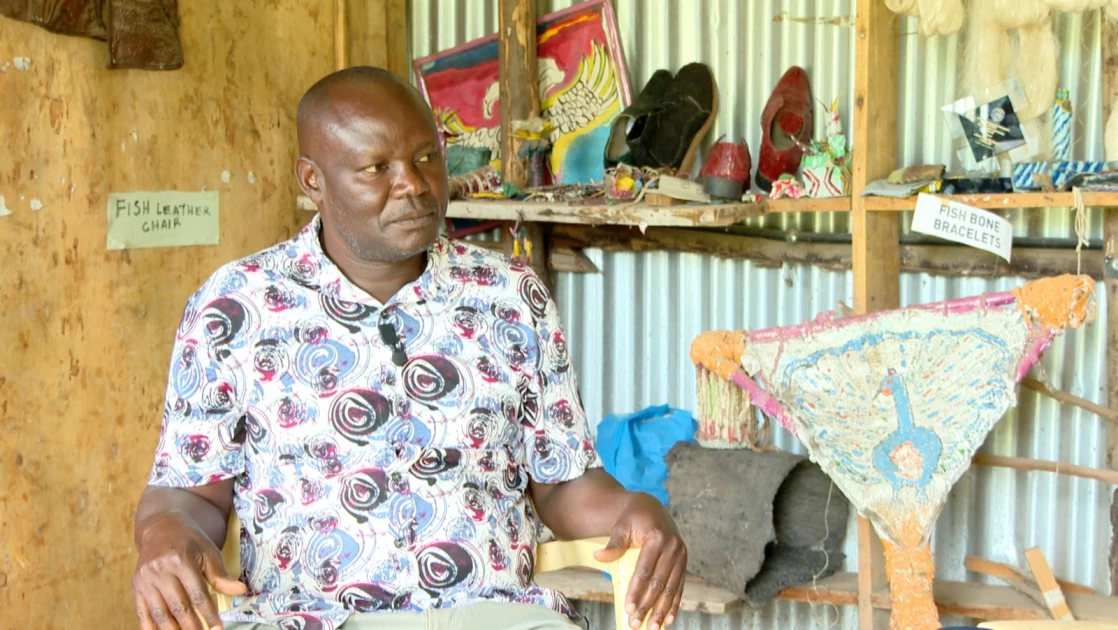
Newtone Owino at his shop in Kisumu, where he is selling fashion products made from fish waste. Photo: Eric Ounda

Audio By Vocalize
Newton narrates that he moved upcountry after realising that slaughterhouses were few and could not sustain the regional tannery. The only viable source of a steady leather supply, he discovered, was the fish filleting industry.
“When I joined the fish leather venture, only nine filleting industries were operational, producing about 150,000 metric tonnes of fish waste,” he says.
At the time, fish waste from residential areas such as Obunga was carelessly dumped, often ending up in Lake Victoria during the rainy season. Witnessing the unhygienic state of the lake, caused by rotting fish remains, pushed Newton to invest in fish leather research.
“At one point, I went to Lake Victoria and found it piled with rotten fish waste. I told myself that instead of struggling to find cow and goat leather, I would do something with the available fish leather,” he recalls.
Newton’s journey into the fish leather industry was far from easy, but resilience carried him through. Before venturing fully into the fish skin business, he spent years working with various non-governmental organisations.
His previous roles at global research institutions such as the International Centre for Insect Physiology and Ecology (ICIPE) and the Centre for Agriculture and Bioscience International (CABI) broadened his knowledge and laid the foundation for his research-based start-up.
“I am a graduate of insect science and leather chemistry. I joined ICIPE in 1992 and worked on insects for over 20 years, but along the way I became fascinated with leather,” Newton says.
“During my time at ICIPE and CABI, I gained a lot of experience that I did not want to waste when I exited employment. That is what pushed me to start this business,” he adds.
Today, Newton runs his venture under the brand Alisam Products Development and Design, a move he says has given him the freedom to innovate and train others, something he could not do as an employee.
How he operates
Alisam Products Development and Design focuses on green chemistry, relying mainly on plant-based substances to reduce the use of hazardous chemicals. Newton’s leather innovation extends beyond fish skin to chicken leather, which he sources from Indian-owned hotels clustered around Mamboleo Market in Kisumu County.
“I studied in India, so I understand their culture well. Many Indians do not like eating chicken skin because of cholesterol concerns, so the supply is guaranteed,” he explains.
With leather research as his inaugural project, Newton’s work has consistently leaned towards environmental conservation.
“We do not process leather using conventional chemicals that are harmful to human health,” he says.
After years immersed in scientific research, Newton discovered that many artificial chemicals used in leather processing can be sourced from naturally growing plants. This realisation motivated him to begin large-scale farming of specific plants that yield the required compounds.
“For example, cassava leaves contain a chemical known as cyanin, which removes bad odour from leather. Banana plants have phenolic acid, which strengthens leather, while papain from pawpaw strengthens leather and also acts as a preservative,” he explains.
These discoveries led Newton to establish an environmentally friendly business model. Choosing naturally extracted chemicals over synthetic ones has proven beneficial.
“There is a chemical called chromium oxide that is commonly used in leather processing. It is very harmful to health and highly carcinogenic, yet most shoe leather is made using it,” he says.
In addition to treating and preserving leather, Newton’s plant-based chemicals help achieve desired colours. Instead of dangerous azo dyes—which release toxic and carcinogenic amines—he uses natural dyes from trees such as Albizia coriaria, Tylosema fassoglense, Rosales and Blue Wild Indigo.
Aquatic plants also play a role: Chlorophyta produces green dye, Phaeophyta brown dye, and Rhodophyta red dye.
Newton’s climate-friendly venture enjoys government support through the fisheries department.
“The fisheries department linked me with Indian traders along Sabuni Road in Kisumu who deal in fish. I also helped them solve the challenge of disposing fish remains,” he says.
Market demand
Newton’s innovation goes beyond leather technology. Using fish bones, Alisam Products creates artefacts such as necklaces, bracelets, earrings and rings.
“We sterilise our artefacts naturally using moringa and aloe vera. Many modern accessories are treated with chemicals that react with the body and can cause systemic health complications,” he explains.
Creativity at Alisam Products is striking. Newton even solidifies fish pupils to create earrings he has branded ‘Dancing Hearing’.
Selling internationally, the entrepreneur operates Amazon stores in New York, Australia and London.
“Natural products are highly sought after in international markets,” he says.
Through the Kenya Leather Development Council, Newton has partnered with the United Nations under the Switch Africa Green Programme.
With a smile, Newton notes that many leather products in the market can only be correctly identified by experts. He adds that fish leather is still undervalued locally, prompting his focus on international markets.
“Even shoemakers rarely disclose the type of leather they use. I once had a client say he could not wear fish leather shoes because dogs would eat them,” Newton recalls with a laugh, dismissing the myth.
Fish leather from Lake Victoria is in high demand abroad due to the preference for unique and environmentally friendly products.
“The fish consumed in Europe comes from Lake Victoria. They care about the cleanliness of the source, and buying fish leather products helps support environmental hygiene,” he explains.
Newton is also a member of the World Fair Trade Organization, which helps him reach wider markets. Locally, his products are sold at Maasai markets and in Malindi.
“I believe every household has a million shillings within reach. People just need to open their eyes. There is money in the informal economy, and capital is in the mind,” he says.
Challenges
Despite the environmental benefits, Newton has faced challenges. Some products exported abroad are smuggled back into the local market and sold at more than double the original price. This prompted him to raise awareness locally through social and mainstream media, leading to increased local acceptance of Alisam’s products.
He also faces stiff competition from imported alternatives. Newton has urged the government to promote local industries focused on waste reduction, pollution control, material circulation and environmental regeneration.
“Taxation, labour costs, power charges and double licensing are major challenges for SMEs in Kenya,” he says.
“We need a single licensing window so that we are not taxed separately by the leather department, KRA, county and national governments. That would motivate us to continue championing a circular economy.”
Recognition
Despite the hurdles, Newton’s work has earned numerous environmental awards and commendations. Most recently, he received the Cross-Border Innovation Award from the Kenya Private Sector Alliance (KEPSA), recognising him as the best innovator in East Africa.
Another accolade displayed in his workshop is the Excellence for MSE Innovation Award (2015), presented by former President Uhuru Kenyatta. Other honours include the African Best Scientific Award and the Nile Basin Best Innovation Award, which he received in Paris, France.
Beyond economic impact, Newton’s fish leather business contributes significantly to education and skills development. Learners from various institutions regularly visit his workshop for hands-on training in leather technology.
Textile engineering students from Moi University, along with learners from the University of Nairobi, Kisumu Polytechnic, Kabete and other institutions, benefit from training in natural dye manufacturing.
“They bring their students here for training and internships, and I do not charge them,” Newton says, adding that he often liaises with institutions to help outstanding trainees secure jobs.
He also notes that Alisam has partnered with the Estonian University, which sends learners annually for training.
To support education further, Newton employs skilled learners facing school fee challenges, enabling them to earn an income and continue their studies.
Leave a Comment