

Nigeria's Nollywood finally makes it into Cannes arthouse film fold
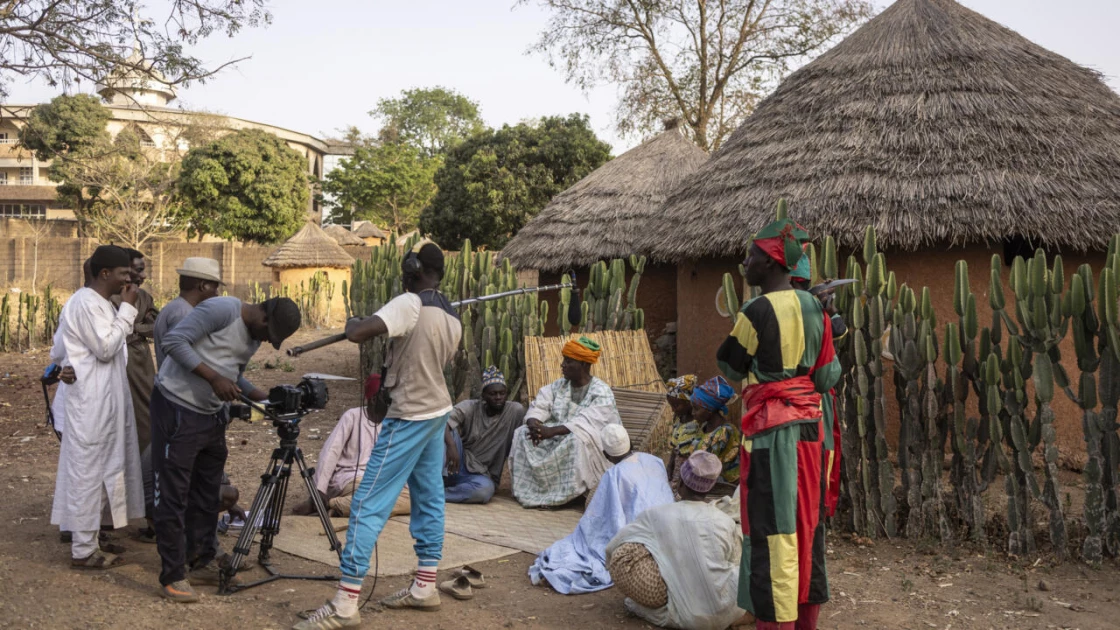
On the set of the Nigerian series 'Yarima' in Jos earlier this year © OLYMPIA DE MAISMONT / AFP

Audio By Vocalize
It has taken nearly 80 years, but a Nigerian movie will
finally be screened in a hallowed official slot at the Cannes film festival on Sunday.
After decades of being written off for its cheap and
cheerful crowd-pleasers, Nollywood -- the frenetic film industry based in Lagos
which churns out up to five films a day -- is basking in the reflected glory.
But producers admit that it is still struggling to reach
audiences outside Africa beyond the diaspora despite making way more films
every year than Hollywood.
Nigerians have long lapped up Nollywood's never-ending
deluge of low-budget dramas about love, poverty, religion and corruption, often
spiced with the supernatural and the clash between modern and traditional values.
Not exactly known for their quality, many are shot at
breakneck speed on shoestring budgets.
But that image -- which producers insist is a hangover from
the days when most were shot on video camcorders -- may be about to change with
"My Father's Shadow", the first Nigerian film to make the grade at
Cannes, the temple of arthouse cinema.
"Getting into competition for the first time ever shows
that Nigerian cinema has come of age," insisted Prince Baba Agba, a
cultural advisor to Nigeria's President Bola Tinubu, who is in Cannes for the
premiere.
Akinola Davies's first feature is set during the 1993 coup,
a pivotal moment in Nigeria's recent history, when the military annulled the
election and General Sani Abacha eventually took power.
This "lost chance" when Akinola said the "rug
was pulled away and everyone's dreams of democracy were just taken away",
still marks the country.
The semi-autobiographical story, featuring "Gangs of
London" actor Sope Dirisu, has two small boys following their father
through Lagos as the coup unfolds.
Editi Effiong's crime thriller "The Black Book"
topped the global lists on Netflix last year, including being number one in
South Korea.
"We have had films going to major festivals and we have
won prizes at Sundance," he told AFP, pointing to "Shine Your
Eyes" -- a hit at the Berlin film festival.
"Eyimofe (This Is My Desire)" has been picked up
by the prestigious streaming and distribution network Criterion Collection.
"It was fully shot in Nigeria, with Nigerian producers,
Nigerian finance, everything," Agba added.
"We are still making an awful lot of films, but now in
all the strata, from the bottom to the top," he added.
"You have people doing million-dollar productions, and
you have people doing $10,000 films... all telling unique stories with the soul
and heart and spirit of Nigeria," he added.
Tax breaks for filmmakers -- now passing through parliament
-- could be a gamechanger, he said, boosting Nollywood's new "penetration
internationally thanks to streaming and co-productions".
Big US streamers began to dip their toe during the pandemic,
with Netflix picking up "Blood Sisters", "Man of God" and
the musical "Ayinla" while local platforms also boomed, particularly
in the Muslim north's "Kannywood", named after the city of Kano.
There has since been a few big bumps in the road, however,
with Amazon closing down its Africa operation last year.
Netflix has also hit the brakes hard, industry insiders in
Cannes told AFP, although officially it's still business as usual.
Big local players, however, are angling to step into the gap
with the Ebonylife Group -- a Nollywood powerhouse -- about to launch its own
platform.
"We will start small and we will build... We can't keep
waiting on everyone else to do this for us," said its founder Mo Abudu,
who is also opening a Nigerian cultural hub in London later this year.
While Agba admitted the industry faces "big
technological and infrastructure challenges", particularly with mobile
networks as most films are seen on phones, there has been progress.
"We hope to double our (cinema) screens to 300. Brazil,
with a similar population, has over 3,000," he said.
Along with Afrobeats music, Nollywood is Nigeria's main
source of soft power.
One measure of its ineluctable rise is that when The
Hollywood Reporter named its "40 Most Influential Women in International
Film" list on the eve of Cannes, Mo Abudu was at its very top.
Leave a Comment