

Honda and Nissan are in merger talks
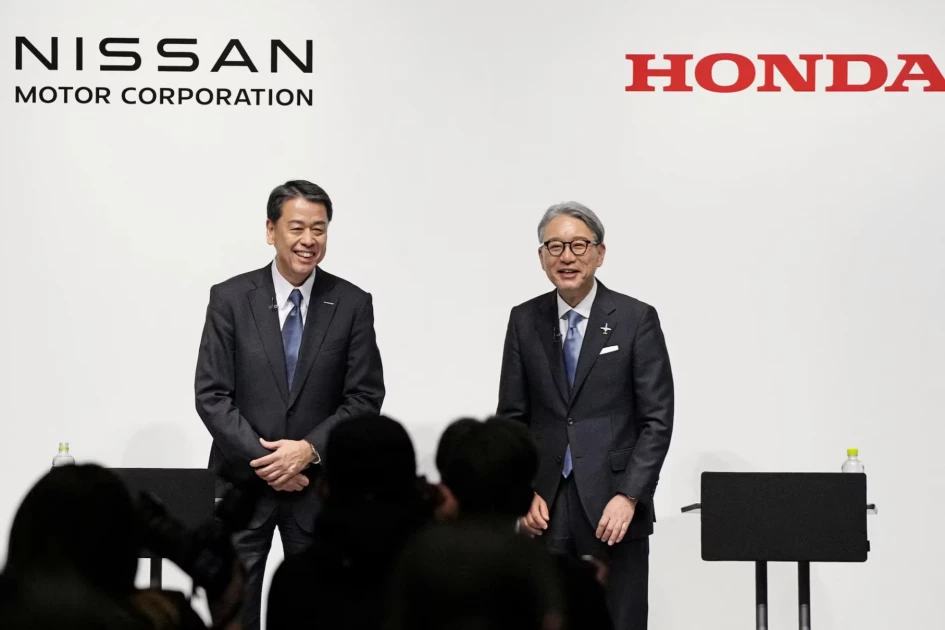
Makoto Uchida, president and CEO of Nissan Motor, and Toshihiro Mibe, Honda Motor president and CEO, attend their joint press conference in Tokyo, Japan March 15, 2024. Mandatory credit Kyodo/via REUTERS/File Photo

Audio By Vocalize
Honda and Nissan are in talks to deepen
ties, two people said on Wednesday, including a possible merger, the clearest
sign yet of how Japan's once seemingly unbeatable auto industry is being
reshaped by challenges from Tesla and Chinese rivals.
A combined Honda and Nissan would create a
$54 billion company with an annual output of 7.4 million vehicles, making it
the world's third-largest auto group by vehicle sales after Toyota and
Volkswagen.
The two firms had already forged a
strategic partnership in March to cooperate in electric vehicle development,
but Nissan's deepening financial and strategic trouble in recent months has
added more urgency for closer cooperation with larger rival Honda.
Nissan announced a $2.6 billion cost
savings plan last month that includes cutting 9,000 jobs and 20% of its global
production capacity, as slumping sales in China and the U.S. led to a 85%
plunge in second-quarter profit.
"This deal appears to be more about
bailing out Nissan, but Honda itself is not resting on its laurels," said
Sanshiro Fukao, executive fellow at Itochu Research Institute. "Honda's
cash flow is set to deteriorate next year and its EVs haven't been going so
well."
Shares of Nissan, Japan's third-largest
automaker, surged more than 22% in Tokyo trade on Wednesday, while shares of
Honda, the second-largest, declined 2.3%. Shares of Mitsubishi rose 13%.
The automakers have been grappling with
challenges from EV makers, particularly in China, where BYD and others have
surged ahead.
The talks between Honda and Nissan, first
reported by the Nikkei newspaper, would allow the companies to cooperate more
on technology and help them create a more formidable domestic rival to Toyota.
The discussions are focused on finding ways
to bolster collaboration and include the possibility of setting up a holding
company, said the people, who declined to be identified because the information
has not been made public.
The companies are also discussing the
possibility of a full merger, according to one of the people, as well as
looking at ways to cooperate with Mitsubishi Motors, in which Nissan is the top
shareholder with a 24% stake.
Honda, Nissan and Mitsubishi said no deal
had been announced by any of the companies, though Nissan noted the three
automakers had said previously they were considering opportunities for future
collaboration.
French automaker Renault, a major Nissan
shareholder, said it had no information and declined to comment.
Honda's market capitalisation is about $44
billion, while Nissan's is about $10 billion after a price surge on Wednesday,
meaning a full merger would be bigger than the giant $52 billion deal between
Fiat Chrysler and PSA in 2021 to create Stellantis.
Over the past year, an EV price war
launched by Tesla and BYD has intensified pressure on any automakers losing
money on the next-generation vehicles.
That has put pressure on companies like
Honda and Nissan to seek ways to cut costs and speed vehicle development, and
mergers are a major step in that direction.
"In the mid- to long-term, this is
good for the Japanese car industry as it creates a second axis against
Toyota," said Seiji Sugiura, a senior analyst at Tokai Tokyo Intelligence
Laboratory.
"Constructive rivalry with Toyota is a
positive for the rather stagnating Japanese car industry when it must compete
with Chinese automakers, Tesla and others."
Any merger would face significant U.S.
scrutiny and President-elect Donald Trump has vowed to take a hard line on
imported vehicles, including threatening 25% tariffs on vehicles shipped from
Canada and Mexico.
He could seek concessions from Honda and
Nissan to approve any deal, auto industry officials said.
Honda and Nissan both produce cars in
Mexico for export to the U.S.
Honda and Nissan would also have to work
out how to integrate their different corporate cultures if they proceed with a
merger, analysts said.
"Honda has a unique,
technology-centric culture with strengths in powertrains, so there should be
some internal resistance to the merger with Nissan, a competitor with a
different culture that is now faltering," said Tang Jin, a senior researcher
at Mizuho Bank.
Leave a Comment