
Zimbabwe's President Emmerson Mnangagwa declares his birthday date an annual public holiday
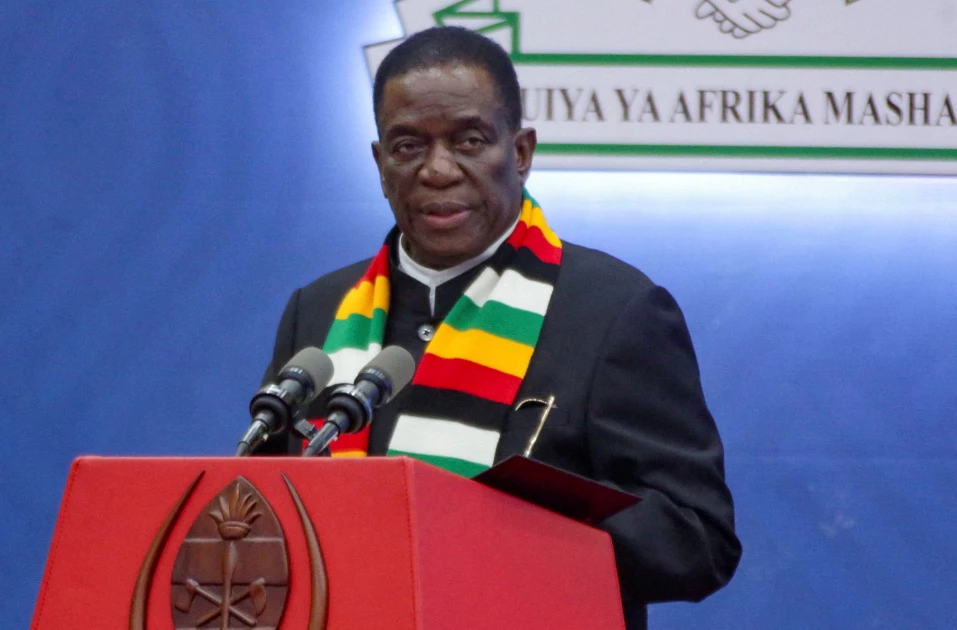
Zimbabwe President Emmerson Mnangagwa presides over the swearing in of former Zimbabwe National Army (ZNA) Commander Retired Lieutenant General Anselem Sanyatwe as the new Minister of Sports, Recreation, Arts and Culture, replacing International Olympic Commitee (IOC) President Elect Kirsty Coventry, at State House in Harare, Zimbabwe, March 27, 2025. REUTERS/Philimon Bulawayo

Audio By Vocalize
The new holiday was introduced through a new regulation, Statutory Instrument 148 of 2026, which declared 15 September an annual public holiday known as Munhumutapa Day.
Local media reported that a notice to this effect was published on Wednesday.
“His Excellency the President, in terms of section 2(2) of the Public Holidays and Prohibition of Business Act [Chapter 10:21], hereby makes the following notice: 1. . This notice may be cited as the Public Holidays and Prohibition of Business (Declaration of Public Holiday) Notice, 2026. 2. It is hereby declared that the 15th of September every year henceforth shall be a public holiday to be known as Munhumutapa Day,” the notice read, according to ZBC News, a Zimbabwean news outlet.
Mr Mnangagwa, who has ruled Harare for about 9 years, is expected to celebrate his 84th birthday on the same day his government has set aside as a holiday to celebrate the country’s “pre-colonial heritage.”
The holiday takes its name from the Munhumutapa title used by rulers of the historic Mutapa Empire, a powerful Shona kingdom that existed from the 14th to 17th centuries.
The state, however, did not explain why it chose 15 September for the celebration.
Hours after the declaration, Mr Mnangagwa also hinted at staying in power beyond 2030.
He said on Thursday that he will “still be around” in nine years, although his term is supposed to expire in about four years.
“I will still be around; I do not know about you,” he was quoted as saying.
In July, Mr Mnangagwa signed into law the bill that extended his term of office by two years. From 2028 to 2030. The bill extended presidential terms from five to seven years amid intense public criticism.
He had previously described himself as a constitutionalist and pledged to respect term limits.
Mr Mnangagwa took power in 2017 after ousting long-time ruler Robert Mugabe with military backing. He went on to win disputed elections in 2018 and 2023.
Mr Mnangagwa defied demands to send the bill, which amends the Constitution, to a public referendum, insisting that the move will bring stability to the southern African nation.
The law also scrapped the presidential election. It changed how Zimbabwe elects its president. Instead of voters electing the president directly, they will elect members of Parliament, who will then choose the country’s leader.
However, critics warn that this will further entrench the reign of Mr Mnangagwa’s party, ZANU-PF, which has governed Zimbabwe since the country gained independence from Britain in 1980.
Join the Discussion
Share your perspective with the Citizen Digital community.
No comments yet
This discussion is waiting for your voice. Be the first to share your thoughts!