
World Relays: Vital lessons for Kenya after mixed performances in Botswana
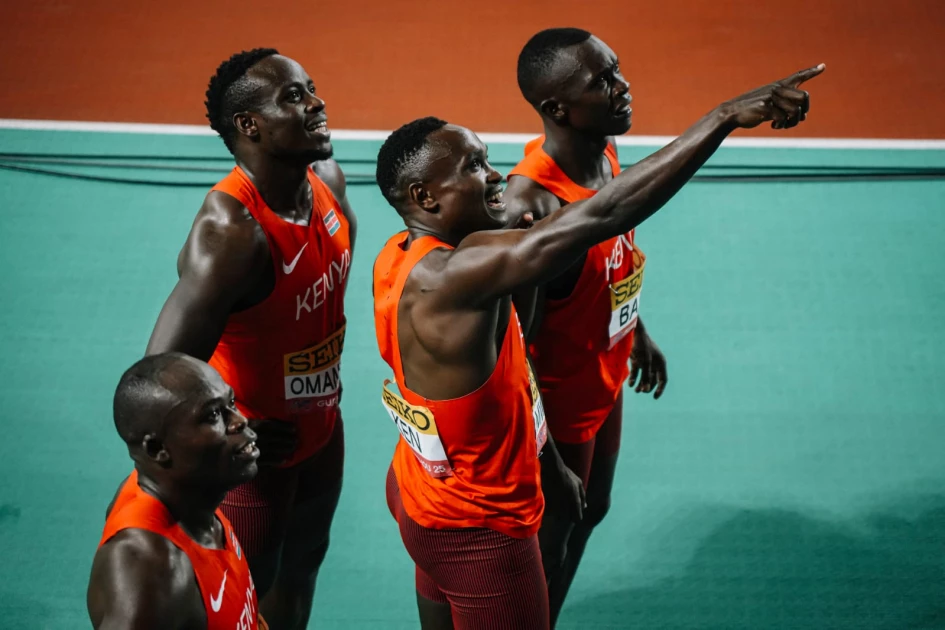
Kenya's 4x100m men's team at the World Relay Championships in Guangzhou, China. It was the first Kenyan 4x100m team to qualify for a World Championship. Photo/ Athletics Kenya

Audio By Vocalize
Kenya's relay team completed the World Athletics Relays in Gaborone, Botswana with a landmark achievement in the mixed 4x400m and a broader reminder that consistency across all relay disciplines remains a work in progress ahead of the 2027 World Athletics Championships in Beijing.
The mixed 4x400m
quartet of George Mutinda, Mercy Oketch, Kelvin Tonui and Mercy Chebet
delivered Kenya's standout performance, clocking 3:09.87 to set a new African
record. The run lowered South Africa's previous continental best of 3:11.16 set
in 2025 and confirmed Kenya's growing competitiveness in the event. Kenya
finished second in their heat behind Great Britain, who posted 3:09.69, one of
the fastest times globally in the 2026 season. The result also secured Kenya
automatic qualification for the World Championships in Beijing, making it the
only Kenyan relay team to earn direct entry from the opening day of
competition.
From a global
standpoint, the performance places Kenya close to elite standards but still
outside consistent medal range. The world record in the mixed 4x400m stands at
3:07.41, while championship-winning performances have typically been around the
3:07-3:09 range. Kenya's time therefore reflects clear progress, but not yet
full conversion into global podium contention.
The race itself showed
tangible technical improvement. Baton exchanges were cleaner, with reduced loss
of speed in transition zones, while the team maintained strong rhythm through
the middle stages. However, Kenya again struggled in the closing leg, losing
pace late despite remaining competitive for most of the race. This late-race
drop remains a recurring technical issue across multiple championships.
George Mutinda
reflected on the performance saying, "I appreciate the moment, it is a
nice experience. It is an achievement for us because we've not been to this level.
So I appreciate the moment because we continue to grow and that is what
matters."
Mercy Oketch,
meanwhile, framed the result as part of a longer process of continuous
improvement and ambition. "We are still working on it. Every other time
when we are coming for competition we hit 3.11, 3.10, 3.15, and now we are in
3.09. We are still working on it, we are hoping for the best," she said.
It is however
worth pointing out that Kenya's relay performances were mixed. In the mixed
4x100m relay, Moses Wasike, Millicent Ndoro, Dennis Mwai and Mercy Oketch
recorded a season's best 41.35, but finished well behind global leaders.
Jamaica dominated the race with a world record 39.99, while Great Britain and
Australia also posted significantly faster times.
The men's 4x100m
team featuring Ferdinand Omanyala, Mark Otieno, Ronald Koech and Meshack Babu
ran 38.50, also a season's best, but still trailed Canada (37.56), Germany
(37.67) and Australia (37.87), reinforcing Kenya's ongoing gap in sprint relay
execution.
In the 4x400m
events, the women's team finished eighth in their heat in 3:35.90, while the
men's team clocked 3:02.70, with both failing to secure automatic qualification
for Beijing. Only the mixed 4x400m team progressed directly, becoming Kenya's
most competitive relay unit.
Across all
events, a consistent pattern emerged: strong starts and competitive middle
phases followed by reduced speed in final legs. This trend, particularly
visible in anchor legs, continues to limit Kenya's ability to convert
competitive positions into podium finishes.
Pre-competition
preparations reportedly focused on improving baton exchange efficiency and
reducing speed loss in transition zones. These adjustments were most evident in
the mixed 4x400m, where coordination and rhythm were noticeably improved
compared to previous seasons.
However, Kenya
continues to rotate relay combinations across events rather than maintaining a
fixed core squad, affecting chemistry and timing in high-pressure situations.
With the World
Championships approaching, Kenya's focus now shifts from qualification to
execution. While the mixed 4x400m now sits within striking distance of global
finalists, sustained competitiveness will depend on eliminating late-race
fade-outs and achieving consistent technical execution across all relay
categories.
Join the Discussion
Share your perspective with the Citizen Digital community.
No comments yet
This discussion is waiting for your voice. Be the first to share your thoughts!