
World Cup final draws record 63 million viewers across Fox and Telemundo
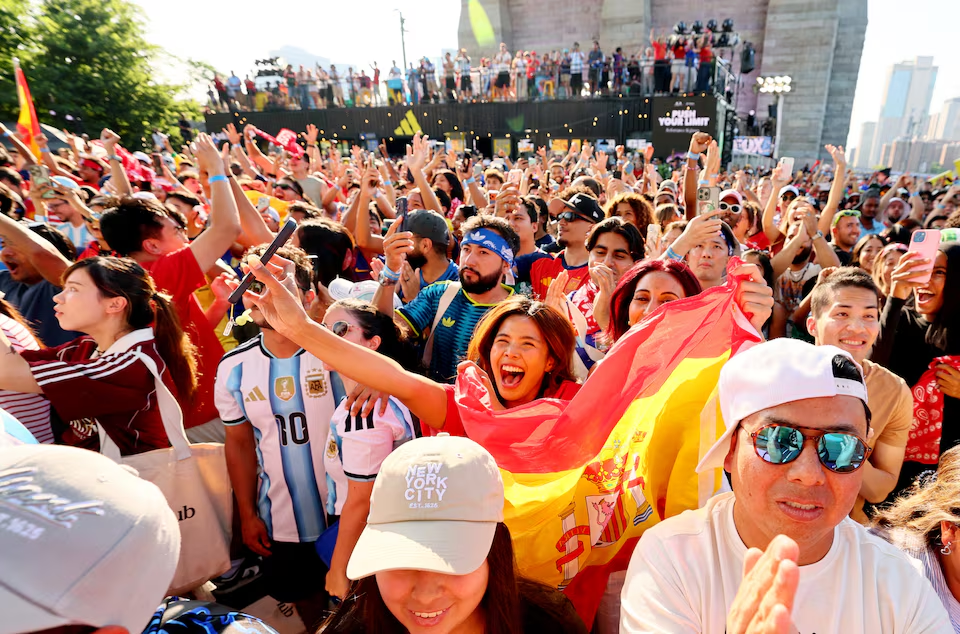
Soccer Football - FIFA World Cup 2026 - Final - Spain v Argentina - Fans gather in New York - New York City, New York, U.S. - July 19, 2026 Fans react as they watch the FIFA World Cup final between Spain and Argentina at the Brooklyn Bridge park party IMAGN IMAGES via Reuters/Caean Couto

Audio By Vocalize
Nearly 63 million Americans tuned in to watch Spain
beat Argentina in the FIFA World Cup final on Sunday, shattering viewership
records and underscoring soccer's growing appeal in the U.S. after decades of
efforts to broaden its audience.
Held in New Jersey, the final remained
scoreless until Spain broke through in the 106th minute to secure a 1-0
victory.
Fox's (FOXA.O), opens new tab English-language
broadcast attracted 38.9 million viewers, while Comcast's (CMCSA.O), opens new
tab Telemundo and its Peacock streaming
platform pulled in another 23.9 million viewers for the Spanish-language
coverage, the companies said.
The combined audience far exceeded the 22.3 million
U.S. viewers who watched the 2022 World Cup final in Qatar.
The strong viewership capped what analysts said was
a solid run for the tournament's broadcasters, with Fox and Comcast paying
roughly $485 million and $600 million, respectively, for rights packages that
included the World Cup, according to
media reports.
Several knockout-stage matches also outperformed
recent championship games in other major U.S. sports.
The Round of 16 meeting between England and Mexico
drew nearly 45 million viewers, well
above the roughly 27 million who watched Game 7 of Major League Baseball's
World Series, when the Los Angeles Dodgers
beat the Toronto Blue Jays in extra innings, and the nearly 25 million who
tuned in for Game 5 of the NBA Finals, where the New York Knicks ended
a 53-year title drought by defeating the San Antonio Spurs.
While the figures remained below the nearly 126
million viewers who watched Super Bowl LX, when the Seattle Seahawks defeated
the New England Patriots, they marked a significant milestone for a sport long
overshadowed in the U.S. by American football, basketball and baseball.
The tournament, co-hosted by the U.S., Canada and Mexico for the first time, benefited from prime-time kickoff slots for American audiences.
Fans were also drawn by what could be the final World Cup
appearances of a generation's biggest stars, including Argentina's Lionel Messi
and his long-time
Portuguese rival Cristiano Ronaldo. The last time the U.S. hosted the
tournament was in 1994.
Fox One, which had the English-language streaming
rights in the U.S., recorded 2.8 million sign-ups
in June, its strongest month since the service's launch in August and more than
double the 1.1 million sign-ups generated during NFL Playoffs in January,
according to industry tracker Antenna.
Soccer's popularity among
Hispanic audiences also drove strong
turnout on Spanish-language broadcaster Telemundo.
"Ratings have blown past internal forecasts for
both networks, and it's not close," said Vicente Navarro, managing partner
at soccer-focused marketing firm GotDigital.
Navarro said a marquee 30-second advertising spot in
the knockout-stage matches cost as much as $1 million, more than double 2018
levels. Major advertisers included PepsiCo (PEP.O), opens new tab, Home Depot
(HD.N), opens new tab, Anheuser-Busch (ABI.BR), opens new tab and Coca-Cola
(KO.N), opens new tab, according to market intelligence firm SensorTower.
For comparison, a 30-second Super Bowl advertisement
typically costs about $8 million or more.
Beyond the ratings, the tournament also proved
lucrative for broadcasters, helped by new
so-called hydration breaks that split
matches into four segments and created additional
advertising opportunities. Some experts said the extra ad slots helped offset
TV rights costs and drew interest from beverage and food brands.
Fox, led by Lachlan Murdoch, is expected to make at
least $250 million from hydration-break advertising alone, according to a June
report, opens new tab by the Hollywood
Reporter. Telemundo did not run ads during those breaks.
"The new inventory definitely creates more
spending for the World Cup," said Luke
Stillman, a managing director at research firm
Madison and Wall. "It would be surprising if the structure wasn't a
permanent fixture now going forward, and therefore the broadcast rights are
going to be more valuable going forward."
Still, it remains unclear whether some of the
tournament's Americanized elements, including a major halftime show that drew
comparisons with the Super Bowl and led to a 27-minute interval, well beyond
soccer's sacrosanct 15-minute halftime period,
will endure. FIFA also announced, opens new tab the World Cup champions will
for the first time receive a ring in a nod to
"one of the most recognisable American sporting traditions."
The next World Cup will be co-hosted by Spain,
Portugal and Morocco in 2030, followed by Saudi Arabia in 2034. Both
tournaments are likely to feature less
favorable kickoff times for U.S. viewers, which could weigh on future ratings.
Join the Discussion
Share your perspective with the Citizen Digital community.
No comments yet
This discussion is waiting for your voice. Be the first to share your thoughts!