
Why your skincare routine could be doing more harm than good
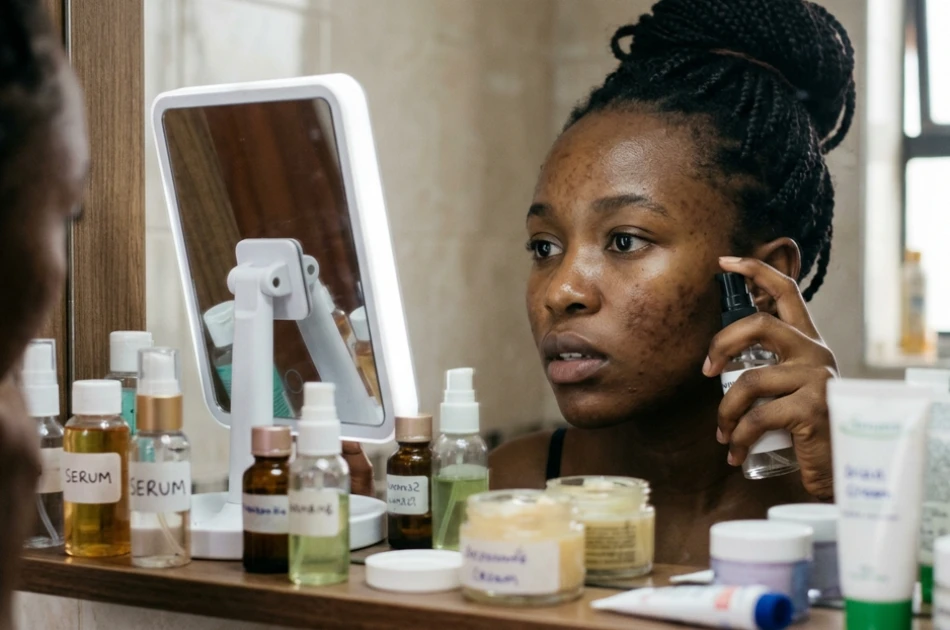
An AI-generated image of a young woman examining her skin amidst a cluttered vanity of serums and creams. PHOTO | GEMINI

Audio By Vocalize
For many Kenyans, a visit to a dermatologist remains out of reach. With just over 30 specialists serving a population of more than 54 million, most people are left to figure out their skin concerns on their own, and increasingly, online.
From acne and eczema to stubborn dark spots, common skin conditions are becoming more visible, especially among young people in urban areas. Experts link this to a mix of pollution, stress, changing diets and constant sun exposure, turning what once were occasional flare-ups into long-term concerns.
But beyond the environmental triggers, a quieter problem is
emerging — how people are choosing to treat their skin.
“Skin is not just about appearance; it is the largest organ
in the body and serves as a critical protective interface between us and the
external environment,” said Dr. Roop Saini, a committee member of the Kenya
Association of Dermatologists (KAD).
With limited access to specialists, many Kenyans are turning to social media trends and over-the-counter solutions. Skincare routines packed with multiple active ingredients, harsh exfoliants and quick fixes are now common — but not always safe.
The result is often damaged skin — more sensitive, reactive and slower to heal. This can trigger a cycle of irritation, moisture loss and even infections. For melanin-rich skin, the risk of post-inflammatory hyperpigmentation is even higher, meaning dark marks can linger long after acne or irritation clears.
What should be simple skincare has, for many, become
complicated guesswork. And without proper guidance, small issues can quickly
escalate into persistent conditions that are harder and more expensive to
manage.
Experts say the solution is not necessarily more products,
but a better understanding.
“From a dermatologist’s perspective, good skincare is
actually preventative medicine,” Dr Saini said, emphasising that simple
routines built on gentle cleansing, proper moisturization and daily sunscreen
care can prevent many common conditions.
There are signs of a shift. As awareness grows, more
consumers are leaning towards science-based skincare and seeking advice from
pharmacists, who are increasingly playing a key role in bridging the gap
between self-care and professional treatment.
Still, specialists caution that products alone are not a
cure-all. Without proper diagnosis, even the most advanced skincare can miss
the mark.
As conversations around skincare continue to grow, one thing
is becoming clear — in a country with few dermatologists, how you treat your
skin at home matters more than ever.
Join the Discussion
Share your perspective with the Citizen Digital community.
No comments yet
This discussion is waiting for your voice. Be the first to share your thoughts!