
Why steady leadership is shaping Somalia’s local development story
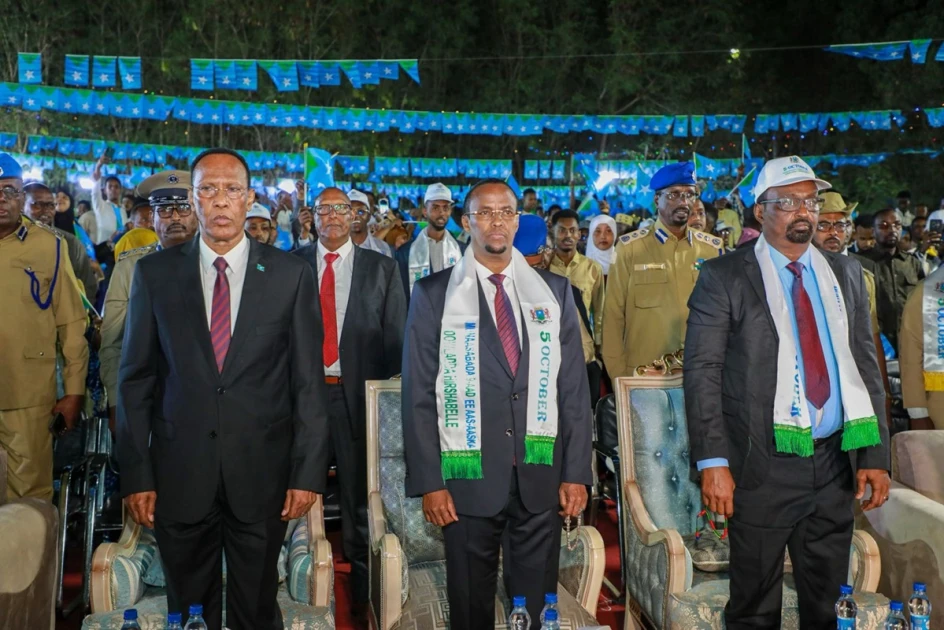
Ali Ghedi, former PM Somalia (left) and current Hirshabelle president at a past event. Photo / Courtesy

Audio By Vocalize
In the often-turbulent landscape of Somali politics, meaningful progress can be difficult to discern. Yet in Hirshabelle State, a quieter transformation is underway, one anchored in the steady development of essential amenities.
Since taking office in late 2020, President Ali Guudlaawe
Hussein has increasingly been associated with practical, on-the-ground
improvements that are beginning to reshape everyday life.
Across both regions that make up Hirshabelle, the
construction of schools has emerged as a defining feature of this
administration. In communities where access to education has long been limited,
these projects represent more than infrastructure, they signal opportunity and
long-term social investment. Schools, in this context, are not just public
works; they are a foundation for stability and growth.
The focus on amenities extends beyond education. In Jowhar,
the refurbishment and rebuilding of government offices have helped restore
institutional presence. Functional public offices are critical in fragile
settings, enabling service delivery and reinforcing public confidence in
governance. Such developments may appear modest, but they are essential
building blocks for a functioning state.
This progress has been reinforced by close cooperation with
Somalia’s federal leadership under President Hassan Sheikh Mohamud. In a
federal system where alignment between regional and national governments can
determine success or failure, this partnership has helped sustain development
momentum.
For Kenyan observers, Hirshabelle’s trajectory echoes
familiar lessons from devolution: continuity in leadership often determines
whether projects are completed or abandoned.
Political analyst Abdi Abdalla argues that development is
cumulative, noting that frequent leadership changes tend to stall progress and
reset priorities. Keeping leaders in office, he suggests, allows citizens to
hold them accountable for results rather than promises.
Security gains have also played a supporting role. Efforts
to push back extremist groups have created space for development initiatives to
take root, highlighting the link between stability and service delivery.
As Hirshabelle approaches its July 2026 elections, overseen
by the National Independent Electoral and Boundaries Commission, there is
growing focus on a proposed “one person, one vote” system. This shift could
deepen public participation and strengthen the legitimacy of future
administrations.
Ultimately, Hirshabelle’s story is not about sweeping
change, but about steady, incremental progress. For a region long defined by
instability, that alone marks a significant step forward.
Join the Discussion
Share your perspective with the Citizen Digital community.
No comments yet
This discussion is waiting for your voice. Be the first to share your thoughts!