
Where did the hair go? Tracing the receding hairlines leaving women with 'prominent foreheads'
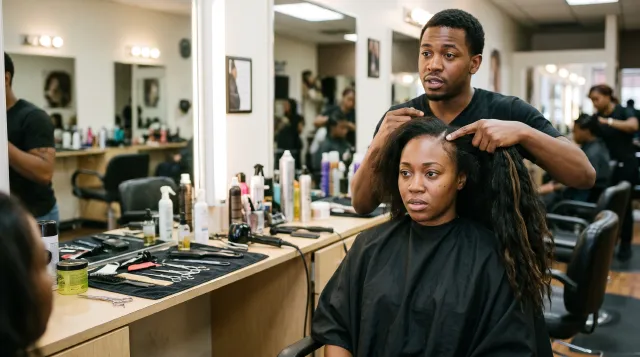
An AI-generated image depicts a woman concerned about her receding hairline.

Audio By Vocalize
But a receding hairline makes many women ask themselves where their hair went. Not only a search for a once-defined hairline, but also to shade off "prominent forehead" comments.
What begins as a few strands falling out or hair becoming noticeably thinner can gradually develop into visible patches, particularly around the forehead. Worse, a receding hairline that only gives prominence to one's ears.
For some women, the problem is associated with hairstyles that place excessive tension on the hair roots, while others experience hair loss during significant hormonal changes, including pregnancy and breastfeeding.
Terry Karanja says she first realised she was losing her hairline when she wanted to have cornrows done at the salon but discovered she no longer had enough hair around the front to comfortably achieve the style.
“I wanted to do cornrows and realised I could not because I did not have a hairline. That is when the salonist advised me not to do them, and I started noticing that I had lost my hairline,” she said.
Terry had previously worn artificial locks and later switched to knotless braids, but believes the styles contributed significantly to the loss of hair around her forehead.
She observes that during retouching, hair at the front is often pulled as stylists work on the extensions, while keeping braids for too long can also contribute to breakage.
“Especially with artificial locks, during retouching, the stylist mostly pulls your hair from the front. That is when you realise you are losing your hairline. Even with knotless braids, when you keep them for longer than three weeks or a month, you realise the hair in front is breaking,” she said.
Fiona also traces her hairline changes back to her primary school years, although she cannot point to the exact cause. She says she initially kept her hair open for extended periods before she began wearing braids and other styles.
She believes hairstyles may have contributed to the changes, especially when hair is held too tightly. Despite the thinning, Fiona says it has not affected how she views herself.
“If you have tight hair, tight braids, and you hold your hair too tightly, it can contribute to hair loss. But it has not affected my confidence. I still believe I am beautiful and wonderfully made despite having a reduced hairline,” she said.
However, restoring her hairline has not been something she has actively pursued, although she has been advised to oil and massage her scalp.
For Esther Kamau, the changes became noticeable when she began wearing hairstyles involving additional extensions, particularly braids with extensions that placed pressure on the hair around the front.
She says some of the hairstyles she previously wore left her hairline visibly damaged, with the additional braiding extensions contributing to the problem.
She has since tried using natural remedies, including avocado, eggs and aloe vera, in an attempt to restore some of the lost hair. She says she noticed gradual improvement over time.
For hairstylists, complaints about thinning edges and hair breakage are not unusual.
Hadassah Peter, a hair stylist in Nairobi, has encountered clients whose hair has broken after having tightly done braids and other hairstyles that place pressure on the hair.
She recalls one client who complained about hair breakage after having cornrows. Rather than repeating the same styling technique, Hadassah opted to work with the client's natural hair first, incorporating it between the braids to reduce the tension.
“When she came back the next time, her hair had improved. It was no longer breaking the way it had before,” she says.
Hadassah also cautions against hairstyles that require excessive pulling, adding that frequent straightening and the use of too much heat can contribute to hair damage.
She advises women to pay attention to the condition of their hair and consider more natural styles, using suitable oils and products.
Mariam Abdul, a hairstylist, says tight braids, chemical relaxers, frequent straightening and weaves are among the practices she has noticed contributing to hair breakage among some clients.
She says the condition of a client's hair is something she considers before settling on a hairstyle, especially when the edges appear weak, or the client complains of pain, itching or discomfort during styling.
“Some people's hair is very weak and breaks easily, so we look at their edges and plan the hairstyle in a way that does not damage their hair. When someone complains of pain or itching, that is also something I pay attention to,” Mariam said.
She advises women experiencing thinning edges to give their hair a break, avoid overly tight hairstyles and reduce the frequent use of chemicals and heat.
Mariam says women do not necessarily have to endure painful hairstyles for them to look neat, adding that changing styles and allowing the hair to rest can help reduce unnecessary tension.
While hairstyles are among the concerns raised by women experiencing hair loss, some say the changes began after giving birth.
Mama Kamau, a mother of two who is expecting another child, says she began experiencing hair breakage after having children, particularly during the breastfeeding period.
She says the changes were significant enough to prompt her to try different remedies in an attempt to restore her hair.
“I started experiencing hair breakage after having my children. It happened when I was breastfeeding,” she recalls.
In an effort to restore her hair, she turned to natural remedies, including avocado and eggs, which she applied to her hair.
Although the remedies did not produce immediate results, she eventually noticed gradual improvement.
“It took some time before my hair started growing back. It was a gradual process,” she says.
However, changing hairstyles and adopting gentler hair-care routines may help reduce preventable breakage; persistent or excessive hair loss should not automatically be attributed to styling practices or childbirth.
Seeking medical advice from a hair clinician can help establish the underlying cause.
Healthy hair is therefore not just about the hairstyle one chooses to wear, but also about how well she cares for the hair.
Join the Discussion
Share your perspective with the Citizen Digital community.
No comments yet
This discussion is waiting for your voice. Be the first to share your thoughts!