
What's in an outfit? Police take on new clothes, again, as other reforms remain hanging
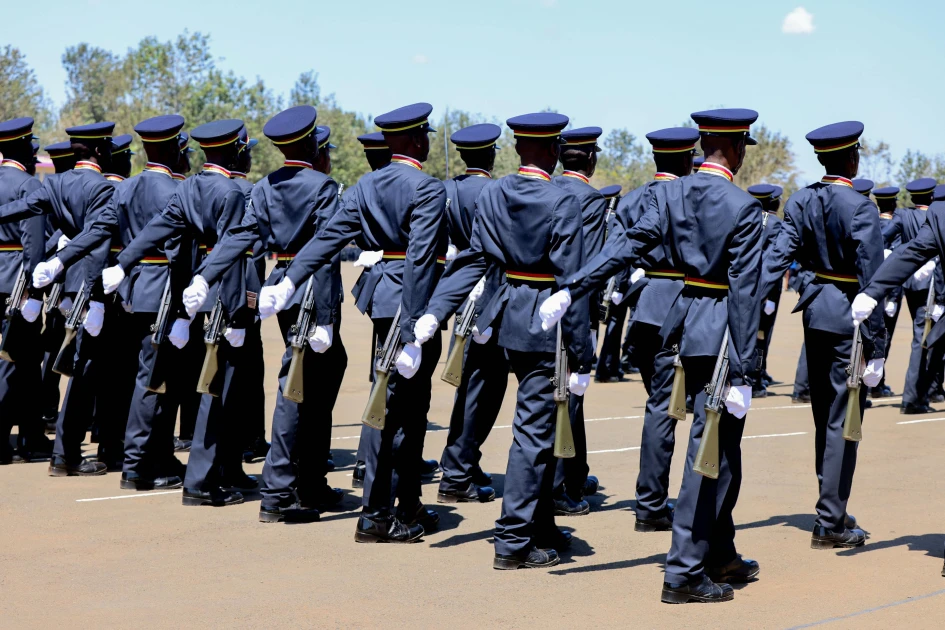
Inspector General of Police Douglas Kanja on August 25, 2026, presided over the recruits' full-dress rehearsal parade at the National Police College, Main Campus, in Kiganjo. Photo: NPS

Audio By Vocalize
Inspector General Douglas Kanja has confirmed that General Duty officers in the Kenya Police Service (KPS) will begin wearing the outfit from Monday, August 31, with more than 6,000 graduating constables the first to wear it at their pass-out parade. The change, Kanja says, will be "a force multiplier in terms of morale boosting for our officers."
It is a familiar script. This is at least the third significant overhaul of the general-duty police uniform in under a decade, and the pattern raises an uncomfortable question. Why is it so much easier for the Kenyan state to change what its police officers wear than to change what they do?
The 2018 reform
In 2018, President Uhuru Kenyatta's administration rolled out an all-blue uniform as part of a wider set of reforms recommended by a police task force, timed to coincide with the merger of the Kenya Police and the Administration Police into a single National Police Service (NPS).
The stated aim was to improve visibility and create uniformity across the newly merged ranks.
That uniform did not last. In February 2023, then-Inspector General Japhet Koome introduced a redesigned hybrid outfit, a light-blue shirt paired with navy-blue trousers, which was later put through a public participation exercise later that year.
According to the NPS, officers who took part in that exercise largely rejected the navy-blue look and expressed a preference for reverting to an earlier design.
It is that 2023 feedback that the NPS says it is now finally acting on, three years later, with Friday's unveiling described by officials as fulfilling President Ruto's pre-election pledge to introduce a more "modest" police uniform.
So, within roughly eight years, Kenyans have watched their police force change its general-duty uniform three times, in 2018, 2023, and now 2026, each time accompanied by talk of morale, visibility, modesty or public preference.
Where the real reform report sits
The contrast becomes sharper when set against what has not moved.
On August 18, 2026, retired Chief Justice David Maraga, who chaired the National Taskforce on Police Reforms, wrote to President Ruto giving him seven days to release the taskforce's complete, unedited report or he would publish it himself.
The taskforce submitted that report to the President on November 16, 2023, the same year the current uniform's replacement process began.
Nearly three years later, its recommendations, which Maraga says include measures to restore the constitutional independence of the National Police Service and address systemic brutality and impunity, remain unpublished and unimplemented.
Maraga's letter did not mince words. He accused the administration of "organized political violence, goonism and partisan policing" in places including Homa Bay, Keumbu and Ol Kalou, and of violence linked to churches in Kisumu, Nairobi and Witima, incidents he characterized as evidence of what he called the "State Capture of the National Police Service."
He argued that under Articles 232, 239, 244 and 245 of the Constitution and the National Police Service Act, the NPS is meant to be an independent security organ answerable to no individual, the President included, and warned that Kenya risked repeating "a road the country has travelled before at terrible cost."
Set against that backdrop, the uniform unveiling scheduled for the same week Maraga's ultimatum was working its way through the news cycle is difficult to read as coincidence-free.
A new shirt and a new pair of trousers are visible, photographable, and popular with officers who might have genuine grievances about comfort and practicality.
A taskforce report on command independence and accountability is none of those things, it is slow, structural, and politically inconvenient to the executive it constrains.
A pattern beyond shirt and trousers
The uniform is not the only piece of police "reform" that keeps circling back to cloth rather than conduct.
Since April 2024, the National Assembly's Administration and Security Committee has been sitting on the Bribery Amendment Bill, sponsored by Bomachoge Borabu MP Obadiah Barongo, which would insert a new section into the Bribery Act to tackle bribery among traffic police officers.
Its headline proposal is almost theatrical in its literalism: strip the pockets out of traffic police uniforms so officers have nowhere to stash a bribe, and install CCTV cameras at designated traffic zones to create a visual record of every interaction between officers and the public.
The Parliamentary Budget Office has estimated the camera rollout alone would cost around KSh.8 billion.
More than two years on, the Bill has not progressed beyond committee consideration. It is, in its own way, a mirror of the uniform saga: a proposal that treats corruption as a design flaw in the fabric rather than a function of impunity, weak internal discipline and a chain of command that answers more readily to political convenience than to the law — and even that modest, garment-focused fix has struggled to move.
The Gachagua precedent
There is also a more pointed irony buried in Kenya's recent political history. Back in 2022, campaigning as William Ruto's running mate, Rigathi Gachagua stood before a rally in Nyandarua County and tore into then-Interior Cabinet Secretary Fred Matiang'i and his Principal Secretary Karanja Kibicho, accusing them of mistreating rank-and-file police officers.
A Kenya Kwanza government, he promised, would restore dignity to the service.
Gachagua got his chance. He served as Deputy President from September 2022 until his impeachment in October 2024, on charges that included corruption and fanning ethnic division. Since then, he has become one of the National Police Service's fiercest critics, not for how officers are treated internally, but for how they are allegedly deployed.
In late 2025, Gachagua accused Kanja's officers of providing "tactical cover" and "back-up" to armed goons disrupting his political rallies and church events, language that echoes almost exactly the "state capture" accusation Maraga would level at the same administration months later.
The through-line is hard to miss: a politician who once promised dignity for the police, from the outside now accuses the same institution, under a different flag but the same command structure, of being weaponized against citizens and rivals alike.
It seems uniforms are the easiest things to change because of the pecuniary benefits that are attached to the procurement of such goods even as the underlying complaint about political control of the force has not.
Uniform as a tool of control
The uniform has never been a neutral piece of cloth in Kenyan policing.
Under colonial rule, dress was deliberately used as an instrument of racial hierarchy within the force. African constables were kitted out in uniforms, often shorts, puttees and simple tunics, designed to visually mark them as subordinate to their European superiors and to the King's African Rifles-style command structure above them.
The uniform was not primarily about function; it was about rank in a racial order, a daily, visible reminder to both the officer and the public of where an African policeman stood in the colonial hierarchy.
That is why one of the earliest acts of the independent Kenyan government was to strip that symbolism away by issuing a single, common uniform across the force, collapsing the old distinctions and, at least on paper, declaring that all officers, regardless of race, wore the same cloth and answered to the same rules.
It was a genuinely important reform, because it attacked the visible architecture of an unequal system.
Six decades on, uniform changes have become something else entirely: a recurring, made-for-view reform that costs the taxpayer money and generates headlines, while the underlying architecture of the police service, its independence, its accountability mechanisms, its relationship with political power, among others remains largely untouched.
Symbols not enough
None of this is to say uniforms do not matter. The post-independence unification of police dress in Kenya mattered precisely because it dismantled a visible marker of a discriminatory system, and officers' comfort and the removable-name-tag problem, which the 2023 exercise also flagged as a way rogue officers evaded identification are legitimate operational concerns.
But the pattern of the last decade suggests a government that has become fluent in delivering cheap reforms that are visible and applause-generating, while the reforms that would actually rebalance power between the police service and the presidency stay locked in a drawer.
Is a change of police uniforms the single police item that Kenyans desire to see first among other police restructuring activities?
Meanwhile, the Bill to remove the pockets from officers' trousers has taken more than two years in committee. Kenyans are still waiting to see the report that might tell them why the men and women wearing those uniforms keep ending up on the wrong side of accountability.
Join the Discussion
Share your perspective with the Citizen Digital community.
No comments yet
This discussion is waiting for your voice. Be the first to share your thoughts!