
What could be done to contain Kenya’s fuel crisis amid limping G-to-G deal
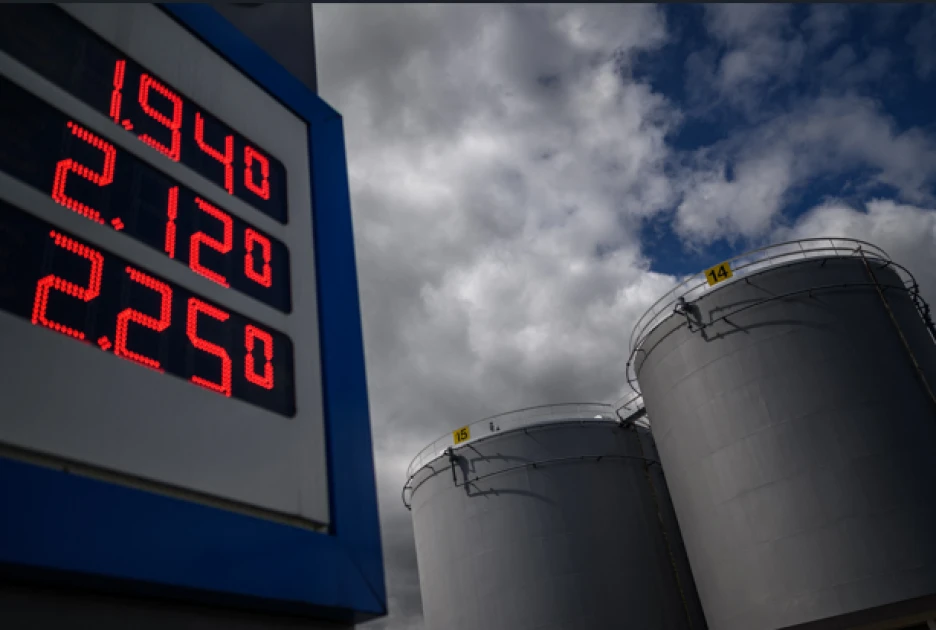
This photograph shows the prices per litre of petrol and diesel fuels at a petrol station next to gasoline and fuel tanks in Geneva on March 31, 2026. Photo by FABRICE COFFRINI / AFP

Audio By Vocalize
Each 14th Day of the month since March 28, 2019, without fail, EPRA, in line with its legal mandate, has always announced the fuel prices effective for the following thirty days.
This time, the source of apprehension was the spiralling cost of global oil prices since the start of the Iran-Israel-US war.
Economically, the war was taking no prisoners, and the cost of oil globally has been high with no respite in sight. Last month, on March 14, Kenyans escaped by a whisker as the stocks in the country landed before the war, which broke out on February 28, when the US and Israel attacked Iran.
EPRA undertook its monthly ritual late in the evening of April 14, and all hell broke loose. Pump prices jumped by a record Ksh.40 from midnight on April 15, with diesel rising by Ksh.40.30 per liter to retail at KES206.84 in Nairobi, while petrol climbed by Ksh.28.69 to Ksh.206.97.
This was later revised on the night of April 15, after EPRA made an addendum following a directive by the National Treasury to cut VAT on petroleum products from 13 per cent to 8 per cent.
This revision would see the price per litre of Super Petrol and Diesel decrease by Ksh.9.37 and Ksh.10.21, respectively, while that of Kerosene remained unchanged.
For millions of households already battered by a high cost of living, the increase, the steepest in recent memory, has reignited a fierce debate about how Kenya procures its fuel, and who, if anyone, is looking out for the ordinary consumer.
The timing could not be worse. The average landed cost of diesel rose by over 68 per cent to $1,073.2 per cubic meter in March 2026, while petrol and kerosene rose sharply as well. These are undeniable global headwinds.
But the crisis has also exposed deep, home-grown vulnerabilities in Kenya's energy supply chain, and raised serious questions about the flagship Government-to-Government (G-to-G) fuel procurement deal that was supposed to be the answer.
The G-to-G Promise and Its Limits
In 2023 President William Ruto's Kenya Kwanza administration entered into the G-to-G agreement with Aramco Trading Fujairah FZE, ADNOC Global Trading Limited, and Emirates National Oil Company (Singapore) Private Limited, government fully owned firms from the Gulf.
Strangely, Kenya did not present its fully owned companies such as National Oil (K) Limited or The Kenya Pipeline Company, which until a month ago was fully government owned, to act on its behalf; instead, and curiously the following firms were chosen; Energies Limited, Gulf Energy Limited, Oryx Energies, Be Energy, One Petroleum Limited and Asharami Synergy.
Not a single share in these firms is government-owned. It then begs how the contact was a G-to-G deal.
This was the arrangement sold to Kenyans as a breakthrough, a direct government-to-government channel that would cut out middlemen, stabilize supply, and shield consumers from the worst of global price volatility.
It came as a shocker when two of the firms within the Kenyan consortium brought in petroleum last month at the behest of top government officials, only to cause an uproar over quality and cost aspects, a matter which saw the managing directors at Kenya Pipeline, EPRA, and Principal Secretary for Energy lose their jobs.
The oil shipped into Kenya, out of the said G-to-G framework, has been ordered withdrawn and re-shipped wherever! Meanwhile, one of Kenya’s trading partners from the Gulf, Aramco Trading Fujairah, yesterday released a notice to Kenya stating that it will increase its oil pricing, effective shipments from 26th April 2026.
The impending further increase has raised concerns about intensified pressure on consumer spending and the overall cost of living for those living in the country.
However, it was not all lost with the G-to-G, because the arrangement allowed Kenya to secure forward contracts for petroleum supplies at pre-negotiated terms, insulating the country from the volatility of spot market pricing and offering greater supply certainty than open-market procurement. But the framework appears to have never been designed to be a price-reduction mechanism.
It seems to be a supply stability mechanism, but even so, under the prevailing circumstances, supply is shaky. That structural limitation is now glaringly apparent.
As pointed out by Kiharu Member of Parliament Ndindi Nyoro, when global crude prices were higher in 2022 at around $115 per barrel, yet are currently lower at around $98, Kenyans are paying more now as compared to regional markets.
The comparison stings. Compared to Tanzania and Uganda, Kenyan motorists now pay significantly more, deepening the strain on households already grappling with a high cost of living.
A Scandal That Shook the Sector
Beyond the structural flaws, the G-to-G framework has been rocked by a corruption scandal that has further eroded public trust.
The government unveiled details of an alleged scheme involving three senior energy sector officials accused of fabricating a fuel shortage to justify an irregular and costly import deal.
Head of Public Service Felix Koskei said investigations point to the involvement of former Principal Secretary for Petroleum Mohamed Liban, Kenya Pipeline Company Managing Director Joe Sang, and EPRA Director General Daniel Kiptoo Bargoria.
Koskei said that, as primary duty bearers responsible for administering the petroleum supply chain, they may have manipulated data on in-country fuel stocks, explicitly to exploit rising global prices and public anxiety, and thereby creating a false impression of an impending supply shortfall. All three officials resigned following their arrests.
The International Monetary Fund (IMF) and National Treasury have previously found that the G-to-G framework distorted market competition, concentrating procurement among the three largest oil marketing companies chosen on a liquidity basis, and giving five major banks outsized influence over dollar allocation.
Defense, Subsidies, and Tax Cuts… But Questions Remain
President Ruto’s response to the unfolding soft belly of the G-to-G arrangement has been defiance. Speaking during a tour of the Gusii region this week, Ruto claimed the G-to-G arrangement has made Kenya a more competitive fuel destination and ensured adequate supply.
He further said that the government has used Ksh.6.2 billion to subsidize fuel costs and reduced VAT to 8% to moderate pump prices.
But the President’s announcement that there’s an 8 per cent VAT reduction on fuel for the next three months has occasioned direct legal scrutiny, which states that, in all non-zero-rated cases, “the rate of tax shall be sixteen per cent of the taxable value of the taxable supply,” hence the measure might not grant an immediate relief. The Value Added Tax Act constrains the lowering of VAT to 8 per cent. Section 6(1) allows a limited variance, providing that the Cabinet Secretary for Treasury may, through Gazette notice, amend the rate “by an amount not exceeding twenty-five per cent of the rate specified in section 5(2)(b).” In practical terms, a downward adjustment from 16 per cent is 12 per cent.
A reduction to 8 per cent, therefore, fell outside the statutory requirement and cannot be affected through a Cabinet Secretary order or presidential directive.
The National Assembly would later, on April 16, give legality to the presidential proclamation by passing the VAT (Amendment Bill) 2026, giving a nod to the 8% VAT reduction.
How can Kenya be insulated from such shocks?
The fuel crisis has catalyzed a broader conversation about what Kenya needs to do structurally to insulate itself from recurring price shocks.
Industry experts and policymakers are pointing to several possible interventions.
1. Building Strategic Petroleum Reserves
Perhaps the most consequential long-term reform on the table is the establishment of a strategic petroleum reserve.
Kenya's near-total reliance on imported petroleum products, combined with the absence of a formal strategic reserve system, is a central structural weakness. Energy experts warn that even minor disruptions can escalate into a national supply crisis.
Energy CS Opiyo Wandayi confirmed before a parliamentary committee that the government is working on a strategy to set up sustainable fuel reserves, as he acknowledged that currently, Kenya relies on a just-in-time supply system, consuming fuel essentially as it arrives.
The government relies on Oil Marketing Companies to hold stocks sufficient to cover only 15 days of national demand, a buffer that is dangerously thin in a scenario where vessel movements through key shipping routes have been disrupted for weeks.
The proposed approach would involve public-private partnerships, where private companies would help finance, build, and operate storage facilities, while part of the capacity would be reserved for national use during crises.
2. Diversifying Supply Sources
As has now been proven, concentration risk is a core vulnerability in Kenya. Kenya's suppliers under the G-to-G deal are all Gulf-based, meaning any disruption in the Middle East hits Kenya directly.
Analysts argue the country must actively pursue supply agreements with alternative producers, including African oil producers such as Angola, Nigeria, and, hopefully, Uganda, to reduce over-dependence on a single recognized geopolitical hotspot.
3. Reforming Pricing and Tax Structure
The ever-engaged political opposition in the country has called for the suspension of key levies such as the Road Maintenance Levy and the removal of VAT on fuel products altogether.
More targeted proposals have come from MPs like Ndindi Nyoro, who has suggested fuel tax cuts, levy removal, and a Ksh.5 billion subsidy boost to reduce fuel prices by a meaningful margin.
Energy economists advocate for a more nuanced approach: to have targeted subsidies for essential transport rather than universal price controls, combined with strategic reserve utilization to buffer temporary supply disruptions and tax policy adjustments during crises. The current system, which applies blanket subsidies, is fiscally expensive and poorly targeted.
4. Renewable Energy Transition
Kenya's fuel dependency is a structural economic vulnerability that renewable energy can help address in the long run. The current fuel crisis conditions accelerate the strategic case for renewable energy adoption as a method to reduce petroleum import dependency. While transportation fuel substitution requires significant infrastructure development, partial electrification could reduce vulnerability to global oil market volatility. Kenya's abundant geothermal, solar, and wind resources provide a credible foundation for this transition.
5. Transparency and Accountability in Procurement
Perhaps most urgently, the government must clean up the procurement pipeline. Government investigators into the G-to-G suspect fuel stock data was manipulated to create an artificial shortage, hence the justification for the emergency imports at inflated prices and potentially allowing certain players to profit from a crisis narrative.
Without robust oversight, any procurement model within the G-to-G will remain susceptible to capture by vested interests. Parliamentary oversight must be strengthened, and audit findings must be made public in a timely manner.
The Road Ahead
The sharp rise in fuel costs is expected to stoke inflationary pressures and raise the cost of living as manufacturers, service providers, and electricity generators pass on higher fuel costs to consumers. The pain is already being felt across the transport sector.
The Kenya Transporters Association warned that the increase will directly affect the cost of transport throughout the nation, projecting a 13 to 14 per cent increase in total transportation operating costs.
For ordinary Kenyans, the matatu passenger, the small business owner, the urban household, the promise of the G-to-G deal as a shield against global shocks has rung hollow.
The arrangement may have provided supply continuity, but it has not delivered affordability. And as long as structural weaknesses persist, thin reserves, opaque procurement, heavy taxation, and a supply chain susceptible to cartel behavior, no single policy fix will suffice.
What Kenya needs is not a silver bullet, but a coherent, multi-pronged energy security strategy: one that builds physical reserves, diversifies supply, cleans up governance, rationalizes taxation, and charts a credible path towards reducing oil dependency altogether.
The fuel crisis of April 2026 is painful. But it would be a greater tragedy still if the country fails to use it as the impetus for the reform it has long needed.
Join the Discussion
Share your perspective with the Citizen Digital community.
No comments yet
This discussion is waiting for your voice. Be the first to share your thoughts!