
US surgeon general urges cancer warnings for alcoholic drinks
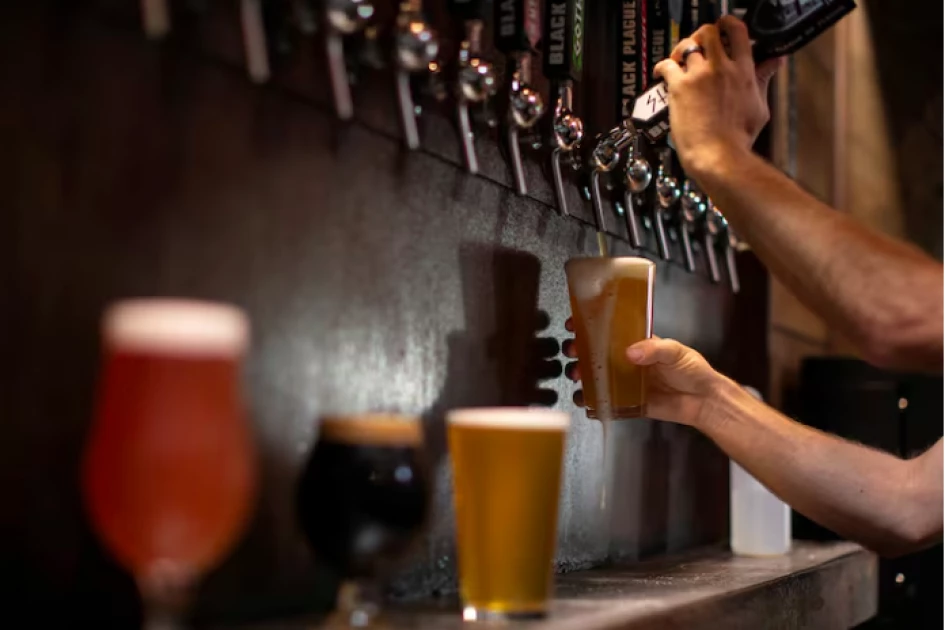
Beer is poured from a tap at a brewery in Oceanside, California, U.S., October 15, 2020. REUTERS/Mike Blake/File Photo

Audio By Vocalize
Alcoholic drinks should carry a warning about cancer risks on
their label, the U.S. Surgeon General said on Friday in a move that could
signal a shift toward more aggressive tobacco-style regulation for the sector
if adopted.
U.S. Surgeon General Vivek Murthy said alcohol consumption
increases the risk of at least seven types of cancer, including breast,
colon and liver cancer, but most consumers remain unaware of this.
Murthy also called for the guidelines on alcohol consumption
limits to be reassessed so that people can weigh the cancer risk when
deciding whether or how much to drink. U.S. dietary guidelines currently
recommend two or fewer drinks per day for men and one drink or less per day for
women.
"Alcohol consumption is the third leading preventable
cause of cancer in the United States, after tobacco and obesity," Murthy's
office said in a statement accompanying the new report, adding the type of
alcohol consumed does not matter.
His advisory sent shares in alcohol
companies including Diageo, Pernod Ricard, Anheuser-Busch InBev, and
Heineken, in some cases over 3%.
The Distilled Spirits Council of the United States (DISCUS),
which represents top spirits makers, pointed to a new report, by the
National Academies of Sciences, Engineering and Medicine showing that moderate
alcohol consumption is associated with lower rates of death from any causes, as
well as higher risk of breast cancer.
"The current health warning on alcohol products has long
informed consumers about the potential risks of the consumption of
alcohol," the group's vice president for science, Amanda Burger, said in a
statement, adding that no one should drink for health benefits.
It is unclear when or if the Surgeon General's
suggestions will be adopted. U.S. President Joe Biden's administration is
ending. Murthy could be succeeded by Janette Nesheiwat, a director of
a New York chain of urgent care clinics and president-elect Donald Trump's
pick for the role.
Trump, whose brother died from alcoholism and who does not
drink himself, has long warned about the risks of alcohol. Robert F. Kennedy
Jr., Trump's nominee for Secretary of Health and Human Services, has been open
about his past struggles with heroin and alcohol, and says he attends
Alcoholics Anonymous meetings.
The decision to update labels will ultimately be made by
Congress.
Murthy's advisory harks back to early U.S. Surgeon General
action on tobacco, starting with a 1964 report that concluded smoking could
cause cancer. The report kicked off decades of increasingly strict regulations,
starting with U.S. laws on warning labels one year later and still ongoing
today.
Alcoholic drinks in the U.S. already carry warnings on
packaging, including that drinking alcohol while pregnant can cause birth
defects and impair judgment when operating machinery. These appear in small
print on the back of the packaging. This label has not changed since its
inception in 1988.
Murthy's recommendations call for an update to existing
labels, rather than new cigarette-style warnings that are displayed prominently
on every packet.
Analysts, however, say cigarette warning labels did little to
curb smoking and ingrained habits are hard to change.
"Warning labels won't be an immediate deathblow to
alcohol makers, but it will compound the long-term threats to the
industry," said Blake Droesch, analyst with eMarketer.
In the U.S., among the largest markets for many western
producers, alcohol sales have been falling following a post-pandemic boom.
Revenues are further threatened by looming tariffs. Longer-term, companies
face competition from alternatives like cannabis and the threat of lower
volumes as some consumers, especially younger ones, drink less than
previous generations in some markets.
Beer makers, however, have enjoyed benefits from a shift
towards healthier lifestyles, with low- or no-alcohol products
enjoying rapid growth. Heineken's 0.0 version, for example, grew double
digits in 16 markets last year.
Public health bodies like the World Health Organization are
also increasingly turning their attentiontoward alcohol after making
progress on stronger tobacco controls.
The WHO says there is no safe level of drinking and that even
a small amount of alcohol can harm health - a position that has prompted tense
debate around the impact of moderate drinking and its role in society.
The Mayo Clinic says the health risk is low for moderate
intake, opens new tab and rises with the amount consumed. The Surgeon
General report says higher consumption raises risks and imbibing two drinks a
day would result in about five more women out of 100 developing cancer and
three more men out of 100.
Current U.S. dietary guidelines run until 2025, and companies
including Diageo and Heineken have lobbied officials ahead of the change,
lobbying records show, amid concerns the U.S. could adopt the WHO's language
around safe consumption.
Other countries' guidelines already include such
language, while nations like Ireland have already moved to introduce warning
labels.
Some scientists accused the industry of misleading
people about the risks of developing cancer from drinking in a 2017 study.
DISCUS said the researchers had anti-alcohol biases and their study was
selective.
The Surgeon General's advisory said alcohol is responsible for
100,000 U.S. cancer cases and 20,000 cancer deaths each year, and more than the
13,500 alcohol-associated traffic crash deaths.
Join the Discussion
Share your perspective with the Citizen Digital community.
No comments yet
This discussion is waiting for your voice. Be the first to share your thoughts!