
UN warns foreign weapons, drones fuelling civilian deaths in Sudan
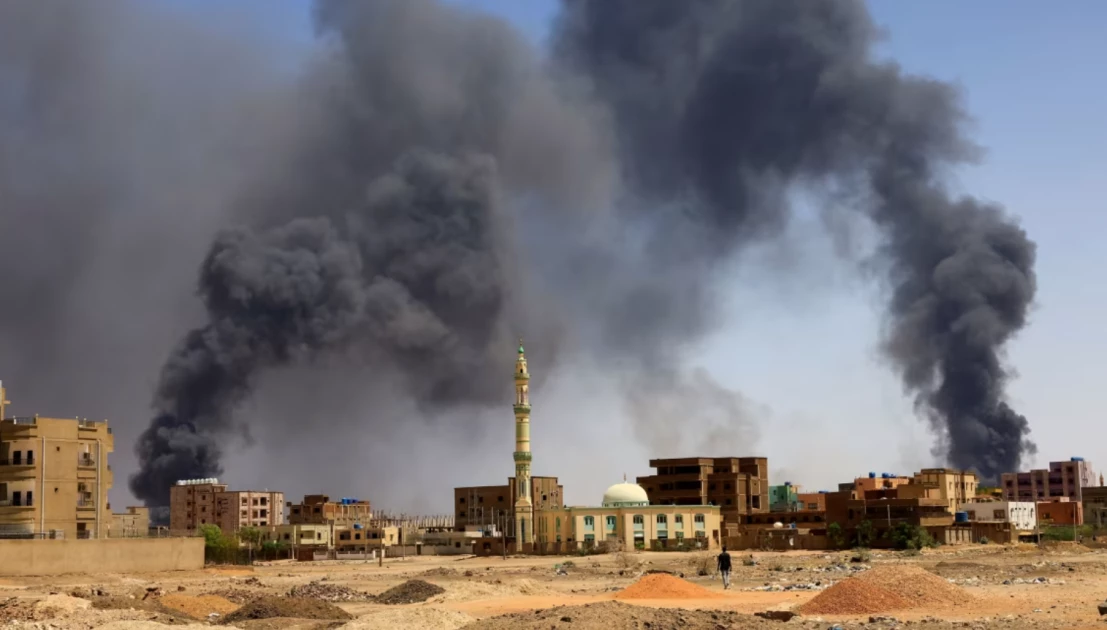
A man walks while smoke rises above buildings after aerial bombardment, during clashes between the paramilitary Rapid Support Forces and the army in Khartoum North, Sudan, May 1, 2023. Mohamed Nureldin Abdallah/Reuters

Audio By Vocalize
The number of civilian casualties in Sudan continues to rise as the use of warplanes and attack drones expands, amid international warnings that the flow of foreign weapons and military technology to the Sudanese army and its allied forces is contributing to the continuation of military operations and the escalation of violations.
Human rights and UN reports reveal that airstrikes have become
one of the most prominent threats to civilians after attacks spread to markets,
residential neighborhoods and vital facilities across large areas of Darfur,
Kordofan and Blue Nile.
The escalation comes as the Sudanese army continues to receive
foreign military equipment, particularly Turkish and Iranian drones, alongside
the political and military support it receives from regional powers, foremost
among them Saudi Arabia and Egypt.
In the latest UN investigation into the Sudanese war, the UN
Independent International Fact-Finding Mission for the Sudan revealed that
drone strikes killed more than 1,000 people during the first five months of
2026.
The report, issued last September, warned that foreign
weapons, military technology and external support networks had become key
factors in sustaining the war, which is witnessing grave violations of
international humanitarian law.
Investigations indicate widespread use of drones in operations
that have resulted in civilian casualties, while the Sudanese army’s reliance
on advanced aerial systems has raised growing concerns over strikes targeting
populated areas.
Human rights organizations, including Human Rights Watch, have
documented airstrikes carried out by the Sudanese army against civilian areas in
Darfur, including the city of Nyala, amid allegations that weapons failing to
distinguish between military and civilian targets were used.
The city of El Fasher stands as one of the most prominent
testaments to the humanitarian tragedy left by the war. After a prolonged
siege, the Rapid Support Forces seized control of the city in October 2025.
More recently, the city has come under near-daily aerial
bombardment targeting markets, residential neighborhoods and facilities, with
the Sudanese army at times using barrel bombs dropped indiscriminately from
military transport aircraft.
The fighting in Darfur has coincided with an escalation in the
use of warplanes and drones across multiple parts of the region, as human
rights organizations have documented strikes carried out by the Sudanese army
that hit populated areas.
Other parts of Sudan have also witnessed air attacks involving
conventional warplanes and drones, amid allegations that unguided munitions were
used in civilian areas.
These attacks raise concerns over compliance with
international humanitarian law, which prohibits targeting civilians and
civilian objects and requires parties to a conflict to take the necessary
precautions to avoid causing disproportionate harm to civilians.
Calls are growing for independent investigations into the
airstrikes, including determining the types of munitions used and the parties
responsible for ordering and carrying them out.
The violations are taking place as the Sudanese army continues
to obtain advanced military systems from foreign sources. International reports
have revealed the army’s use of Turkish Bayraktar TB2 drones, alongside Iranian
Mohajer-6 drones, while other reports have spoken of the arrival of more
advanced Turkish systems.
Egypt also figures among the countries maintaining close
military ties with the Sudanese army leadership, after Reuters revealed last
February that Akıncı drones had been deployed near the Sudanese border.
As for Saudi Arabia, it continues to provide financial and
military support to the army leadership, although media reports said it had
backed away from financing a $1.5 billion Pakistani arms deal intended for
Sudanese forces.
These relationships raise questions over the extent to which
external support affects the Sudanese army’s ability to continue its air
operations, particularly as reports of civilian casualties from airstrikes
continue to mount.
The military landscape is becoming increasingly complex with
the participation of irregular armed formations alongside the Sudanese army,
including the al-Baraa ibn Malik Brigades and groups linked to Sudan’s Islamist
movement.
Some of these formations face allegations of committing
violations against civilians, while the nature of their links to the military
establishment raises questions over military command responsibility for the
operations they carry out.
Human rights advocates warn that the proliferation of armed
militias and the multiplication of command centers increase the incidence of
violations and complicate efforts to establish responsibility and hold
perpetrators accountable.
The continued provision of military support to the army,
without sufficient oversight of the entities receiving weapons and equipment,
also raises concerns that some of these resources could pass into the hands of
extremist armed formations.
The impact of the war has not been confined to residential
areas but has extended to humanitarian supply routes and convoys carrying food
and medicine.
On October 7, reports said that a driver was killed in a
strike targeting trucks belonging to the World Food Programme in South
Kordofan, despite the vehicles carrying markings indicating their humanitarian
nature.
Other areas have also witnessed attacks on civilian facilities
and residential neighborhoods, while ethnic violations continue in Khartoum and
areas under the control of the Sudanese army.
These developments come as millions of Sudanese suffer from
food insecurity, forced displacement and the collapse of basic services.
Humanitarian organizations warn that continued attacks on
supply routes threaten to deprive entire communities of essential assistance
needed for survival.
The escalating violations in Sudan are placing arms networks
and foreign military support under mounting legal and ethical scrutiny.
As civilians continue to be killed in airstrikes, calls are
growing for international investigations that go beyond identifying those
directly responsible for the attacks and also examine the parties providing the
weapons and military technology used in them, where evidence exists of their
contribution to violations.
International humanitarian law emphasizes the need to
distinguish between military and civilian targets and prohibits indiscriminate
and disproportionate attacks, regardless of the party carrying them out or the
entity providing it with support.
As the war continues, there is an increasing need for more
effective international measures to prevent weapons from reaching entities
where there are serious grounds to believe they will use them to commit grave
violations.
The continued flow of weapons into Sudan, without effective oversight and accountability, not only threatens to prolong the war but also increases the likelihood of further civilian deaths and of new cities becoming arenas of destruction and displacement.
Join the Discussion
Share your perspective with the Citizen Digital community.
No comments yet
This discussion is waiting for your voice. Be the first to share your thoughts!