
UN report puts Crawford Oil levy at 0.3%, not 0.03%
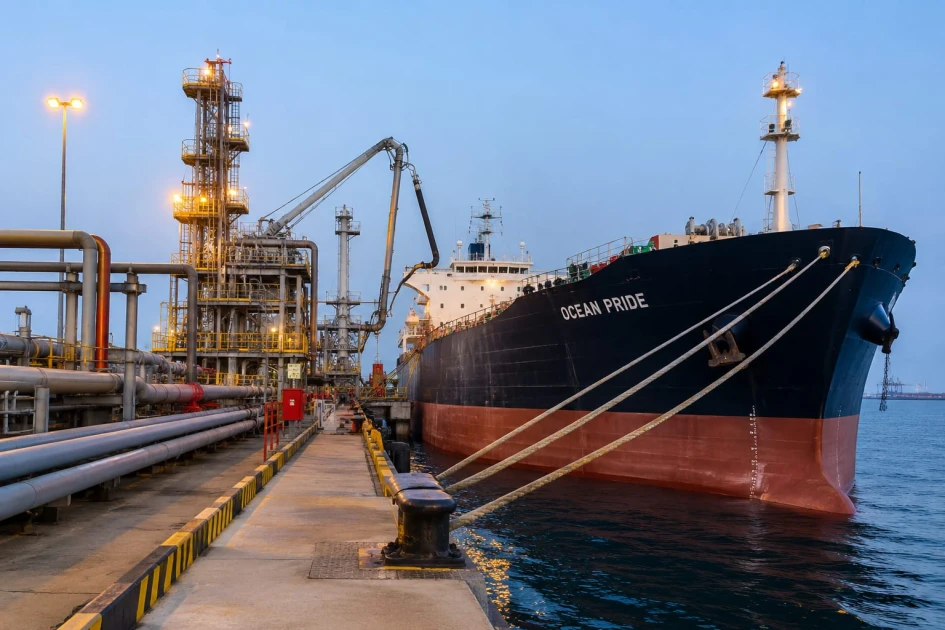
An oil tanker docked at an industrial port, illustrating crude-oil shipping and cargo-handling operations. Illustrative image.

Audio By Vocalize
A discrepancy between a published oil-accreditation rate and
figures in a United Nations report raises questions about the accuracy of the
reported levy calculation, while leaving separate concerns over contracts,
payment authority and the handling of funds unresolved.
A tenfold discrepancy in the reported rate for South Sudan’s
electronic crude-oil accreditation levy has emerged between a March 2026
investigation by Radio Tamazuj and the underlying account cited from a United
Nations Commission report, with the difference having significant implications
for the calculation of fees on oil shipments.
Radio Tamazuj reported an accreditation rate of 0.03 per
cent, while paragraph 145 of the UN report, A/HRC/60/CRP.5, states a rate of
0.3 per cent of cargo value.
The difference is material. Applied to the same shipment,
the lower rate produces a fee one-tenth the amount generated by the rate
recorded in the UN report.
However, the larger rate does not exactly reproduce the fee
reported in the shipment example, leaving a small discrepancy that requires
further documentation. The numerical inconsistency warrants clarification but
does not, on its own, invalidate the wider investigation or settle separate
questions concerning the administration of the accreditation system.
A tenfold difference
in the calculation
The shipment example involves 600,000 barrels of crude oil
valued at US$81.30 per barrel, giving a total cargo value of US$48.78 million
before the accreditation fee is applied.
At 0.03 per cent, the fee would amount to US$14,634. At 0.3
per cent, it would rise to US$146,340.
The reported fee of US$146,349 is therefore US$9 higher than
the amount calculated using the 0.3 per cent rate.
The arithmetic establishes two points: the 0.03 per cent
figure cannot account for the reported fee on the stated cargo value, while the
0.3 per cent rate comes within US$9 of the reported amount.
The remaining difference is relatively small compared with
the total cargo value, but it should not be dismissed or explained through
speculation. The original assessment, invoice or underlying calculation would
be needed to determine whether the difference resulted from rounding, a
different valuation basis or another adjustment.
Until those records are available, the most defensible
conclusion is that the UN report’s stated rate is consistent with the reported
fee to within US$9, rather than an exact reconciliation.
The e-Crude Oil Accreditation Permit, known as ECOAP, is
described in published accounts as an electronic requirement for buyers lifting
South Sudanese crude through Port Sudan using services associated with the
Ministry of Petroleum.
Radio Tamazuj identifies CapitalPay as the technical payment
interface and reports that payments were made through commercial banks. The UN
Commission examines the arrangement as part of its broader investigation into
public finances and the allocation of revenues.
These elements raise questions that cannot be answered by
the percentage discrepancy alone.
Establishing how the system operated requires records
showing who introduced and authorized the accreditation requirement, which rate
applied to individual cargoes, who had authority over the receiving account,
what contractual rights the service provider held and how the money was
ultimately distributed.
A payment receipt bearing a platform's name may help
identify the interface used for a transaction, but it does not, by itself,
establish the ownership of the funds or their final destination. Likewise,
describing an account as government-related does not establish who controlled
it or how individual payments were handled.
Those questions require documentary evidence, including
contracts, bank records, transaction-level reconciliations and records of
transfers to the designated recipient.
In a statement dated 22 June 2026, Crawford Capital rejected
allegations of diversion and described technology services provided under
government agreements. Its response also explained a US$15 convenience fee and
a separate 2 per cent platform charge associated with non-oil revenue
collection.
Those explanations are relevant to understanding the
company's stated business model, but they do not independently establish the
rate or distribution of ECOAP oil-accreditation payments.
The US$15 convenience fee and the 2 per cent platform charge
concern different payment arrangements. They should not be treated as evidence
of how the crude-oil accreditation levy was calculated or distributed without
documentation demonstrating that the same contractual terms applied.
Similarly, the UN report's account of a 75/25 allocation of
oil-accreditation fees needs to be assessed against the applicable
oil-programme agreement and financial records. An arrangement used for
electronic visa or other non-oil revenue services cannot automatically be
assumed to govern the oil programme.
The central issue is therefore not simply whether Crawford
Capital has described other technology and payment services. It is whether the
contractual and financial records for ECOAP substantiate the authority to
collect the levy, the applicable rate and the allocation of the proceeds.
A report by the South Sudan Broadcasting Corporation on a
September economic-reform committee meeting records praise for improvements
attributed to the revenue authority and Crawford-Capital Pay.
Such statements provide context about official assessments
of the services and reforms associated with the platform. They do not, however,
constitute a published audit of individual oil-accreditation transactions.
An assessment of the ECOAP arrangement would need to go
beyond general endorsements and examine whether collections were made under
valid authority, whether the correct rates were charged, whether the proceeds
were allocated according to the applicable agreements and whether the
designated recipients received the amounts due.
Without transaction-level evidence, neither official praise
nor a company's general description of its services can independently resolve
those questions.
The oil-accreditation dispute must also be distinguished
from published accounts concerning a separate per-litre charge on fuel imported
into South Sudan by road.
The two arrangements involve different transactions and
charging methods. ECOAP, as described in the reports, concerns accreditation
linked to crude-oil exports through Port Sudan, with a fee calculated as a
percentage of cargo value. The imported-fuel charge is based on the volume of
fuel entering the country.
Consequently, a suspension, dispute or change affecting one
programme should not be presented as proof of the status of the other without
evidence linking the two arrangements.
Keeping the programmes separate is essential to an accurate
account of the country's oil-related revenue systems and the responsibilities
of the institutions and service providers involved.
The discrepancy between 0.03 per cent and 0.3 per cent is a
specific and verifiable numerical issue. On a cargo valued at US$48.78 million,
the difference between the two rates is US$131,706.
The reported fee of US$146,349 is incompatible with the
lower rate on the stated valuation but is US$9 above the amount produced by the
higher rate. Paragraph 145 of the UN report provides the stronger basis for
identifying the applicable percentage in the published record, although the
underlying invoice or assessment is still needed for an exact reconciliation.
That correction should be made without conflating a
demonstrable arithmetic discrepancy with the wider allegations and questions
surrounding the accreditation system.
The outstanding issues concern the legal authority for the
levy, the terms governing the service provider, the allocation of fees and the
destination of collected funds. Answering them requires evidence beyond a
percentage printed in a report or an explanation of a separate payment service.
The immediate conclusion is narrow but important: the
reported 0.03 per cent rate does not match the shipment calculation, while the
UN report's 0.3 per cent rate comes within US$9 of the stated fee.
Resolving the remaining difference and assessing the broader
concerns will depend on the underlying contractual, assessment and banking
records.
Join the Discussion
Share your perspective with the Citizen Digital community.
No comments yet
This discussion is waiting for your voice. Be the first to share your thoughts!