
UK actions reignite reparations row as Mau Mau veterans demand accountability
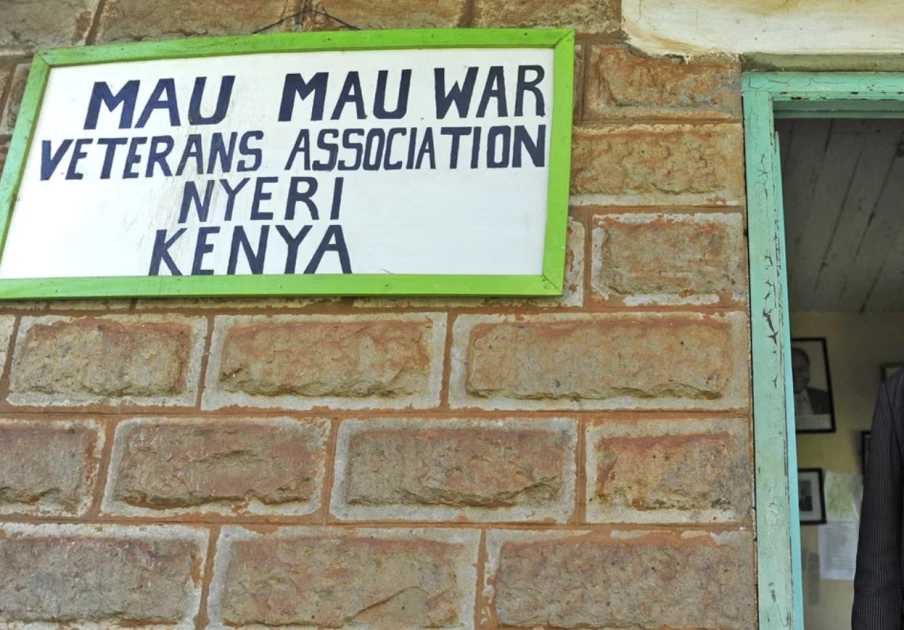
The Mau Mau War Veterans Association Nyeri chapter office. PHOTO | COURTESY

Audio By Vocalize
Recent decisions by British officials have sparked renewed outrage in Kenya, with the Mau Mau War Veterans Association accusing the United Kingdom of maintaining a pattern of avoiding full accountability for historical and ongoing injustices.
The latest
tensions follow a March 25, 2026 vote at the United Nations General Assembly,
where a resolution recognising the transatlantic slave trade as the gravest
crime against humanity was adopted with 123 votes in favour and three against.
The United Kingdom abstained, while the United States, Israel and Argentina
voted against the motion.
Days later, the UK
political party Reform UK announced a proposal to deny visas to countries,
including Kenya, that are pursuing slavery reparations.
The proposal drew
criticism from Hilary Beckles, chair of the Caribbean Community reparations
commission, who described it as punitive and reflective of a legacy of racism.
For Mau Mau
veterans, the developments mirror Britain’s response to colonial-era abuses
during the 1950s uprising, when thousands of Kenyans were detained, tortured
and killed.
In 2013, the UK
government paid £19.9 million in compensation to 5,228 survivors and expressed
regret, but did not accept legal liability or commit to broader reparations.
The association
says similar concerns persist in Nanyuki, where the British Army Training Unit
Kenya (BATUK) operates.
A Parliamentary
inquiry concluded in November 2025 documented allegations including sexual
abuse, deaths linked to unexploded ordnance, environmental damage and cases of
children fathered by British soldiers and left without support.
The case of Agnes
Wanjiru remains central to the concerns. The 21-year-old was last seen with
British soldiers in Nanyuki in 2012 before her body was later found in a septic
tank.
In November 2025,
former British soldier Robert James Purkiss was arrested in the UK following an
extradition request from Kenya. He denies the charges and is contesting
extradition.
Veterans argue
that provisions in the 2021 UK-Kenya Defence Cooperation Agreement limit
Kenya’s ability to prosecute British personnel, effectively shielding them from
local jurisdiction in certain cases.
In March 2026, Sir
Roland Walker, head of the British Army, acknowledged that British soldiers had
caused harm in Kenya and said justice “must be done and must be seen to be
done.”
However, the Mau
Mau War Veterans Association dismissed the remarks as insufficient, describing
them as acknowledgement without accountability.
With the defence
agreement due for renegotiation later this year, the veterans are calling for
reforms including granting Kenyan courts jurisdiction over serious crimes
involving foreign troops, establishing independent oversight and ensuring
support for affected communities. They also want reparations formally included
in future bilateral discussions.
The association
argues that without accountability, cooperation between Kenya and the United
Kingdom will remain imbalanced, with historical grievances continuing to shape
present-day relations.
Join the Discussion
Share your perspective with the Citizen Digital community.
No comments yet
This discussion is waiting for your voice. Be the first to share your thoughts!