
UAE diplomat Lana Nusseibeh vows to rebuild trust in bid for UN top job
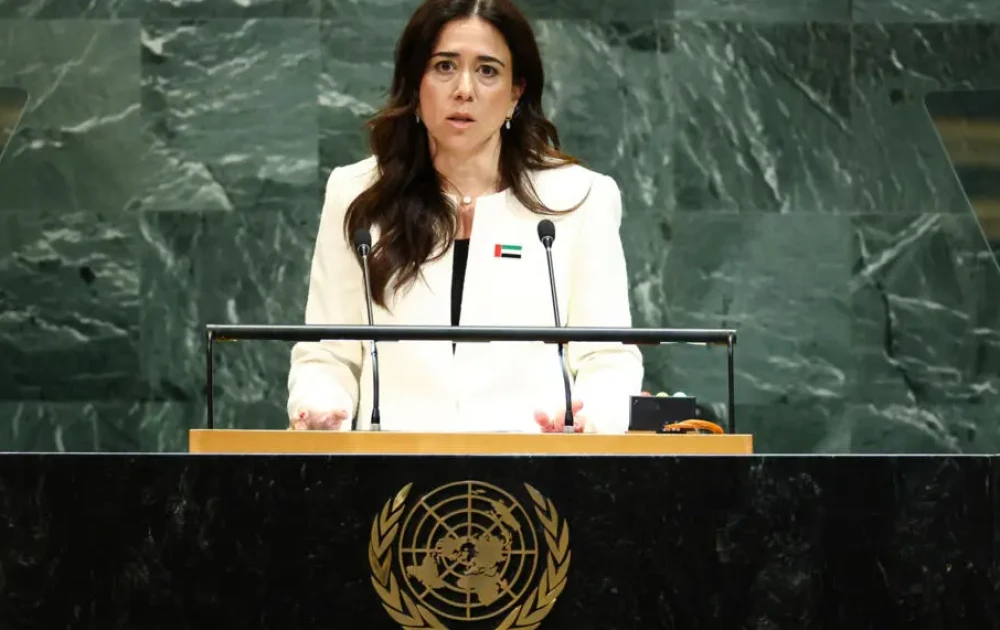
Emirati diplomat Lana Nusseibeh during an address. PHOTO | AFP

Audio By Vocalize
Conflicts around the world are becoming increasingly complex, amid declining trust between parties, placing the United Nations before major challenges, particularly in the post-term era of current Secretary-General António Guterres, whose tenure ends on December 31, 2026.
The international community is facing a growing number of
crises and violent conflicts, from Gaza to Ukraine, Sudan and the Democratic
Republic of the Congo.
These are compounded by the consequences of climate change,
manifested in droughts, heavy rainfall and floods, which are becoming
increasingly severe, as well as the continued decline in biodiversity.
Although various United Nations organisations have achieved
considerable progress in combating poverty over decades of work, many regions
continue to suffer from it.
Today, the world is undergoing an unprecedented fundamental
transformation amid the artificial intelligence revolution.
This technology has moved beyond being merely a set of
supporting software tools to become an integrated, vital system reshaping the
structure of societies and economies, and even the way human beings think.
Against this backdrop, Emirati Lana Nusseibeh says she's running for
the post of UN Secretary-General, bringing extensive experience in this field
and presenting her vision for addressing these challenges during a session
dedicated to an interactive dialogue on her vision on October 27, 2026.
During an interactive dialogue, Lana said: “Artificial
intelligence will either level the playing field or divide us profoundly. We
must agree on principles and broaden access to this technology. We must also
determine and ensure that those who stand to benefit the most are ultimately
the ones who do.”
Her vision draws on this approach to addressing the challenges
of a changing world, encompassing development, technology, climate and
international partnerships.
Her country has developed a vision for confronting a changing
global landscape, preparing for it through the establishment of diverse economic
partnerships and careful long-term planning, while diversifying its political
and strategic partnerships.
The UAE has expressed its desire to establish a just global
peace that respects the rights of all countries, protects civilians from the
devastating effects of wars, and preserves economic stability, which is a key
foundation for the continuity of societal development.
Building on this vision, Lana said: “The United Nations that I
will lead will be judged by what each country is able to determine for itself,
not by what the system imposes. We must prioritise fulfilling our commitments
under the Charter and advancing better lives with greater freedom.”
“Others need sustained support to build institutions and
deliver essential services. Many need both types of support. I will champion
fairer solutions, debt relief, decent work and expanded development
opportunities in vulnerable contexts. I pledge to revitalise the way this
organisation operates through business and philanthropy.”
She added: “The Charter reminds us that international peace
and security rest on the recognition of the value and dignity of every human
being. The Charter and the United Nations are not philosophical aspirations,
but binding commitments, and the credibility of our organisation depends on
their consistent implementation. As Secretary-General, I will defend human
rights resolutely and without double standards.”
The Emirati candidate said she would act early, before
conflicts escalate into wars, stressing that the organisation needs to rebuild
trust.
She noted that the Secretary-General has neither an army nor a
vote in the Security Council, but possesses the power of trust and the capacity
to mediate.
She added that she wanted to be a driving force in mediation
efforts, noting that Sudan would be one of the key tests of the next
Secretary-General’s success.
In another context, she said that “three forces will shape
this effort”, stressing: “More than one billion young people in developing
countries will enter the workforce over the next decade. This is a reality we
must not forget in our work across security and peace, development and human
rights alike.” These remarks formed part of her vision for addressing the
challenge of extreme poverty.
Noting that the heaviest burdens fall on the poorest
countries, Lana Nusseibeh said she would “prioritise prevention and early
responses to disasters. The United Nations Charter begins by reaffirming faith
in fundamental human rights. The Charter reminds us that international peace
and security rest on the recognition of the value and dignity of every human
being.”
She pledged to revitalise the way the organisation operates
through business and philanthropy. She said the United Nations was under
pressure but that she believed in its purpose, adding that she would work with
partners to build trust, revitalise the organisation through philanthropy, and
recognise the value and dignity of every human being.
She explained that she would defend human rights resolutely
and without double standards, warning that for every “promise the organisation
fails to fulfil, we will pay the price with what we hold most dear.”
Meanwhile, all six Gulf Cooperation Council countries, along
with Jordan, Mauritania, Palestine, Palau, Montenegro and Georgia, have
announced their support for Lana’s candidacy.
They have praised her extensive diplomatic record and UN
experience, her ability to build consensus, and her commitment to peace and
dialogue in resolving crises, describing her as an ideal choice to lead the
international organisation.
Lana has extensive experience in this field. In 2013, she
became the first Emirati woman to serve as her country’s Permanent
Representative to the United Nations, a position she held until April 2024. She
has served as a Minister of State since September 2025.
Previously, she was appointed Assistant Minister of Foreign
Affairs for Political Affairs in February 2021 and was accorded ministerial rank
by federal decree in December of the same year.
She also presided over Security Council sessions during the
UAE’s two presidencies of the Council while serving as a member in 2022 and
2023.
She managed files relating to peace and security, humanitarian
affairs, sustainable development, security risks associated with climate
change, women’s affairs and reform of the multilateral system.
Nusseibeh chaired the Executive Board of UN Women in 2017 and
served as a Vice-President of the General Assembly during its 72nd session. She
also co-chaired the intergovernmental negotiations on Security Council reform.
Since 2015, she has also co-chaired, alongside the United
Kingdom, the Group of Friends of the Future of the United Nations, an informal
forum for exchanging views on issues affecting the organisation’s future,
according to information published by the ministry in 2024.
She served as the UAE’s co-special envoy to Afghanistan and
Pakistan in 2010 and 2011, and as a deputy to the UAE’s G20 Sherpa during
France’s presidency of the group in 2011.
Join the Discussion
Share your perspective with the Citizen Digital community.
No comments yet
This discussion is waiting for your voice. Be the first to share your thoughts!