
Trust in Russian anti-doping system remains 'very limited', WADA chief says
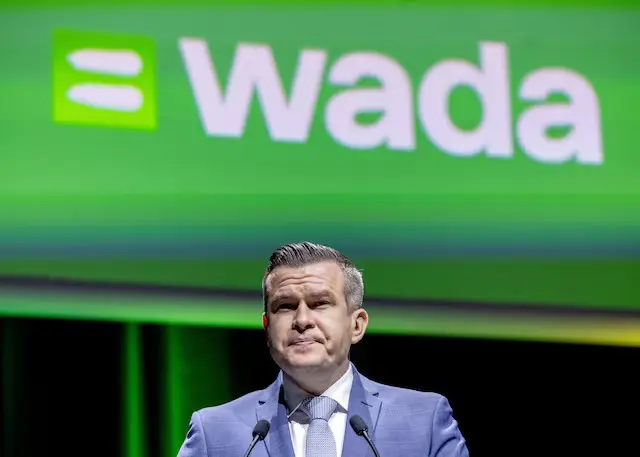
World Anti-Doping Agency (WADA) President, Witold Banka attends the World Anti-Doping Agency Symposium in Lausanne, Switzerland, March 12, 2024. REUTERS/Denis Balibouse/File Photo

Audio By Vocalize
A robust testing programme must be in place to
ensure Russian athletes returning to
international competition are clean, with trust in the country's anti-doping
system still "very limited", World Anti-Doping Agency President Witold
Banka told Reuters.
After Russia’s full-scale invasion of Ukraine in
February 2022, the International Olympic Committee urged sports federations to
exclude Russian athletes and officials.
It later suspended the Russian Olympic Committee for
recognising sports bodies in Russian-occupied Ukrainian territories, but
provisionally lifted the suspension in July. Several sports federations now
allow Russians to compete.
Russian athletes had already faced Olympic
restrictions over doping. More than 100 were excluded from the
2016 Rio Olympics following an investigation into state-sponsored doping.
Doping-related sanctions subsequently required
eligible Russians to compete without their flag or
anthem at PyeongChang in 2018, Tokyo in 2021 and Beijing in 2022.
Russia's anti-doping agency, RUSADA, remains non-compliant
with the World Anti-Doping Code.
Speaking after WADA’s Foundation Board meeting in
Astana, Kazakhstan, on Thursday, Banka said complete confidence in any anti-doping
system was impossible, but Russia's record warranted particular caution.
"You can never be confident when it comes to
anti-doping policy," he said. "You have to have a limited trust,
especially taking into account all of what happened in the past. This trust is
very limited when it comes to the Russian Anti-Doping
Agency from our side."
RUSADA did not immediately respond to a Reuters
request for comment.
Banka said he expected the International
Testing Agency (ITA), an independent body that runs anti-doping programmes
worldwide, to establish a rigorous regime for Russian athletes and increase
testing both at international competitions
and inside Russia.
"The more we're going to have tests done by
independent agencies like the ITA on the Russian athletes, the more we can say
to the athletes that they should be confident that those who are coming back
are tested properly," he said.
RUSADA cannot be declared compliant until WADA has
audited its operations in Moscow, but Banka said the war had made that
difficult.
"I cannot tell you when
exactly we will be able to send our
experts to do the audit," he said. "It's really hard to send the team
where the drones are landing in Moscow."
Banka said WADA was responsible for the safety of its
experts and needed assurances that they would not be at risk, despite Russian
officials saying conditions were secure.
He also warned athletes that they were responsible
for understanding and complying with anti-doping rules.
The International Tennis Integrity Agency charged
French player Arthur Rinderknech on Wednesday with refusing to submit to an
anti-doping test. Rinderknech denies any wrongdoing and says he expects to be cleared
by a
tribunal.
Banka did not comment directly on the case but said
there was "no excuse" for
athletes failing to understand their obligations.
"Once you are a professional athlete, you have
duties and responsibilities," he said. "You have to be aware of the procedures.
We have very robust educational programmes for every athlete who competes at
the international level."
Join the Discussion
Share your perspective with the Citizen Digital community.
No comments yet
This discussion is waiting for your voice. Be the first to share your thoughts!