
The teen mothers of Igembe Central

Audio By Vocalize
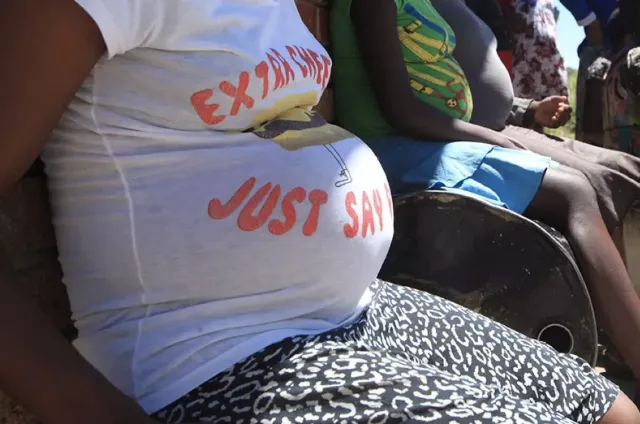
Recent health data show that roughly three in every ten deliveries in the county are by teen mothers, putting Meru among counties with the highest adolescent pregnancy prevalence in the country. In Igembe Central, poverty and broken promises have trapped mothers and their daughters in an unbreakable cycle of early motherhood, creating grandmothers who are barely out of their twenties.
A drive through the narrow village pathways of Hamaku Village in Igembe Central, Meru County, brings us to a homestead where a story unfolds, a story of a seemingly unbreakable cycle of adolescent pregnancies.
Here, three generations share a roof. A grandmother, mother and grandchild. Their story starts 32 years back.
Nkatha, not her real name, was only thirteen when she gave birth to her daughter, whom we will call Jullie.
Nkatha says poverty led her down the path to very early motherhood
"Sikudhani kama ningeweza kupata mtoto, alinidanganya akanipea kit kama shilingi twenty hiyo sasa nikamkubali na nikapata mtoto," she recalls.
The child she birthed then is now sixteen and has been a mother for the last three years.
She too gave birth to her son at the age of thirteen. Lured into this situation by a fellow adolescent boy.
"Tukakutana tulikuwa marafiki na yeye alikuwa ananisaidia pesa, paka nikamwamini hapo sasa nikapata ujauzito nikamwambia niko na uja uzito akanitoroka," Jullie recalls.
It is a story that is replicated a few homesteads away. Another mother and daughter duo, struggling to survive the harsh economic realities that come with raising a baby. Naomi, not her real name, was thirteen when she gave birth to her daughter Makena, also not her real name.
"Nilipitia changa moto mingi, za kijamii kukosa pants kukosa vitu mingi sa nikapatana na vijana akanidanganya kuninunulia tu tuvitu akanifurahisha tu nikajikuta niko na mimba, kutoka hapo akanitoroka," Naomi told Citizen TV.
The same fate befell her daughter years later
"Nilikuwa grade seven, nilikuwa nataka kusoma niwe daktari nikapatana na kijana mmoja hapo akanidanganya, mara kumi hivyo nikajipata na uja uzito," Makena shares.
Their stories are not isolated. Meru consistently ranks among the counties with a high prevalence of teenage pregnancy. Kenya's vital statistics report put it second in the country in 2024, at 17.4 per cent.
Health data also shows teen mothers account for roughly three in every ten deliveries in the county.
Here at Nyambene Sub County Hospital, the evidence is in the wards. Here you find girls, some just getting into their teens, waiting to bring forth their offspring. The officers say 40 per cent of the deliveries at just this one facility are of girls aged between 13 and eighteen
"About 70 per cent of our caesarean section deliveries are mothers between the ages of 13 and 19. The youngest mother we have seen was 12," says Dr. Githu Wachira, a Medical Superintendent in Meru.
"Out of 100 women coming to give birth in our facilities, 24 of them are children," says Judy Kawera, a GBV coordinator.
Health officials and NSDCC attribute the high numbers to, amongst others, poverty, transactional sex linked to the miraa trade and broken families.
Indeed, nearly every homestead in this constituency of Igembe Central has stands of miraa trees.
On any given day, you will find young boys and men perched atop them, harvesting the stems for sale…this puts money into their pockets, money they use to lure girls out of school and into early sexual relationships. Naomi knows this too well
"Huku miraa inakuwanga na pesa kuna wakati miraa inakuwanga na pesa ukiingia hata kwa shamba za wenyewe wanachuna wanauza wanapata pesa," she shares.
But the HIV numbers show who is most at risk.
Data presented at the 2026 National Syndemic Diseases Control Council roundtable indicates that young people aged 10 to 34 account for 72 per cent of all new adult HIV infections in Kenya. While women and girls make up roughly 65 per cent of new cases.
"Kenya is home to 3.6% of people who are living with hiv globally in 2025 kenya was home to 3.4% of population whom we lost to HIV," says Dr Douglas Bosire, CEO, NSDCC.
In Meru County, the two levels of government, county and the national, are working to change the tide, move the numbers downward, and protect the Ameru girl.
Swift responses to cases of SGBV, holding to account those defiling children, and provision of safe spaces for those already affected, as well as re-entry to schools for teen moms are seen to be the mechanisms that will change the tide here.
In Meru, the danger is not a single threat but a cycle.
Until a girl's school fees, sanitary pads and next meal no longer depend on a man's favours, there will be more Faiths, and more Lucys.
Join the Discussion
Share your perspective with the Citizen Digital community.
No comments yet
This discussion is waiting for your voice. Be the first to share your thoughts!