
Sudan war: Tasis forces claim capture of Suda base in latest Blue Nile advance
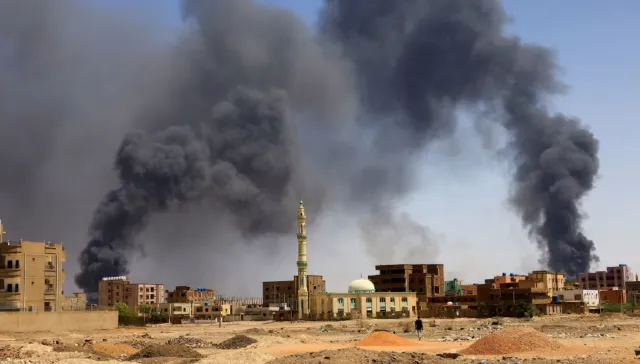
A man walks while smoke rises above buildings after aerial bombardment, during clashes between the paramilitary Rapid Support Forces and the army in Khartoum North, Sudan, May 1, 2023. Mohamed Nureldin Abdallah/Reuters

Audio By Vocalize
The developments have placed positions held by the Port Sudan Army and its allied militias under mounting military pressure.
In a statement issued on Monday, November 23, Tasis Forces said they had seized what they described as one of the largest military bases in the region, capturing vehicles, weapons and ammunition, the inventory of which is still underway.
The alliance announced the killing of hundreds of army and jihadist militia fighters, including individuals it described as foreign mercenaries, considering the operation an important step towards securing forward positions and expanding the scope of its military operations in the New Funj region.
The announcement of control over “Suda” came four days after Tasis Forces declared their entry into Bau town, and three days after announcing their takeover of five other areas in Geissan locality. The developments reflect the widening scope of hostilities in southeastern Sudan.
“Suda” Base: A Gain Beyond Territorial Control
The latest operation carries particular military significance, as it involves not merely control of a geographical area but also the capture of a military base previously used by forces affiliated with the Port Sudan Army.
“Suda” is located in Bau locality, approximately 70 kilometres southwest of Damazin, the regional capital. The area witnessed clashes during earlier stages of the Sudanese conflict.
The area was previously under the control of the Sudan People's Liberation Movement, led by Malik Agar, before government forces recaptured it in 2012, lending its return to the forefront of the fighting both military and historical significance.
Control of military bases can provide positions for redeployment and the securing of lines of movement, in addition to allowing the use of captured equipment and ammunition.
Tasis Forces' media office published an image showing several of its field commanders in front of the health centre in “Suda”, coinciding with the announcement of control over the area and its military camp.
Successive Gains in Bau and Geissan
The announcement of control over “Suda” was not an isolated development, but part of a series of successive military operations witnessed in Blue Nile in recent days.
On November 20, Tasis Forces announced their takeover of five areas: Khor Mak, Al-Madina 10, Al-Madina 11, Sinja Nabag and Al-Taqa village.
The alliance said the operations had resulted in the seizure of 27 military vehicles, six tanks and two armoured vehicles, in addition to the destruction of more than 70 vehicles belonging to opposing forces.
This followed an earlier announcement of the capture of Bau locality headquarters, after a field advance in an area that represents one of the key axes southwest of Damazin.
Damazin in the Calculations of the Battle
The succession of battlefield advance announcements has placed Damazin at the forefront of military calculations, given its status as the administrative capital of Blue Nile and the headquarters of the Fourth Infantry Division.
The city derives additional strategic importance from its proximity to the Roseires Dam, one of Sudan's most prominent water and electricity infrastructure facilities.
According to field reports, clashes along some Geissan fronts have reached points approximately 40 kilometres from Damazin, coinciding with the deployment of military reinforcements to the area.
Local authorities affiliated with the Port Sudan Army announced the launch of operations to recapture positions lost during the fighting, while Tasis Forces reaffirmed that their operations were continuing to expand the area under their control and secure their forward positions.
The repercussions of the military developments have also extended into neighbouring Sennar State, where authorities have introduced security measures, including a nighttime curfew and restrictions on the movement of goods, amid fears that the fighting could spread further.
The Battle for Influence in Southeastern Sudan
The significance of Blue Nile extends beyond its administrative boundaries, given its geographical position adjoining Ethiopia and South Sudan, as well as its connection to routes leading towards Sudan's central states.
This geography makes control of administrative centres, military bases and supply routes a consequential factor in the course of military operations.
The clashes also carry a political dimension linked to the future of power in Sudan, amid the participation of armed formations allied with the Port Sudan Army, including groups linked to the Islamist movement, whose influence within state institutions dates back to the era of Omar al-Bashir.
By contrast, the Tasis Alliance links its military operations to its declared political project of refounding the state and ending the influence of forces associated with the former regime.
Join the Discussion
Share your perspective with the Citizen Digital community.
No comments yet
This discussion is waiting for your voice. Be the first to share your thoughts!