
Sudan: Official position strains intensify amid Iran war

Audio By Vocalize
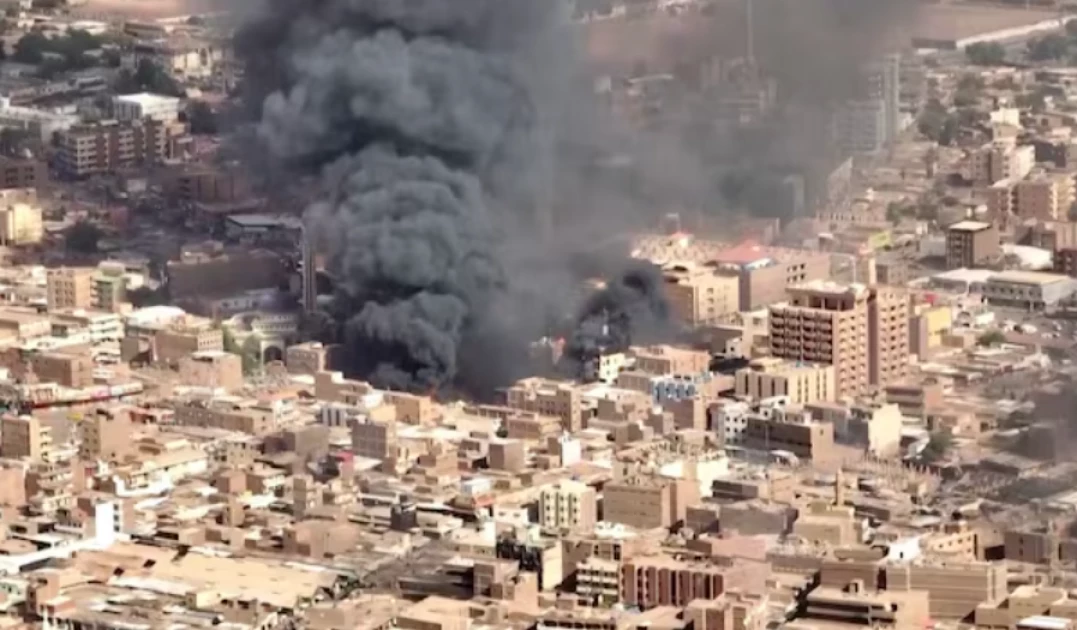
As Sudan’s war approaches its fourth year, the humanitarian situation continues to deteriorate day by day, according to UN and local reports, amid urgent calls to halt the conflict.
A United Nations spokesperson expressed deep concern over the
escalating violence in the states of Kordofan and Blue Nile, where intense
fighting continues to harm civilians and obstruct the delivery of critically
needed, life-saving humanitarian assistance.
The UN spokesperson called on all parties to protect civilians
and civilian infrastructure, ensure the rapid and unhindered delivery of
humanitarian aid, and comply with international humanitarian law.
He also pointed to “the urgent need for sustained and flexible
funding to maintain life-saving services and prevent further deterioration.”
Clashes continue in South Kordofan, particularly in the city
of Dilling and its surroundings. Fighting along the main supply routes is
disrupting commercial transport and humanitarian operations, according to the
United Nations in a statement issued several days ago.
Meanwhile, in developments on the ground, authorities in Port
Sudan released Islamist leader Al-Naji Mustafa after detaining him for more
than three days without an official announcement of the reasons for his arrest.
His release was confirmed on Sunday through a post published on his personal
account.
In a brief message, Al-Naji said he had resumed his public
activities after the period of detention, without providing further details
about the circumstances or reasons surrounding his arrest.
The release came after Al-Naji had previously declared,
together with a group of militias affiliated with the Islamic Movement, their
support for Iran in its war against Gulf states and their readiness to move to
Iran, a stance that sparked widespread controversy in political and media
circles.
With the launch of the joint military operation by the United
States and Israel against Iran, Brotherhood leaders—including Youssef Alam and
Yasser Obeidallah—announced the readiness of their fighters to head to Iran to
confront any ground landing, in a scene reminiscent of the “Quds Force,” but in
a Sunni Brotherhood version, according to local media reports.
In recent days, observers and activists circulated several
video clips of leaders affiliated with “Brotherhood-aligned” currents within
the Sudanese army, appearing in military uniforms and speaking about the link
between the war in Sudan and the ongoing conflict in the region. According to
the clips, they asserted that the fate of the war in Sudan and Iran is one and
the same.
The footage included statements by several speakers who
affirmed their readiness to defend Iran and send military battalions to fight
alongside it if circumstances required—remarks that observers considered a
troubling indicator revealing the nature of ideological alliances.
Among the reactions, the United Civil Forces (Qimam) in Sudan
strongly condemned the recent statements attributed to members of the Muslim
Brotherhood, in which they declared support for Iran in its ongoing war and
mobilized their battalions to fight alongside it, describing these moves as a
direct threat to Sudan’s national security.
The official spokesperson for Qimam, Othman Abdelrahman
Suleiman, said that “these statements represent an explicit admission of
attempts to drag Sudan into military axes and regional conflicts in which the
Sudanese people have no stake.”
He stressed that the move aims to transform Sudanese territory
into a platform serving external alliances aligned with what he described as
“terrorist” agendas, warning that such actions could expose the country to
international isolation and a new wave of security and economic collapse.
He further emphasized that “no ideological organization has
guardianship over the Sudanese state,” considering attempts by the group to
monopolize speaking in the name of the nation or to mobilize its youth for
transnational projects as “an explicit betrayal of the national will.” The
statement added that the group has consistently placed its narrow
organizational agenda above the country’s broader national interest.
Meanwhile, the army commander in Port Sudan, Abdel Fattah
al-Burhan, criticized the pro-Iranian statements, saying: “We will stand
against what the group has done and against those who support it… The
government will not allow any group to speak on behalf of the armed forces or
the Sudanese state on matters and issues that do not concern them, and we will
not accept any space of freedom or public celebration being exploited to harm
the Sudanese,” according to the official Sudan News Agency (SUNA).
However, the release of Islamist leader Al-Naji Mustafa after
three days of detention sparked widespread debate over whether Al-Burhan is
serious about efforts to distance the Brotherhood from the military
establishment.
Sharif Mohammed Othman, a leader in the “Sumoud” alliance,
said that Al-Burhan is unable to explicitly name or arrest the Muslim Brotherhood
leaders because they now constitute the “organizational and financial backbone”
upon which he relies to sustain the war.
He added: “A few weeks ago, Al-Burhan publicly asked, ‘Where
are the Keizan?’ while turning his head from side to side. Now, after
Brotherhood leaders emerged and openly declared their support for the Iranian
offensive, he threatened what he called ‘clowns’ with decisive action—but he
could not name them explicitly.”
He also noted that “the Brotherhood’s position is clear: Iran
has armed and trained Brotherhood battalions, and the army’s own relationship
with Iran cannot be denied; the military manufacturing sector itself is an
Iranian investment.”
Previously, conflict resolution and peacebuilding expert
Abdullah Didan said that Al-Burhan’s plan cannot in any way be separated from
the plans of the Islamic Movement and army leaders aimed at dividing Sudan
according to the so-called “Hamdi Triangle.” He argued that the project aligns
with their worldview and values, as well as their vision of what he described
as an “Islamic Arabist” state with a single cultural orientation that does not
recognize diversity.
He added that Al-Burhan’s positions indicate that Islamists
are maneuvering to secure gains and keep the army within the political process,
noting that the army’s continued presence in politics effectively ensures the
continued presence of the Islamic Movement. He explained that they control the
military institution and have done so for the past three decades.
Amid the divergence—and at times convergence—between the
positions of the Brotherhood and Al-Burhan, the U.S. Department of State
announced on Monday, March 9, 2026, the designation of the Sudanese Muslim
Brotherhood as a Specially Designated Global Terrorist entity, with the
intention of also designating it as a Foreign Terrorist Organization, in a step
aimed at isolating the group and cutting off its sources of funding.
In a statement, the department said that the Sudanese Muslim
Brotherhood—comprising the “Sudanese Islamic Movement” and its armed wing, the
“Al-Baraa bin Malik Battalion”—uses violence against civilians to undermine
efforts to end the conflict in Sudan and promote its hardline Islamist
ideology.
The statement added that the group has contributed more than
20,000 fighters to the war in Sudan, noting that many of them received training
and support from Iran’s Islamic Revolutionary Guard Corps.
According to the department, fighters from the Al-Baraa bin
Malik Battalion carried out mass executions of civilians in areas under their
control and repeatedly conducted summary executions of civilians on the basis
of race, ethnicity, or suspicion of links to opposition groups.
Under the designation, all property and interests belonging to
the Sudanese Muslim Brotherhood within the United States, or under the control
of U.S. persons, will be frozen, and U.S. citizens will be prohibited from
conducting any business transactions with the group.
According to reports, Abdel Fattah al-Burhan had provided
Washington, through negotiations, with the names of Brotherhood leaders and
requested that they be designated as a terrorist organization in exchange for
not designating him and sparing him from accountability.
Join the Discussion
Share your perspective with the Citizen Digital community.
No comments yet
This discussion is waiting for your voice. Be the first to share your thoughts!