
Sudan: Chemical contamination deepens Khartoum’s water crisis
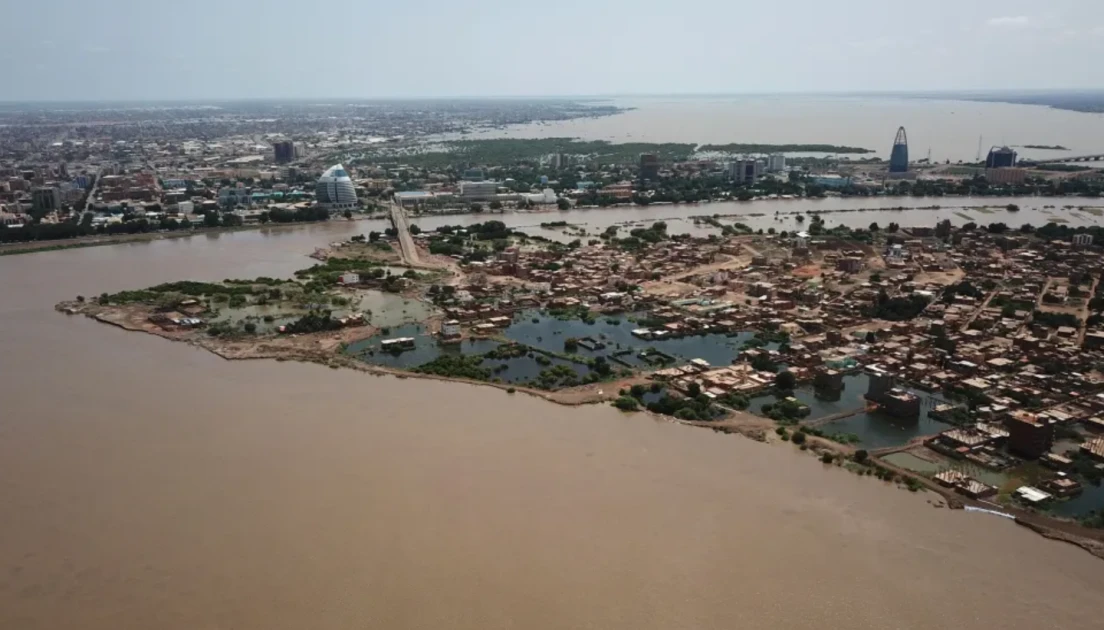
An aerial view shows buildings and roads submerged by the Nile floodwaters [El Tayeb Siddig/Reuters]

Audio By Vocalize
Mysterious epidemics are spreading in the Sudanese capital, Khartoum, including dengue fever, malaria, and viral hepatitis, as well as measles and diphtheria, at a time when the war that began in mid-April 2023 continues unabated between the Sudan Founding Alliance ‘Tasis’ and the army affiliated with the Port Sudan authorities.
Despite the health risks, thousands of Sudanese have turned to
drinking water from the Nile and shallow wells, as well as using various other
water sources, leading to outbreaks of diseases, particularly cholera, typhoid,
hepatitis A, and giardiasis, according to Sudanese reports.
Amid the health catastrophe, vast areas of Khartoum are facing
a severe water shortage that threatens the lives of millions, particularly
those who have returned from the hardship of displacement and asylum only to
find themselves confronted with a severe scarcity of drinking water.
Reports confirm that, for months, obtaining a single drop of
water in a number of Sudanese cities and rural areas has become a daily ordeal
for thousands of citizens, who spend long hours waiting in lines for tankers
distributing water to neighborhoods.
Earlier, UN High Commissioner for Human Rights Volker Türk
warned that the shortage of clean water had reached a critical level in the
city of El Obeid.
Faced with a water crisis that has become the foremost concern
for thousands of Sudanese, local authorities and the federal government have
been unable to find fundamental, or even temporary, solutions.
The availability of water is no longer the only pressing
concern for Sudanese. The lack of safe drinking water and contamination
resulting from the bombing of water-treatment facilities during the war have
placed Sudanese people before a genuine health catastrophe.
One resident recounts the daily struggle to secure safe
drinking water, noting that “the concern is no longer simply the scarcity of
water, but the diseases it carries.”
He confirmed that “the majority are forced to disinfect the
water before drinking it, but this option has become a costly financial
burden.”
Akram Mahjoub, a resident of the Jadin area in Omdurman, says
that “the situation is alarming, particularly after two families, comprising
eight people, died from poisoning caused by contaminated water in the area, in
addition to dozens suffering from watery diarrhea.”
In a statement to Independent Arabia, he pointed out that “the
lack of access to clean water, health services, and sanitation in areas west
and south of Omdurman has contributed to the spread of diseases, leaving
hundreds infected and resulting in dozens of deaths.”
He added that “most health centers have ceased operating, as
have pharmacies, while even the few that remain open have raised the cost of
treatment. As a result, patients have been unable to undergo medical tests or
purchase medicines after exhausting their financial savings.”
Meanwhile, press reports and investigations have spoken of
chemical contamination affecting water sources and causing a health
catastrophe, while the U.S. newspapers The New York Times and The Washington
Post have indicated that the army used chemical weapons during the ongoing war.
The Washington Post two days ago revealed documents showing
that the Sudanese army had established a secret stockpile of chlorine bombs and
used them, noting that Sudanese military officials attempted to conceal the
stockpile after the chlorine bombs were used.
It explained that the development of chemical weapons in Sudan
involved “diverting shipments of chlorine intended to provide clean drinking
water, concealing warhead production sites at military bases, testing bombs in
remote desert areas, and preparing lists of targets where toxic gas could
penetrate the enemy’s defenses.”
It pointed to “dual-effect” munitions filled with “choking
gas,” as well as videos showing weapons tests producing plumes of green and
yellow vapor, and messages between Sudanese military officials indicating that
army forces stored as many as 290 chemical munitions.
In assembling its presumed arsenal, the Sudanese army appears
to have relied on scrap components, diverted chlorine shipments, and a
rudimentary manufacturing process.
According to the newspaper, the collection includes
photographs and videos showing dozens of primitive bombs stacked in
warehouse-like structures.
According to the newspaper, several photographs show groups of
cylinders resembling those widely used for household barbecues, as well as
tanks whose primary purpose is to store liquefied gas. Welders then fitted them
with pointed noses, spring-loaded firing pins, and aerodynamic fins intended to
ensure that the bombs fell nose-first onto their targets.
Gareth Williams, a former senior official at the Organisation
for the Prohibition of Chemical Weapons and currently a senior fellow at the
Royal United Services Institute, a British defense and security research
center, said: “The evidence is concerning and deeply troubling.”
He noted that the storage of chlorine munitions “cannot be
conclusively verified through visual evidence alone, but the indicators are
strongly consistent with the existence of a chemical weapons program.”
Meanwhile, local authorities attribute the water crisis in
parts of the country to a number of causes, including the suspension of
maintenance at production facilities that suffered extensive acts of sabotage
during the war, fuel shortages, and the authorities’ inability to purchase
spare parts.
Two months ago, the Khartoum State Water Corporation said that
the shortage of water supplies in the northern Bahri area, north of the
capital, was due to the Nile receding from the intake of the station supplying
the area.
Caught between the twin crises of thirst and contamination,
Aida Abdullah, 58, says: “Obtaining drinking water has become a great dream for
families. Water is unavailable either through distribution lines or for
purchase, and residents have appealed to charitable organizations to provide
them with water, while they stand for hours in long queues to fill containers
and barrels.”
Aida, a mother of five, told Al-Araby Al-Jadeed media outlet
that: “Despite the exorbitant prices and the state of poverty, the water crisis
has become the greatest concern for thousands of families that have returned
from displacement and asylum, only to find themselves facing shortages of water
and fuel and power cuts, forcing their members to become displaced once again.”
In this context, an engineer with the Khartoum State Water
Corporation told the Sudan Tribune that they have been facing exceptional and
unprecedented conditions since the beginning of this year, as the receding flow
of the Nile has coincided with severe damage to the infrastructure of the main
stations.
Speaking on condition of anonymity, he said that workers are
fully aware of the scale of citizens’ suffering and the difficulty of obtaining
a drop of safe drinking water.
He pointed out that the full stabilization of supplies depends
on protecting the stations and ensuring a regular supply of energy and
water-treatment materials.
Join the Discussion
Share your perspective with the Citizen Digital community.
No comments yet
This discussion is waiting for your voice. Be the first to share your thoughts!