
Spotify Africa boss Jocelyne Muhutu-Remy speaks on royalties, streaming and the continent's music revolution
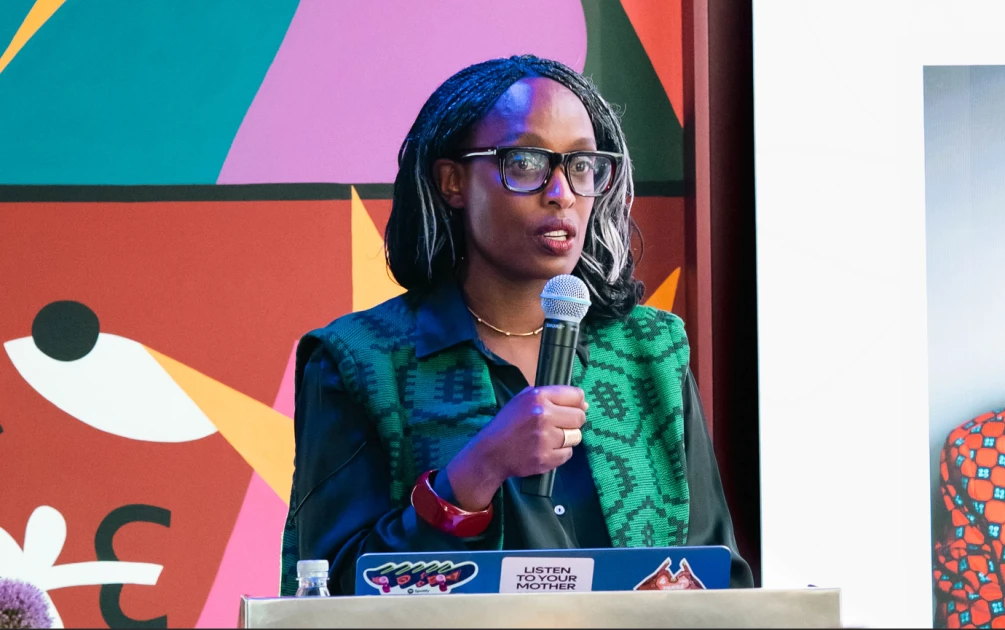
Spotify Sub-Saharan Africa Managing Director Jocelyne Muhutu-Remy speaks during the platform's 'Loud & Clear' event in Johannesburg on May 13, 2026. PHOTO | COURTESY | SPOTIFY

Audio By Vocalize
For more than two decades, Jocelyne Muhutu-Remy has operated at the intersection of African media, technology, storytelling and culture; long before the rest of the world fully realised the continent’s creative industries were becoming a global economic force.
The Rwanda-born
media executive has built a career across some of the world’s biggest media and
technology companies including Reuters, MTV Base, Viacom, Facebook and now
Spotify, where she serves as Managing Director for Sub-Saharan Africa.
According to her LinkedIn profile, her work has largely centred on amplifying
African voices and expanding digital access across the continent.
That mission was
evident during Spotify’s Loud & Clear event in Johannesburg last week,
where the streaming giant unveiled new data showing South African artists generated more than Ksh.3.9 billion (ZAR504 million) in royalties on the
platform in 2025 alone.
But beyond the
billions, the charts and the streaming milestones, Muhutu-Remy believes
something deeper is happening across the continent; African audiences are
reshaping the economics of digital culture in ways even Spotify did not
initially anticipate.
In an exclusive
interview with Citizen Digital on the sidelines of the event, Muhutu-Remy spoke
candidly about Africa’s growing streaming economy, the misconceptions many
artists still hold about royalties, and the structural weaknesses she believes
continue to hold back the continent’s creative industry.
From weak
copyright systems and struggling collection societies to limited payment
integrations across African markets, she argues that while African music has
already conquered global ears, the business ecosystem supporting artists still
has significant ground to cover.
Yet despite the
challenges, Muhutu-Remy remains optimistic about Africa’s digital future,
pointing to rising local music consumption, growing willingness among Africans
to pay for streaming services, and the emergence of hyper-local genres that are
beginning to thrive both at home and internationally.
For Spotify, she
says, success will not simply be measured by subscriber numbers or viral global
hits, but by whether an artist singing Benga in Dholuo somewhere in Nyalenda or
Amapiano in South African township slang, or folk music in a local dialect can
build a sustainable career from their craft.
What has
surprised you the most about African audiences since you started leading
Spotify nearly five years ago?
You know,
sometimes we make assumptions about our continent. One assumption is that
because data is so expensive, because we have economic issues, there would not
be as much engagement.
What I mean by
that is that I thought because of all of this, people would engage here and
there, listen a little bit, but then say data is expensive, or “I don’t have
the right phone,” and all those kinds of reasons. But it’s been completely the
opposite of that. We have very deep consumption levels in terms of content
hours per user.
So that has been a
big surprise. It just shows you that we all make trade-offs. We’re all very
savvy in terms of the trade-offs we make. And if music is important in our
lives, and listening to podcasts is important, well, we’ll make the
arrangements needed for that to happen.
Another thing is
that I thought my biggest challenge was going to be convincing African
audiences to convert into subscribers from the free service, again for all the
reasons you know. And that has proven to be a complete misconception on my
part.
Willingness to pay
is very much there, if it’s the right service at the right price, something
that considers affordability and brings value to your life.
So these things
were the biggest surprises and honestly my biggest joy. It’s the reason I come
to work every day, knowing that this is the reality I’m actually working with.
Spotify
distributed $11 billion in royalties last year, the highest ever for any
platform. For context, $11 billion is about Ksh.1.4 trillion. Kenya has 47
counties and the total budget for all 47 counties is a little over Ksh.400
billion per financial year. So $11 billion could finance all 47 counties in
Kenya for two financial years. I guess my question would be that, do you feel
African governments actually understand the economic potential of the creative
sector?
If you had asked
me this 10 years ago, did we even have creative economy ministers then? Not at
all. Nowhere. But now this is becoming more prevalent. Many countries have such
ministries, which shows you there is more and more understanding.
There is also the
fact that funding is now much more prevalent among international and
Pan-African institutions. I’m thinking of Afreximbank, IFC, AfDB. All these
institutions now have strong creative economy tracks. So, there is really this
trickling awareness that we can’t just rely on agriculture and two or three
other sectors. We have this youth population, they need employment, and the
creative economy is going to be one of those contributors.
So, there is more
awareness, but of course much more work still needs to be done to strengthen
some of the ecosystem. For example, in music, IP protection is still very weak
in many of our markets.
Music collection
societies and music rights organisations as a whole still have a lot of work to
do. Often, they are in shambles, even though there are improvements. And then
support to musicians, artists and the creative economy as a whole from
governments - there still isn’t enough of it. So that’s still work in progress.
But in short, the awareness is coming and there is change.
There’s still a
bit of skepticism among some African musicians about royalty distribution. What
are some of the hard truths African musicians need to know about the revenue
generation and royalty distribution process?
First of all, they
need to understand how it works; that it’s not per stream, it’s per share. I
think that one is really important because often they don’t understand that.
The other thing
that is important to understand is that since Spotify redistributes about
two-thirds of its revenue to the music ecosystem, it all depends on how much
revenue is made in the market. And that depends on two things: how many people
subscribe, but also how much each person pays.
We really consider
affordability. It’s not a one-size-fits-all pricing model, otherwise it
wouldn’t work. You can’t ask somebody in Nakuru to pay USD12/13 a month for a
service like Spotify. So, we really adjust the pricing according to the market.
Of course, it can’t be the same revenue per user as it is in other markets.
That’s one thing
artists often don’t understand. They think that if you live in France, you’ll
earn X for the same stream share, but if you live in Kenya, it can’t be
compared because of the price of the subscription. I think those are the
misconceptions.
And I think one
role artists could really play is first understanding it themselves and then
explaining it to their fans, that; “When you pay, I get paid.” Sometimes that
doesn’t happen as much as it should.
As the head of
Spotify in Sub-Saharan Africa, there’s obviously a lot on your plate. But over
these past five years, what is the one thing that keeps you awake at night
about the African music ecosystem? Something you wish you could change tomorrow.
It’s two things.
If I had a magic wand, first of all I would have these music royalty
organisations and CMOs functioning transparently, efficiently, paying out
quickly across the continent.
Another would be
making sure that wherever you are in any country, if you want to pay for
Spotify, you are able to because whatever payment method you have available is
integrated. Right now, among the big streaming platforms, we are one of the
most integrated with local payment methods. In Kenya, we are with M-Pesa
obviously. But there are other systems elsewhere. In Cameroon they use
something else.
If I had a magic
wand, Spotify would integrate with any payment method so that whatever your
preference or ability is in terms of payment, you can pay. If you’re sitting in
Burundi using a Burundian bank card and your local currency, paying for Spotify
should be really easy. That’s where I hope we’ll get to in a few years.
So now you’re
five years in charge, what does success for Spotify Africa look like in the
next five years?
It means adoption
across the board. It means artists being satisfied for two reasons: either they
had export potential and discovered audiences across the world with Spotify
facilitating that, or their genre is hyper-local and they still make a
sustainable living from the local revenue Spotify generates.
For me, that would
be success. That you can sing Benga in Dholuo and make a sustainable living
from it.
How is Kenya,
generally, performing as a streaming market compared to other regions?
Kenya is one of
the most important markets for us. It’s absolutely a priority market. There are
many reasons for that. Kenya is extremely digitally savvy, as you know. The
youth are very quick when it comes to adopting things. You don’t even need much
promotion. They just know. They’re very connected to the world.
Secondly, Kenya is
generally one of the most economically successful markets in Sub-Saharan
Africa. It’s in the top three. The population is also growing really fast. I
used to live in Kenya when the population was 30 million, now it’s over 55
million. It’s crazy, it’s almost doubled in 20 years, and a lot of that is
youth population growth.
With devolution
and all the other changes that have happened, the digital economy has really
penetrated. Fibre connectivity and internet access have improved significantly.
Third, the music
industry itself is diversifying and growing. The local music industry is going
through a very exciting evolution. When we first started, a lot of the music
consumption was international music. Now, and I don’t have the stats in front
of me right now, there has been significant growth in local consumption. We’re
seeing local genres developing. We’re seeing hyper-local music becoming a big
thing. Kenyan pride in general is really up there now.
Join the Discussion
Share your perspective with the Citizen Digital community.
No comments yet
This discussion is waiting for your voice. Be the first to share your thoughts!