
'Soprano?' How Kindiki turned his flaws into power and gained political currency
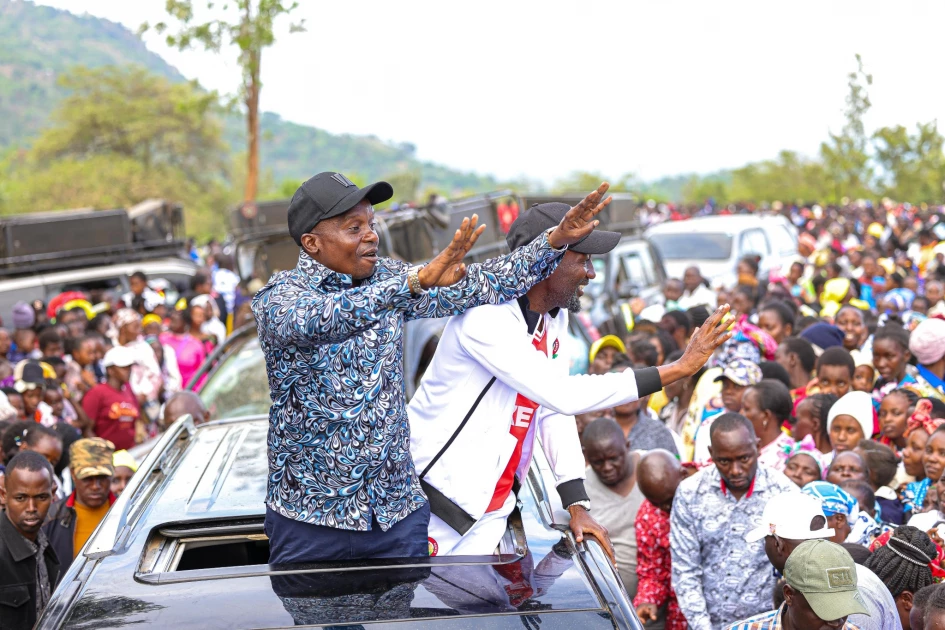
Deputy President Kithure Kindiki engaging with Mbeere residents during the campaigns for Leonard Wamuthende. Photo I File

Audio By Vocalize
At first, his attempts to work up the crowds and set the tone fell flat as he struggled to inject the much-needed pomp and circumstance required to keep the average political crowd in Kenya engaged, mesmerised and jaw-droppingly enthralled.
His attempts were not just ludicrously disastrous; they were painfully mortifying.
While attempting to sound cool and to sway the youthful masses, Kindiki regularly blundered his way through most of his impromptu chants, with his sloganeering often veering into the realms of cringey comedy and viral dumpsters.
To many, the new Deputy President just didn't have the voice, the tone or the bravado required to light up the stadium - he just didn't have the swaggering charm of the typical Kenyan politician; the machismo, the grit, the ruthless spittle.
As he continued to stumble his way through his public barazas, the Opposition found just the right - but scathing - nickname for him - Soprano.
In the red-blooded Kenyan political atmosphere, defined by toxic chauvinism and brash masculinity, a senior politician speaking in a feminine voice was the ultimate character flaw - the optimum missile his rivals could launch against him and his attempts to assert authority.
From former Deputy President Rigathi Gachagua to ousted Cabinet Secretary Justin Muturi, everyone in the opposition realm dubbed him 'Soprano', laughed at his slogans, mimicked his voice and rebuffed his not-so-manly Mount Kenya offensives.
It was a well-choreographed blitz meant to viscerally obliterate him and ruthlessly disembowel his stamp of authority.
After a while, even he felt it - Kindiki, tired of the version he'd been painted of, that of a political weakling with a piercing voice, questionable credibility and a charmless aura, took on his detractors head on, this time, sounding a little bolder, shooting a little harder and grimacing a little stronger.
And then the universe presented him with the perfect opportunity to prove his worth and show his mettle - the Mbeere North by-election campaigns.
Like a wounded Samurai, who had just rediscovered his sword and licked the bloody clots off his wounds, Kindiki entered the battlefield with renewed vigour and outstanding vitality; this time, he had come for war, and was dressed in the full armour, ready for the gruesome mess and the scathing blows.
In Mbeere, Kindiki was no longer the mild-mannered caricature with a bland presence and a shaky roar. He was a man who had embraced his eccentricities, accepted his vocal fate and purposed to turn the mockery into the most outstanding moment of his political career.
A master at churning out viral soundbites on TikTok, which many found hilarious and easily imitable, Kindiki used his hidden charm to drum up support for the UDA candidate Leo Wamuthende, singlehandedly propelling the unknown figure to national headlines - all by the sheer power of his sharp voice, unrelenting commands, sing-song slogans and munchable nursery rhymes.
Unlike Gachagua, whose attacks came from a place of seething anger and contemptuous sneer, Kindiki responded with childlike rejoinders; almost preachy and sob-worthy, Kindiki hissed at Gachagua, but in a tone which endeared him to the average villager and won him the sympathy of even the most apolitical mama mboga.
"Wewe Goliath! Wachana na mimi!" he barked at Gachagua, earning the mercy and trust of a deeply-evangelical village crowd, which grew up on the biblical tales of the David versus Goliath epics.
He didn't exactly bite back - he winced, but tactfully.
"Wamuthende, Wamuthende, Wamuthende!" he again rallied the crowds, quickly turning the rallying cry into a viral TikTok sound, used and reused by hundreds of thousands of Kenyan TikTok users and a masterful trick in the national branding of his preferred candidate.
Somehow, Kindiki had managed to turn his flaws into power, his shortcomings into improbable victory.
This is a man who knew that there was nothing he could do about his sharp voice, but also a man who knew that he could harness his laughable idiosyncrasies into a Midas touch on the soul of the bored electorate.
He didn't even plan it. He didn't even require a strategy. He just, like magic, decided to be himself. And it worked tremendously.
As if leading the crowds in an evangelical chorus, Kindiki sang: "Wewe Goliathi nitapita na wewe, nitapita na wewe, nitapita na wewe!" as the sun-drenched crowds backed him up, turning the moment into a remarkable session of wondrous symphony and vocal aesthetics.
Perhaps buoyed by his victory in Mbeere North, Kindiki is now marching forward with a renewed spring and a reenergized conviction, confident of his surprise success and unprecedented dexterity at public machinations.
And for those attempting to write him off the 2027 Deputy President continuance, the no longer timid man from Tharaka Nithi, and the seasoned law professor, is now bolder and more forthright - if I could bring home the Mbeere seat, and trample Gachagua in his dominion, I can certainly trounce you too.
You better not get me started. Because I don't really need a strategy. I just need to be me. And that is extremely dangerous.
Join the Discussion
Share your perspective with the Citizen Digital community.
No comments yet
This discussion is waiting for your voice. Be the first to share your thoughts!