
Solar-powered irrigation transforms farming in Tana River

Audio By Vocalize
Tana River is one of the counties in Kenya’s Arid and Semi-Arid Lands (ASAL) regions, where farming remains a difficult source of livelihood due to prolonged droughts and frequent floods.
For residents such as farmer Ibrahim Wayu, farming has long
been marked by uncertainty and repeated losses. Born and raised in Bondeni
area, Wayu says farming often felt like a losing battle, with crops either
drying up after planting or being swept away by floods during heavy rains.
“Farming in this area, especially in the lowlands, was not
easy. After planting crops, long dry spells would set in, causing them to
wither and die completely,” recalled Wayu.
He says that the floods came while Tana River was
experiencing the normal drought. The floods were as a result of backflow, after
it had rained in Mt. Kenya region, especially Sagana.
Wayu also lost irrigation equipment, including pipes and a
water pump he had installed to support his farming activities.
He explained that climate change has worsened the situation.
In the past, communities could predict droughts and floods and prepare in
advance, but weather patterns have now become increasingly unpredictable.
After suffering repeated crop losses, Wayu moved to a
higher-ground area six years ago to start farming afresh. To address water
shortages, he dug a borehole and bought a generator to pump water to his farm.
However, operating the generator proved expensive. “To get water to the farm, I had to use a lot of fuel. It was very costly for me,” he says.
At times, he could not afford fuel or maintenance costs,
forcing him to suspend irrigation for days. Besides the high operational costs,
the generator also produced noise and smoke.
His fortunes changed last year after the introduction of the
Financing Locally Led Climate Action (FLLoCA) Programme in the county.
Jointly funded by the Kenyan government, the World Bank,
DANIDA, SIDA and the German government, the initiative is helping communities
build resilience and strengthen local capacity to address the impacts of
climate change.
Elius Komora, an Environmental Officer, says the World Bank
contributed KSh122 million towards the programme. He explained that the funds
were channeled from the national government to the county government and used
to purchase solar panels and irrigation equipment, including drip irrigation
pipes.
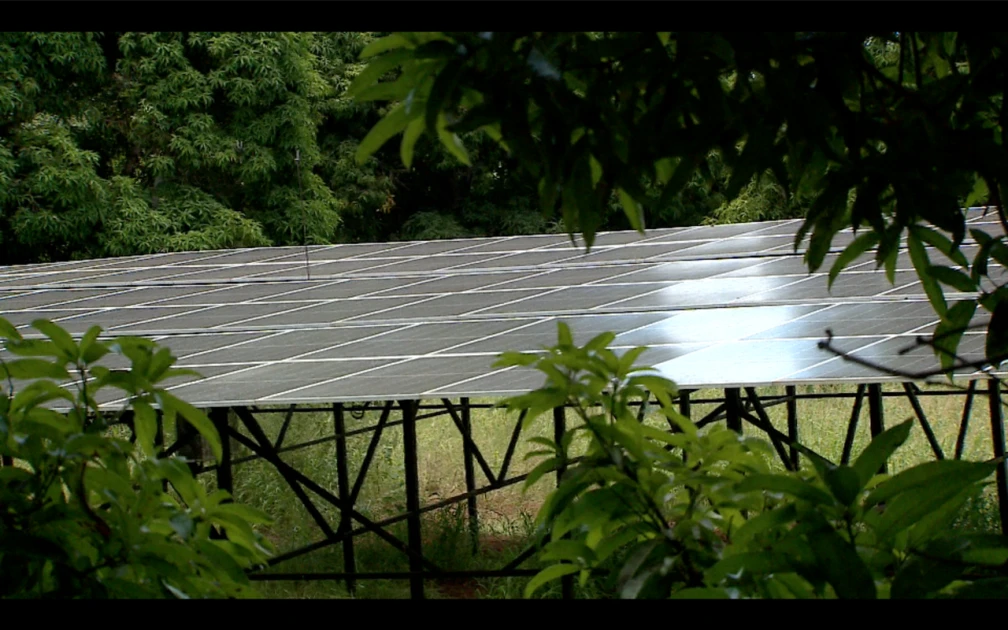
Wayu is among the members of the Kelo Kelo and Bondeni villages that came together and proposed a community project that uses solar energy to pump water from Tana River located 6km away. The water is then supplied to a 30-acre land where the community uses for irrigation farming.
The investment led to the establishment of the Bondeni Minor
Irrigation Scheme, which has improved access to water for farming and supported
irrigation activities in the area.
Powered entirely by solar energy, the scheme uses
solar-powered pumps to draw water from the river, located about six kilometres
away, and distribute it across the irrigation scheme for community farming.
Wayu explained that the project has enabled them to access
water throughout the year, including during dry seasons, reducing dependence on
rainfall and improving crop production.
He now grows green grams, vegetables, tomatoes and
drought-resistant maize. He has also planted pixie oranges, sugarcane, Napier
grass, sweet potatoes and sugar grass, while venturing into fish farming.
Wayu says solar energy has significantly lowered farming
costs by eliminating fuel expenses associated with generators. Unlike
generators, he notes, solar energy is clean, produces no harmful emissions and
requires minimal maintenance.
The availability of water has also enabled the community to
farm throughout the year.
Another resident, Mwanajuma Doyo, says solar-powered
irrigation has transformed livelihoods in the area.
“We lost a lot of crops in the past due to prolonged drought
and floods while farming in the lowlands. At times, we depended on relief
food,” she recalls.
Today, Doyo grows maize, green grams, watermelons,
vegetables and other crops throughout the year.
She says the use of solar energy has lowered farming costs
since farmers no longer rely on expensive fuel-powered generators.
“As a result, many farmers are now able to expand their
farms, grow vegetables, maize and fruits in large quantities and harvest more
produce,” she says.
Many families now harvest enough for home consumption and
sell the surplus to earn income and support their households.
“Since this area experiences prolonged drought, if we
continue accessing water, powered through solar, we will maintain irrigation
farming and improve our livelihoods,” she explained.
Abdallah Jilo says that since the launch of the
solar-powered water project, he has remained busy on his farm irrigating crops
such as maize, green grams, watermelons, vegetables and other produce.
“The access to water powered by solar energy enables me to
plant and harvest crops such as green grams, maize and melons throughout the
year,” he said.
Unlike before, when he struggled to provide for his family,
Jilo says his life has improved significantly. He now consumes part of the
maize and sells the surplus to earn money for buying other foodstuffs and
paying school fees for his children.
Before joining the irrigation project, Jilo survived by
cutting trees and burning charcoal for sale. Today, he only takes up casual
jobs occasionally and by choice rather than out of necessity.
Members of the irrigation scheme pay Sh100 each time they
irrigate their farms, with the funds used to support the sustainability and
maintenance of the project.
Dr. Dan Adino, Social Safeguards Specialist for the FLLoCA
Programme at the National Treasury, says climate adaptation has been central to
the programme’s implementation, particularly in the agriculture sector.
He explains that many communities have experienced prolonged
droughts due to climate change, resulting in repeated crop failures and
increased food insecurity.
According to Dr Adino, farming in the Bondeni community was
previously difficult because of limited access to water. However, the community
now benefits from boreholes, water harvesting systems and improved water
distribution closer to households.
Although River Tana is located several kilometres away,
solar-powered water pumps have helped bring water closer to the community,
enabling residents to access water for both household and productive use.
He says the initiative is helping communities adapt to the
impacts of climate change while improving agricultural productivity and
livelihoods.
Isaac Kiva, Secretary for Renewable Energy at the Ministry
of Energy and Petroleum, says that solar energy is becoming a major driver of
Kenya’s transition to clean and reliable energy,
He says the country is working towards achieving universal
access to electricity and a fully clean energy grid by 2030, with solar power
playing a central role in this mission.
“Solar energy is one of Kenya’s most abundant natural
resources and is helping to expand electricity access, especially in remote
counties such as Tana River, Mandera and Marsabit, where connection to the
national grid remains difficult,” explained Eng. Kiva.
Through a partnership with the World Bank under the Kenya
Off-Grid Solar Access Project (KOSAP), the government has established
mini-grids and supported companies providing solar home systems in underserved
areas.
Currently, Kenya has 210 megawatts of solar power connected
to the national grid, while more than one million solar home systems have been
installed across the country. He said that these off-grid solutions have
significantly increased electricity access levels nationwide.
Kiva says solar energy is among the cleanest and most
environmentally friendly sources of power, playing a key role in promoting
environmental sustainability and protecting the climate.
He adds that solar energy helps reduce greenhouse gas
emissions, which are a major contributor to global warming and climate change.
He explained, “Solar energy, together with other renewable
energy technologies such as geothermal and wind power, forms the foundation of
Kenya’s clean energy transition.”
He noted that Kenya has vast potential in renewable energy
resources, giving the country an opportunity to expand access to clean
electricity while reducing dependence on fossil fuels.
Join the Discussion
Share your perspective with the Citizen Digital community.
No comments yet
This discussion is waiting for your voice. Be the first to share your thoughts!