
‘Snake under the bed!’ EACC boss Oginde warns on normalising corruption
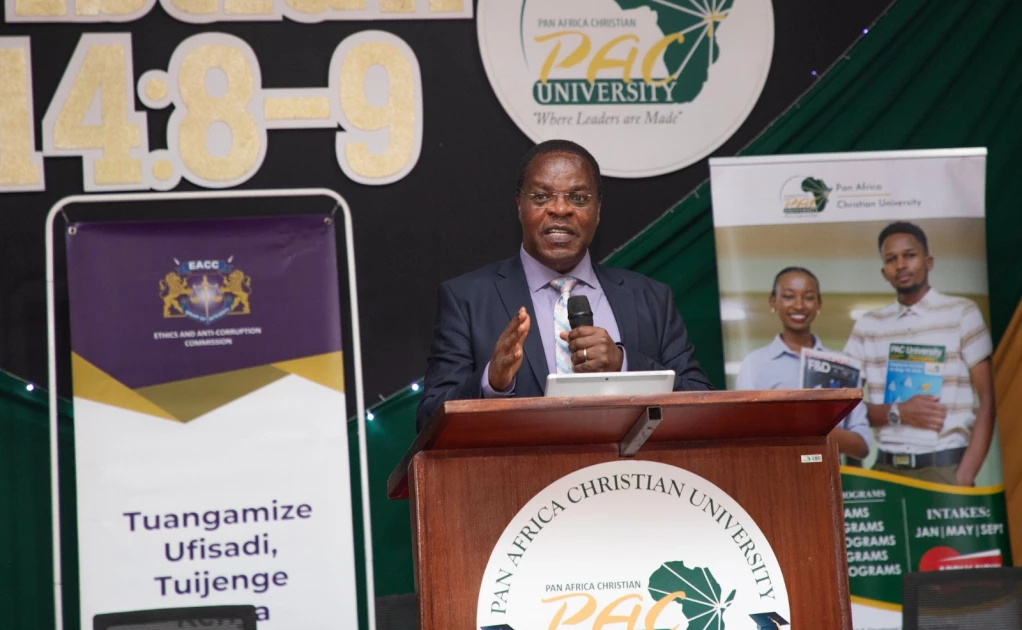
EACC Chairperson David Oginde speaking during the Kenya Leadership Integrity Forum (KLIF) Campus Edition at Pan Africa Christian University on March 13, 2026. PHOTO | EACC

Audio By Vocalize
Ethics and Anti-Corruption Commission (EACC) Chairperson David Oginde has warned that corruption in society should never be accepted as normal, likening it to “a snake under the bed” that threatens the safety of the entire house.
Speaking during the Kenya Leadership Integrity Forum (KLIF)
Campus Edition at Pan Africa Christian University on Wednesday, Oginde
cautioned against growing tendencies to view corruption as a necessary evil in
society.
“The idea that corruption is a necessary evil comes from a
concept known as the ‘grease the wheels’ argument,” he said, noting that some
economists argue that corruption can speed up bureaucratic processes.
However, the EACC boss added that modern research shows the opposite, saying; "Rather than ‘greasing the wheels,’ corruption adds sand to the system by rewarding influence instead of competence."
The event, held at PAC University’s main campus in Nairobi,
brought together university leaders, students and anti-corruption stakeholders
to discuss the theme: Can we really tame corruption or is it a necessary
evil in today’s society?
Using a vivid metaphor, Oginde described corruption as a
hidden danger within institutions, warning
“From where I sit, corruption is a snake under our bed. You may not see it, but once you know it is there, the entire room becomes unsafe," he said.
“It may sound clever, but no responsible household accepts a
snake as part of the furniture."
The EACC Chairperson noted that corruption often operates quietly through procurement decisions, licensing approvals and regulatory processes while institutions outwardly appear stable, adding that the biggest casualty of corruption is trust.
“When citizens begin to believe that justice can be bought,
that opportunities depend on connections rather than merit, and that laws apply
only to the powerless, then the legitimacy of institutions begins to erode,” he
said.
Oginde further stressed that leadership plays a decisive role in shaping the ethical tone of a nation, underscoring that responsibility does not lie with leaders alone and that corruption also persists through citizen participation.
“The ethical tone of a nation is often set by those who lead its institutions. When leaders tolerate corruption, corruption multiplies. When leaders excuse wrongdoing, integrity becomes optional,” he noted.
“A bribe requires two actors: one who demands it and one who
offers it,” he said, pointing to everyday compromises such as bribing traffic
officers, cheating in exams and falsifying documents as contributors to broader
national corruption.
He linked corruption to wider economic and social challenges facing the country.
“The pain of corruption is all around us – tough economic times, unemployment, floods, and many such anomalies in our nation. These are snake bites,” he added.
Consequently, the anti-graft boss explained that eliminating corruption requires a coordinated effort from leadership, institutions and citizens, thus urging the society to “smoke out the serpent,” since it will not disappear on its own.
“Corruption must first be exposed through transparency and investigative scrutiny. It must then be confronted through accountability and enforcement. Finally, institutions must be strengthened so that corruption cannot easily return,” he said.
“The snake enjoying the warmth of your house will not just slither away on its own – it must be forcefully removed."
While highlighting the progress made by the commission over the past three years, Oginde said the commission has filed 133 asset recovery suits valued at approximately Ksh.25.71 billion, recovered Ksh.7.4 billion from illegally acquired assets and secured 72 convictions in corruption-related cases.
He said the agency has also safeguarded Ksh.10.74 billion in public funds through disruption interventions, conducted 41 systems reviews across ministries, departments and agencies, and supported 17 county governments through corruption risk assessments.
Join the Discussion
Share your perspective with the Citizen Digital community.
No comments yet
This discussion is waiting for your voice. Be the first to share your thoughts!