
Sifuna matrix in Western Kenya and echoes of Kijana Wamalwa, Masinde Muliro
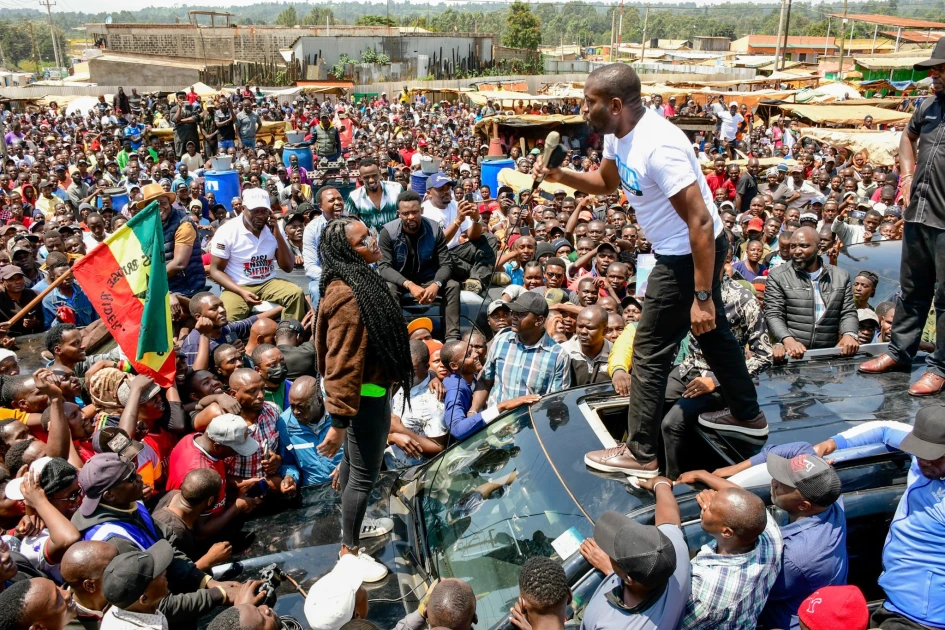
Nairobi Senator Edwin Sifuna addresses Trans Nzoia residents during a tour on July 25, 2026. Photo: Edwin Sifuna/X

Audio By Vocalize
What began as the Linda Mwananchi tour, a series of rallies ostensibly organized around civic mobilization, has morphed into something closer to a presidential launch.
Sifuna's back-to-back rallies in Trans-Nzoia and Bungoma on July 25 and 26, capped by scenes of Luhya elders symbolically anointing him as the region's political heir, have forced a reckoning across Kenya's political class.
The question worth asking is not simply whether the Nairobi Senator is popular; the crowds answer that. But what kind of political phenomenon does he actually represent? And can it survive contact with the machinery that has controlled Western Kenya's vote for two generations?
The Kijana and Muliro effect
To understand why the region is “Sifunated,” or the widespread “Sifuna-mania,” it helps to recall what made the late Kijana Wamalwa and the late Masinde Muliro formidable in their days.
Muliro was one of the founding fathers of multiparty democracy in Kenya, a Ford patriarch whose moral authority derived from decades of principled opposition to single-party rule, and whose base, while strongest in Bungoma, carried weight because it was tied to a national democratic project rather than to ethnic arithmetic alone.
Wamalwa inherited that mantle, led Ford Kenya, ran for president, and eventually became Vice President under the NARC government in 2003, giving Western Kenya real proximity to state power.
Both men were, in essence, institution-builders: their authority rested on party structures, a coherent ideological project, a multi-party dispensation, and later anti-KANU movement and politics.
Their long records of service predated the era of viral rallies and the use of digital media to project sentiments and crowds instantly.
Sifuna's rise looks different in almost every respect.
He has no comparable institutional base of his own.
He was, until recently, Secretary-General of ODM, a party built and dominated by Raila Odinga.
His current momentum is built less on decades of coalition-building and more on a rapid, almost organic mobilization following Odinga's death, which analysts describe as having created a vacuum in opposition politics that Sifuna has moved unusually fast to fill.
Where Wamalwa and Muliro built their standing across careers spanning the pre- and post-independence struggle for pluralism, Sifuna's ascent has occurred over a matter of months, propelled heavily by young, online supporters and ground support, the same "Gen Z" energy that reshaped Kenyan protest politics in 2024.
That is a fundamentally different kind of political capital: highly visible, quickly generated, but historically less tested for durability than the machine politics Wamalwa and Muliro practiced.
Natembeya's ceiling
Governor George Natembeya's Tawe movement is instructive precisely because of its limits.
Natembeya has built genuine standing in Trans Nzoia, and Tawe registers real sentiment in Bungoma too, but it has struggled to break out of the wider Luhya-Bukusu-Sabaot corridor into a national movement.
That is roughly the ceiling that the old Western political bloc has often hit: strong in its home ground, thin everywhere else.
Sifuna's trajectory looks different so far, and this is the central claim analysts are testing. His Linda Mwananchi tour has not confined itself to Western Kenya; it has moved through Taita Taveta, Nakuru, and Thika, drawing sizeable crowds in each.
Kakamega Senator Boni Khalwale has argued that Sifuna occupies an unusual position because he can draw on both ethnic-regional loyalties in Western and a separate, youth-driven national following simultaneously, a combination Khalwale suggested makes him uniquely dangerous to the establishment.
On the other hand, Natembeya has effectively subordinated his own movement to Sifuna's candidacy, positioning himself as the western region's coordinator for Sifuna rather than a rival contender, which is itself a significant data point; the Tawe leader appears to have concluded that Sifuna's ceiling is higher than his own.
Whether that reach is real or a function of favorable, well-organized rallies remains contestable.
Government-aligned figures such as Kenya Kwanza's diaspora coordinator have dismissed Sifuna as a "joker," pointing out that Mudavadi's own 2013 presidential run generated large crowds in Western Kenya and translated into negligible national votes, a cautionary precedent for reading crowd sizes as electoral strength.
The Western Kenya proposition
This is where the numbers matter.
In 2022, Mudavadi and Wetang'ula delivered a Western Kenya bloc that gave President Ruto well over two million votes, a margin widely credited with helping tip a tight race.
That was the payoff for a Kenya Kwanza strategy that installed both men in senior government positions, Mudavadi as Prime Cabinet Secretary, and Wetang'ula as Speaker of the National Assembly specifically to lock down the region for 2027 as well.
Their public response to Sifuna has been dismissive almost to the point of understatement. Mudavadi has compared the Linda Mwananchi movement to a newspaper fire, spectacular but brief and drawn an explicit, somewhat unflattering contrast with Raila Odinga, suggesting today's challengers lack the substance of Kenya's historic opposition figures.
Both men have leaned on their institutional advantages: government resources, established party machinery, and years of patronage networks built through Ford Kenya and ANC.
Central Organization of Trade Unions (COTU) leader Francis Atwoli has alleged that retired President Uhuru Kenyatta is bankrolling Sifuna’s Linda Mwananchi movement.
The Nairobi Senator has ardently rebutted the claims, saying the movement is propelled by crowd-funding methods via digital payments or directly as seen during their Western region tour.
But the dismissiveness displayed by the leaders in government sits awkwardly next to visible anxiety.
Both men have intensified their own touring schedule in Western Kenya in direct response to Sifuna's rallies, and political analysts, have publicly warned them against complacency, arguing their dominance in the region "may be diluted, if not lost" by 2027 if they continue to treat the emerging challenge lightly.
Sentiment on the ground, as reported by multiple outlets, is that a section of Western Kenya voters says that Mudavadi and Wetang'ula "abandoned them" once they secured their national positions, a grievance Sifuna and Natembeya have naturally amplified.
What’s at stake for UDA and Ruto
If the Sifuna wave holds, the practical threat to UDA is not that Sifuna wins the Western votes outright in a formal sense, but that he denies Ruto the 626,512-vote cushion Mudavadi and Wetang'ula delivered in 2022. Raila won in 4 out of 5 counties of Western Kenya.
Bungoma county is where President Ruto beat Raila with nearly 100k votes. With Raila out, and in comes Sifuna, a son of Bungoma, the 2027 direction of these third largest voting block seems more menacing than ever to the status quo.
In a country where the last two presidential elections have been decided by margins in the low single digits, eroding this cushion, even partially, would be consequential.
It would also complicate UDA's broader coalition math at a moment when the party is already hemorrhaging support in Mt Kenya where many say it is just a matter of time before many politicians abandon the ruling party amid what is widely described as voter hostility toward the party.
That said, government allies are not without a rebuttal. The "joker" framing echoes a real historical pattern: Kenyan crowds have proven poor predictors of vote totals before, and Mudavadi's own 2013 experience is Exhibit A.
UDA strategists are betting that institutional incumbency, patronage, and the sheer organizational discipline of an incumbent party will outlast a movement still searching for a registered vehicle, reliable financing, and a settled relationship with the rest of the opposition.
Gachagua's calculated embrace
The most consequential recent development may be Rigathi Gachagua's public willingness to back Sifuna as a united opposition candidate.
It followed Sifuna's Bungoma rally, when Gachagua said he called Sifuna to congratulate him and declared, in characteristically self-promoting terms, that he had personally helped engineer Sifuna's rise and would support him "if he is the opposition's" agreed flagbearer.
That endorsement carries real weight given a recent TIFA poll finding that Kenyans want Gachagua to back the strongest opposition candidate rather than run himself and the same survey shows Sifuna's own support climbing meteorically within ODM's base in just two months, even as Gachagua's and Kalonzo Musyoka's numbers softened.
But Gachagua's embrace should be read as strategic rather than sentimental. He has simultaneously kept his own presidential ambitions alive, framed himself as indispensable to Sifuna's success, and left the door open to a "Kibaki moment" a late, unifying opposition candidacy modeled on 2002 in which he, not Sifuna, might yet be that figure.
Opposition unity talks involving Gachagua, Kalonzo, and Sifuna's camp have reportedly stalled over exactly this ambiguity, with Sifuna's ally James Orengo insisting Linda Mwananchi will field its own presidential and deputy-presidential candidates regardless.
The matrix
Sifuna's national appeal is real in a way Natembeya's is not yet: it spans regions, generations, and crucially party lines, with figures inside Gachagua's DCP and Kalonzo's orbit now openly courting him.
That marks a genuine departure from the Wamalwa-Muliro template of regionally rooted, institutionally anchored leadership, and from Natembeya's more geographically contained brand of protest politics.
Whether it constitutes durable political power of the kind Wamalwa and Muliro eventually converted into national office is a different question, and one the "passing wave" critics from Mudavadi and Wetang'ula are not wrong to raise.
Crowds are not votes, movements are not parties, and youthful enthusiasm has burned out before in Kenyan politics.
What is different this time is the scale of elite defection toward Sifuna, well-known political leaders from different parts of the nation, and business figures simultaneously hedging their bets on him, which suggests Kenya's political establishment, whatever it says publicly, is no longer confident the wave will simply pass on its own.
Meanwhile, Eastern’s loyalty to Kalonzo Musyoka, Rigathi Gachagua’s stranglehold of the “mountain” coupled with Sifuna’s influence among the youth and Western block, should have every strategic-thinking Kenya Kwanza politician going for their politico-math calculator.
Join the Discussion
Share your perspective with the Citizen Digital community.
No comments yet
This discussion is waiting for your voice. Be the first to share your thoughts!