
Ruto increases duty-free allowance from Ksh.39K to Ksh.260K as he assents to Finance Bill 2026
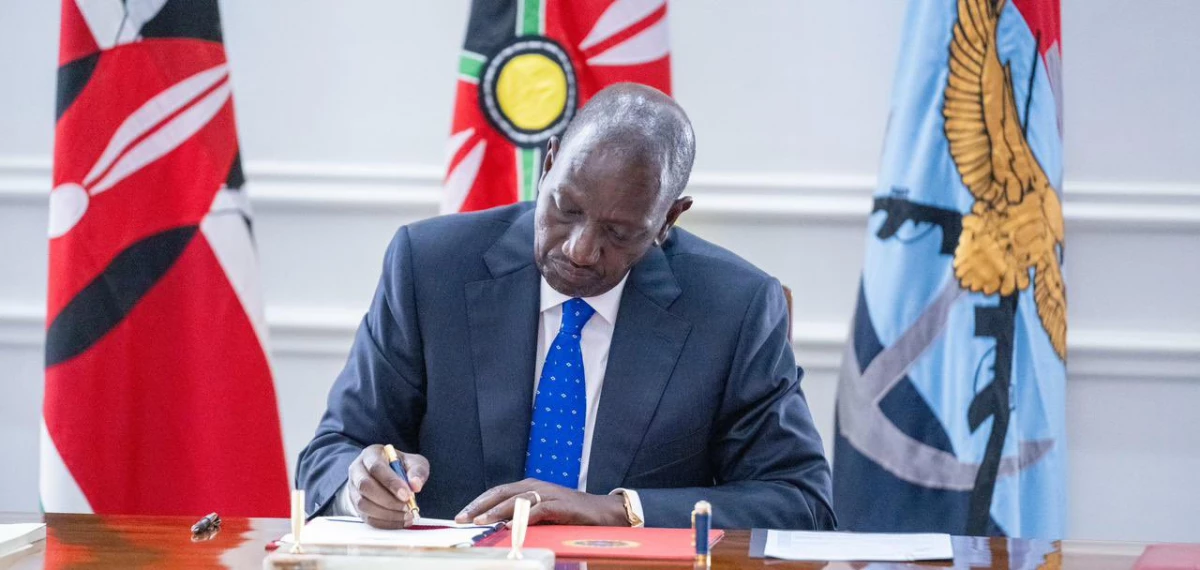
President William Ruto signs into law the Ksh.5 trillion National Infrastructure Bill, 2026, in State House, Nairobi on March 9, 2026. PHOTO | PCS

Audio By Vocalize
President William
Ruto has announced an increase in the duty-free allowance for returning
travellers from Ksh.39,000 to Ksh.260,000, a move aimed at addressing concerns
raised by Kenyans living and working abroad as well as other visitors.
Speaking when he
assented to the Finance Bill, 2026 at State House, Nairobi, on Tuesday, the
President said the revised threshold would allow travellers to bring in more
gifts and personal items without attracting duty charges.
“To address
concerns raised by returning travellers, including Kenyans who travel abroad
and members of the diaspora, we have increased the duty-free allowance from
Ksh.39,000 to Ksh.260,000 for gifts and personal effects that Kenyans can buy
as they travel or as they come home from their jobs abroad,” Ruto said.
The increase
represents a more than six-fold rise in the duty-free allowance and is expected
to benefit Kenyans returning from overseas employment, members of the diaspora
and other travellers bringing personal goods into the country.
The announcement
formed part of measures contained in Finance Bill, 2026, which the President
signed into law on Tuesday.
The National
Assembly passed the Finance Bill with
amendments last week, paving the way for its transmission to
President Ruto for assent before it becomes law.
President Ruto also
assented to the Appropriation Bill into law, explaining that the two laws will
provide the legal framework and resources required to finance Kenya’s transformation
priorities, create jobs, strengthen livelihoods and invest in more programmes
and projects under the Bottom-Up Economic Transformation Agenda.
“The vision is
clear, the agenda is set, the plan is funded and on course, the transformation
is happening and, together, we are building the prosperous, inclusive and
modern nation that we all deserve,” he said.
President Ruto
cautioned Kenyans against falling for propaganda and misinformation about the
Finance Act propagated by the opposition to advance their selfish cause.
“Together, we must
reject propaganda, misinformation, disinformation, fake news, insults, hate,
ethnic bigotry and profiling, and division,” he said.
He said the
Finance Act, 2026, does not raise taxes that affect ordinary citizens.
Instead, he said,
it improves fairness by strengthening compliance, closing loopholes and
ensuring that every individual and business pays what is lawfully due.
"We are
pursuing tax avoidance, not taxpayers; offshore schemes, not ordinary wages;
and leakages, not livelihoods," he said.
Contrary to
misinformation, he explained, there are no taxes on freehold land, no taxes on
mitumba, no changes on rental income tax, no tax on bottled water, no new tax
on M-Pesa or mobile money transactions, no new tax on mobile phones, airtime or
data, and no new tax on locally manufactured packaging.
The President
pointed out that the Finance law supports livelihoods through incentives for
motorcycles, electric buses and bicycles, solar batteries and locally assembled
mobile phones.
He added that the
duty on imported sugar has been increased from Ksh.7.50 to Ksh.40 a kilo to
protect local producers, safeguard 17 operational factories and support the
livelihoods of 10 million Kenyans who depend on the sector.
He further noted
that a six-month tax amnesty will waive penalties and interest on outstanding
tax obligations while mortgage tax benefits previously available only through
banks have been extended to borrowers in microfinance institutions.
President Ruto
explained that tax incentives for projects implemented through public-private
partnerships and the National Infrastructure Fund will lower delivery costs,
accelerate implementation and support efforts to progressively reduce the
country's debt burden.
“This is what a
fair tax system looks like: One that protects the vulnerable, rewards
enterprise, promotes compliance and shares responsibility fairly,” he said.
On the Budget, the
President noted that it invests in people, productivity and prosperity.
He said education
has received the highest allocation at Ksh.784 billion, up from Ksh.526 billion
in 2022, while funding for health has increased from Ksh.132.4 billion to Ksh.175.5
billion and agriculture from Ksh.44 billion to Ksh.63 billion.
On education, the
President pointed out that 20,000 teachers on contract will be employed on
permanent and pensionable terms, while a further 24,000 teachers will be
recruited, bringing the total number hired under his administration to 124,000.
In higher
education, funding for the Higher Education Loans Board (HELB) has increased to
Ksh.56.7 billion, while Ksh.40.4 billion has been allocated for university,
Kenya Medical Training College (KMTC) and TVET scholarships.
He pointed out
that Ksh.3 billion has been allocated for school feeding programmes to support
2.8 million vulnerable learners while Ksh.15 billion will be spent on
construction of classrooms and laboratories, and the teaching of science,
technology, engineering and mathematics education under the Competency-Based
Education and Training system.
On healthcare,
President Ruto noted that Ksh.19.1 billion has been allocated to primary
healthcare, ensuring Kenyans registered under the Social Health Authority (SHA)
can access outpatient services at accredited facilities without paying.
“As a result, no
Kenyan should pay for outpatient services at dispensaries, health centres and
sub-county health facilities in SHA-accredited public, private or faith-based
hospitals,” he said.
He added that
KEMSA funding has increased from Ksh.5 billion to Ksh.21 billion to strengthen
the supply of medicines and medical commodities across the country.
On agriculture,
President Ruto noted that funding for the sector has increased to Ksh.63
billion from Ksh.44 billion last year.
He explained that
Ksh.20 billion has been allocated for seed and fertiliser subsidies, up from no
allocation in 2022, helping maintain fertiliser prices at Ksh.2,500 a bag, down
from Ksh.7,500 in 2022. He noted that 6.5 million farmers are already
benefiting from the programme.
The President
added that Ksh.5.4 billion has been allocated for food resilience programmes, Ksh.2.7
billion to support farmers and workers in the sugar sector, Ksh.2 billion to
waive coffee farmers' debts and Ksh.500 million for the Coffee Cherry Fund.
He further noted
that young farmers will benefit from a Ksh.1.3 billion credit facility, while
pastoralists resilience and livestock commercialisation programmes have
received Ksh.3.3 billion and Ksh.1.3 billion respectively.
In addition, Ksh.5.5
billion has been allocated to support 300,000 pastoralist farmers in 21 arid
and semi-arid counties through cooperatives.
Additionally, the
President noted that Ksh.110 billion has been committed to programmes targeting
women, youth and vulnerable groups.
This includes Ksh.22.6
billion for youth programmes, Ksh.12.4 billion for the National Youth Service,
Ksh.8.8 billion for affordable credit to small businesses and Ksh.25 billion
for cash transfers benefiting 1.2 million vulnerable households.
To enhance access
to justice and strengthen the rule of law, funding for the Judiciary has
increased from Ksh.16 billion in 2022 to Ksh.30 billion in the financial year's
budget.
A total of Ksh.138
billion has been allocated to affordable housing and urban development.
“We are investing
in housing, infrastructure, energy and digital connectivity because growth
requires jobs, mobility and opportunity,” he said.
The President also
highlighted major investments in infrastructure, energy and connectivity,
including Ksh.225 billion for roads, Ksh.52 billion for transport
infrastructure and Ksh.20.8 billion for the extension of the Standard Gauge
Railway from Naivasha to Kisumu and Malaba.
To cushion Kenyans
against fluctuations of fuel prices, Ksh.21.5 billion has been set aside for
fuel stabilisation.
He also explained
that Ksh.10.5 billion has been allocated to the digital economy to expand fibre
connectivity, digitise government services and create more opportunities for
young people.
At the same time,
President Ruto said Ksh.112.4 billion has been allocated to water, sanitation
and environmental protection projects, while Ksh.9.4 billion has been set aside
to address the longstanding land question at the Coast region through the
settlement of landless families and squatters.
He further noted
that investments in the blue economy will support the establishment of 15 fish
landing sites and markets, rescue centres, rescue boats and expanded ferry
services.
In sports, Ksh.26.4
billion has been allocated to complete 39 stadia, prepare for AFCON 2027 and support
sportsmen and sportswomen who participate in sporting activities globally.
“The ultimate
measure of this Budget will be the opportunities it creates and the lives it
transforms,” he said.
The President also
assented to the Supplementary Appropriation Act, 2026.
Present were Deputy President Kithure Kindiki, Prime Cabinet Secretary Musalia Mudavadi, National Assembly Speaker Moses Wetang’ula, ODM Party Leader and Senator of Siaya Oburu Oginga, and MPs led by National Assembly Majority Leader Kimani Ichung’wah.
Join the Discussion
Share your perspective with the Citizen Digital community.
No comments yet
This discussion is waiting for your voice. Be the first to share your thoughts!