
Roots on borrowed land: Inside the lives of Kisumu Women feeding the nation

Audio By Vocalize
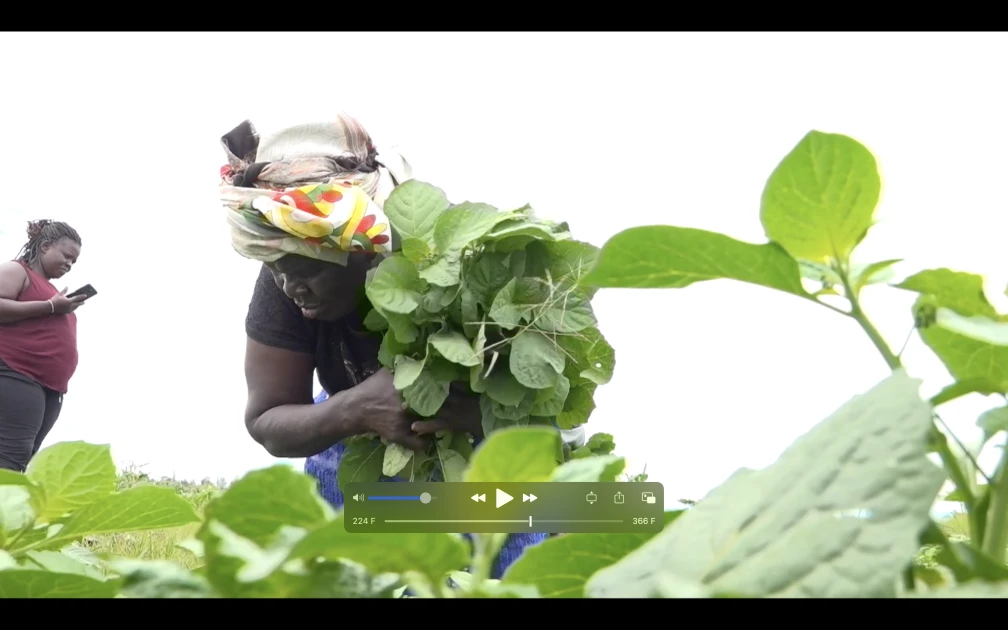
“We had leased this four-acre piece at Ksh 12,000. Off peak leasing is cheaper. The vegetables we sell here fetch us about Ksh5,000 per week, which gives us good money by the time the next rice season kicks in”.
Irene is the chairlady for the Jasho Letu women group. 30 women, who till on their husband’s pieces of land opted to join hands to lease alternative plots during the off peak season for rice.
The 4 acre leased plot is part of the rolling plains of Kano in Kisumu County. Covering a significant portion of the Nyando River catchment, the black cotton soils offer the best buffer for rice farming. However, during the off peak season, typically between January and April, some farmers like the Jasho Letu Women’s group, opt to plant vegetables to make a living.
The Ahero Irrigation Scheme lies within the Kano plains. 2,230 acres of land are currently under rice production, feeding into the national basket. For the farmers outside the scheme, they market and sell the rice directly. Those under the government-run Ahero Irrigation Scheme have additional benefits such as access to drying fields, milling, and cooperative formations to yield higher profits.
The vibrant green of the rice paddies defines a land of abundance. However, it masks the social inequality that thousands of women in one of Kenya’s rice baskets face daily.
Ostracised by Patriarchy
35-year-old Linet Awuor has been a farmer for six years. She has been tilling the land, overseeing planting, and weeding of rice on a halfacre piece of land owned by her husband. She is a member of the Jasho Letu women group.
On the half acre piece owned by her husband, the harvest in January yielded Ksh 60,000 in profits. Despite having worked on the land, she says her husband asked her to give him all the money after selling the produce.
“My husband took all the money, part of which he used to pay school fees for the children” she said while crouching over to catch a break from plucking the vegetables.
The mother of five however expressed her disapproval of her husband’s decision. According to the Kenya National Bureau of Statistics Economic Survey released in April 2026, three in five women in Kenya are empowered to make decisions on expenditure at the household level. Linet however, is among the near half population of women in Kenya, who rely on their spouse for decision making. Despite handling the manual labour in tending to the rice farm, she has no say on how the money is spent.
“My husband does not give me any money, for things like women’s table banking groups or anything else. That is why I work on this vegetable farm, because I can claim all the money that I make here”.
Over the three-month period, the 4-acre leased farm can generate an average of Ksh 150,000 from the vegetable sales, which is split equally among the group members after deducting costs such as leasing fees.
“Last year, one of the member’s husbands gave us land for free. He realised, we made money out of it, and he said he will charge us the regular leasing fees moving forward. If we had our own land, we would make more money”. Irene told Citizen Digital.
In her case however, she sits at the decision-making table when deciding how to spend the money made from rice farming.
“My husband allows me to manage all the money. In January, we had a profit of Ksh 230,000. I used it to complete our house. We now live in a modern house. I would want all women to enjoy the fruit of their labour, that is why all the money from the vegetable farms goes to the women directly”.
About 15 kilometres within the Ahero Irrigation Scheme, Nancy Ondus is also getting ready for the planting season. Nancy has leased 2 acres of land for Ksh 60,000. For ten years, she has scaled through the rice value chain from casual labourer to become the secretary for the Ahero Rice Scheme Umbrella group, keeping records of 30 farmers’ groups under the scheme.
“I was orphaned at an early age, so I began working on the rice farm before I ventured out on my own. As the first born, I had to make ends meet for my siblings. My father had a will, and when I was of age, I was given my portion of land”.
Women and Land
According to the 2022 Kenya Demographic and Health Survey (KDHS), 25% of women own agricultural land, with women in rural parts of Kenya leading at 32%. However, further breakdown shows that a meagre 3% of women have titles to the land, with 97% holding joint titles, either with a spouse or as a group.
The 2026 economic survey released by the Kenya National Bureau of Statistics showed that 75% of the workforce is small holder farms are women. The National Irrigation Authority, which manages 2230 acres of land under the Ahero Irrigation Scheme underscores the need to support women in agriculture.
Kennedy Ouma, the manager for the West Kenya Schemes says that NIA has overseen the representation of women within the farmers’ groups affiliated with the authority.
“We have a farmers' institution called the land dispute resolutions committee where we have ensured that women sit in these committees. Having realized that most of the women in the scheme are widowed, we saw it prudent to advise the farmers that they not only adhere to the two third gender rule, but also adhere to the new constitution”.
Section 13 of the Matrimonial Property Act 2013 states that property acquired before marriage generally remains separate, unless improved by the other spouse. Section 14 continues to expound that property acquired jointly during marriage is presumed to be owned equally. In 2023, a Supreme Court ruling clarified that the property is divided based on proportional contribution, not an automatic 50/50 split.
Humphrey Otieno, a legal counsel at FIDA Kenya in Kisumu has pointed out the need for continued advocacy on the law to protect widows from disinheritance.
“As FIDA, we were pushing for the recognition of non-monetary contributions which include tilling the land, companionship when the husband was tilling the land, for the property to be split 50/50 but the court has interpreted that either party has to prove that they contributed”.
Legal Landscape vs the reality
Legal experts have hailed the Constitution of Kenya as one of the most progressive, ringfencing not just human rights, but guaranteeing against -gender discrimination in land succession and property rights.
Article 27 prohibits discrimination based on sex, ensuring equal treatment and opportunities for men and women, with Article 60 spelling out land policy mandating the elimination of gender discrimination in laws, customs, and practices regarding land ownership.
Section 35 and 36 of the Law of Succession Act also states that a widow/widower is entitled to personal/household effects absolutely and a life interest in the residue of the estate.
In Ahero however, the women are clinging on to hope that these laws will one day apply if not to them, but for their children.
“I do not think it would be possible, my husband would not allow the half acre piece to be listed in my name. I have three sons who will inherit the land.” Linet says, with the resolve of a woman crushed by the continued oppression, wrapped around the finger of a patriarchal system, where women are almost secondary.
Irene on the other hand seems more optimistic, but her smile hides a pain borne so long, it has become almost familiar.
“It is impossible to own land when your husband is still alive. But I have two daughters. I am saving to buy land which I will put under their names. The small tract my husband owns will automatically go to my two sons”.
Shimmers on the Horizon
There have been concerted efforts to bring more women to the table, and on to lands where Kenya fights the pangs of hunger. According to the West Kenya Schemes manager Kennedy Ouma, 40 percent of land in the scheme is owned by women. This is a good indicator that the people around here are adhering to the issues of land rights, and them being in the committee means that they are able to agitate for their issues”.
Nancy Ondus says that she has been steadfast in weeding out the systemic oppression of women, who like Linet, barely get any money even after tilling the land, weeding and ultimately selling the rice through the organized groups.
“During distribution, everybody knows that I will not allow anybody who was not in the field to get money. As the secretary, having been in the farms, they know that the women who have been doing the heavy work are the ones who will touch the profits”, she says, as her eyes shine proudly, setting a bright ray that the hands that weave Kenya’s rice basket, get a feel of the money which they toil and sweat for.
Join the Discussion
Share your perspective with the Citizen Digital community.
No comments yet
This discussion is waiting for your voice. Be the first to share your thoughts!