
Retailers call for crackdown on illicit trade networks, cite rising tax losses

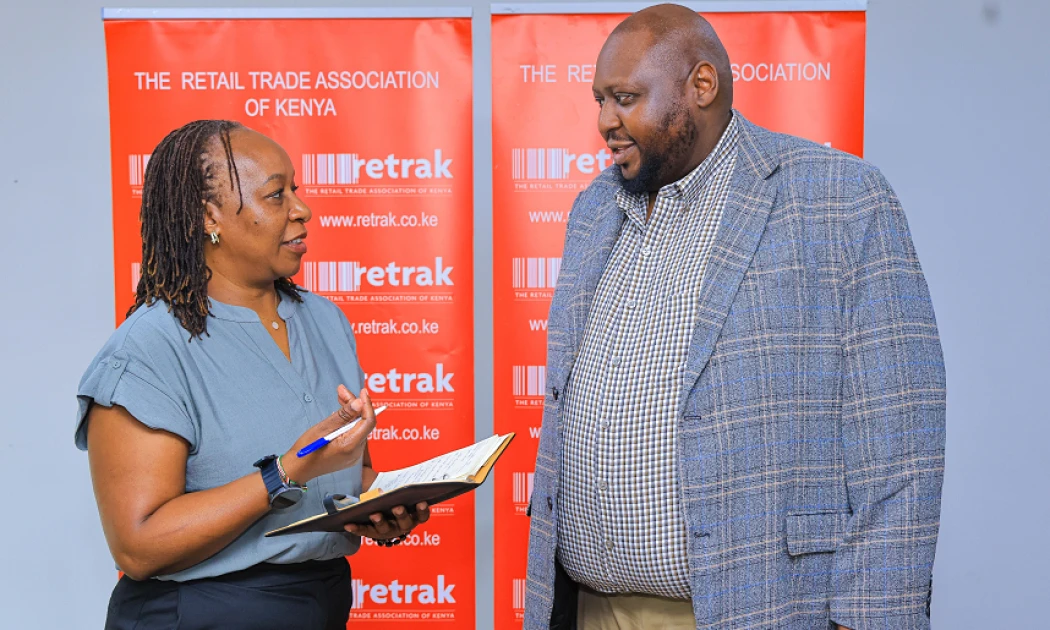
Wambui Mbarire, CEO Retail Trade Association of Kenya (Retrak), with Michael Kiragu, National Chairman of the Pubs, Entertainment and Restaurants Association of Kenya (Perak) during the press briefing.

Audio By Vocalize
The association wants the Kenya Revenue Authority (KRA), Anti-Counterfeit Authority (ACA), Kenya Bureau of Standards (KEBS) and National Police Service to establish a joint enforcement plan, designate a lead agency and set clear timelines for reporting progress.
RETRAK Chief Executive Officer Wambui Mbarire said authorities must go beyond seizing illegal products from shops and investigate the suppliers, transporters, storage facilities and financiers involved in the trade.
“Seizing illicit products from a shop is only the beginning. Investigators must establish who supplied the goods, where they were stored, who transported them and who financed the consignment,” Mbarire said.
She added that tracing the supply chain was critical to dismantling illicit trade networks and preventing further distribution of illegal products.
The call comes amid growing concerns over the scale of illicit trade in Kenya, with estimates pointing to significant losses in government revenue and increasing competition for legitimate businesses.
A recent Kantar study estimates that illicit cigarettes accounted for 45.1 per cent of Kenya's cigarette market in 2025, up from 34.1 per cent in 2021.
The study estimates that the government lost KSh10.2 billion in excise duty and Value Added Tax (VAT) revenue from illicit cigarettes in 2025 alone, with cumulative losses reaching KSh47 billion between 2021 and 2025.
Figures presented to Parliament by the Anti-Counterfeit Authority indicate that illicit alcohol accounts for approximately 59 per cent of alcohol consumed in Kenya by volume, with an estimated economic cost of KSh71 billion in 2022.
The authority's latest firm-level survey also found that counterfeit products accounted for an average of 18 per cent of goods in the sectors surveyed. Motor vehicle spare parts recorded a 21 per cent counterfeit rate, while alcoholic drinks stood at 19 per cent.
Recent enforcement operations have also highlighted the extent of the problem.
The ACA seized counterfeit goods valued at more than KSh563 million during the first three quarters of the 2025/26 financial year, while KRA destroyed fake and illicit products worth KSh218 million in July.
Authorities also recently intercepted nearly 100 tonnes of smuggled sugar in Lodwar and Marsabit.
Despite the enforcement operations, RETRAK says more sustained coordination is needed to ensure investigations reach the major players behind the trade.
The association is also calling for practical tools to help retailers verify excise stamps and product authentication marks, alongside clear guidance on how to handle suspicious deliveries.
It wants authorities to establish accessible and safe reporting channels through which shop workers and members of the public can report suspected illicit products and receive feedback on action taken.
Mbarire said legitimate retailers were being disadvantaged by businesses dealing in smuggled and counterfeit goods, which often avoid taxes and other regulatory costs.
“Retailers who meet licensing requirements, keep proper records and source goods legitimately cannot compete fairly against operators supplied by smugglers, counterfeiters and tax evaders,” she said.
She warned that illicit trade was threatening jobs, undermining compliant businesses and exposing consumers to potentially dangerous products.
RETRAK further wants enforcement agencies to publicly report their progress, including investigations into major suppliers, prosecutions and the recovery of unpaid taxes.
“We need an accountable, sustained response, not isolated raids. Kenyans deserve to know whether investigations are reaching the sources of illicit products and whether offenders are being brought to justice,” Mbarire said.
The association urged retailers to strengthen supplier due diligence, maintain proper purchase records and reject products whose origins cannot be verified.
It also pledged to work with regulators and enforcement agencies to develop awareness programmes and practical compliance guidelines for businesses of all sizes, including small-scale traders.
Mbarire said tackling illicit trade should be treated as a consumer protection and public safety priority, citing the dangers posed by counterfeit alcohol and substandard motor vehicle spare parts.
“This is more than lost revenue or unfair competition. Counterfeit alcohol can threaten lives, and fake vehicle parts can cause serious harm. Tackling illicit trade protects consumers, legitimate businesses, jobs and public finances,” she said.
Join the Discussion
Share your perspective with the Citizen Digital community.
No comments yet
This discussion is waiting for your voice. Be the first to share your thoughts!