
Rejected by their own: When children get caught in parents' fallout
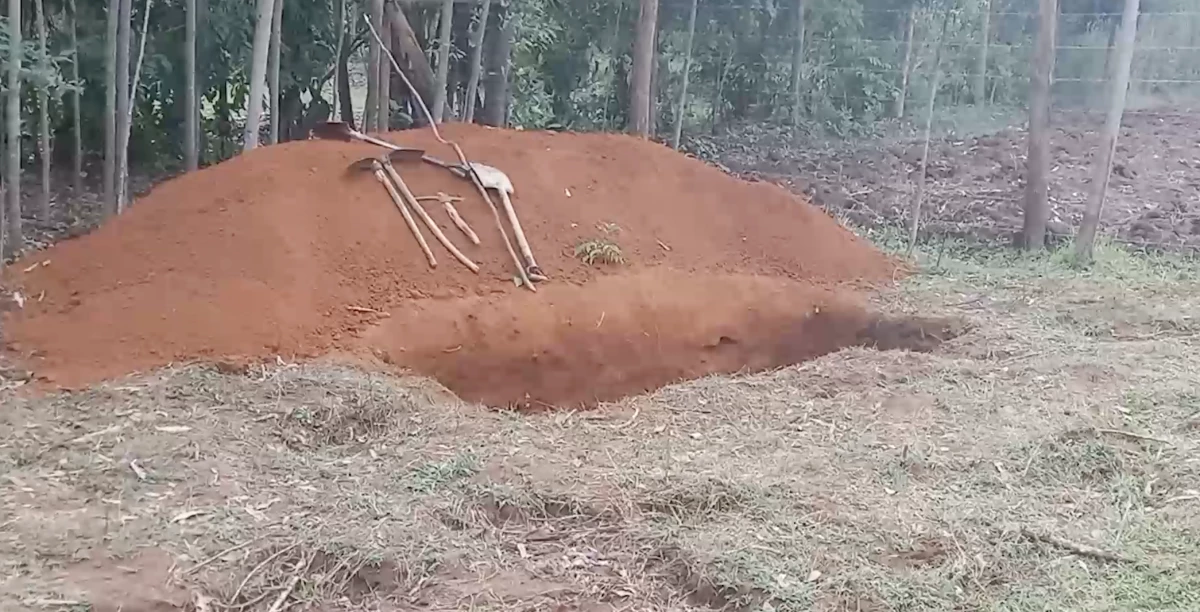
A file photo of a burial site. Several wrangles escalate during burials.

Audio By Vocalize
From being excluded from family photographs to being denied access to ancestral homes, some children grow up carrying the burden of family conflicts they had no part in creating.
Imagine standing at your grandmother's graveside after her burial, only to be asked to step aside to make room for the other grandchildren for a family photograph.
You, too, are a grandchild. You share the same bloodline. But in the eyes of some family members, you do not quite belong.
That was the painful experience of Julia Awuor, whose exclusion at her paternal grandmother's burial brought back memories of a childhood spent on the margins of her own family.
Julia was her late father's fifth child, born to a woman who had been inherited by her father's cousin. Growing up with her younger brother, she says, meant struggling for basic necessities, including school fees, food, clothing and shelter, while her biological father led a relatively comfortable life with another family.
Despite knowing her paternal relatives and sharing a bloodline with them, Julia says she never enjoyed the same acceptance as the other children in the family.
Her grandmother's burial brought that reality into sharp focus.
A woman she closely resembled, and whose bloodline she shared, had died. Yet, when the family gathered for a photograph, Julia was made to feel that she did not belong.
The incident reopened a painful question: Had she ever truly been accepted as part of the family?
Julia's experience is not an isolated account of family exclusion. Across different family arrangements, some children find themselves caught in the tensions surrounding their parents' relationships, with the consequences extending far beyond childhood.
For some, the rejection is subtle, expressed through unequal treatment and reminders of their place in the family. For others, it is more explicit: they are denied access to ancestral homes, excluded from family ceremonies or treated as though their existence is an inconvenience.
When family history becomes a child's burden
Elva and Oliver, children of Mburu from his second marriage, have never set foot in their paternal ancestral home.
Their mother's relationship with their father has, according to Elva, become the basis for their exclusion from his extended family.
"It used to hurt me, but the day I took my fiancée to our home in the city because I was not welcome at our ancestral home, it broke my heart," Elva recalls.
The rejection became particularly painful during his dowry negotiations, an important cultural milestone that he had hoped would bring both sides of his family together.
Instead, only his maternal uncles and his father's friends attended.
"I felt embarrassed by the absence of my paternal family. They hate us. According to them, my mother broke my father's marriage, and neither she nor anything associated with her is welcome," he says.
For Elva, the experience was a reminder that his father's family continued to judge him and his siblings based on circumstances surrounding their parents' relationship.
But what responsibility do children have for the decisions their parents make?
Whether a child is born outside marriage, into a polygamous family or from a subsequent relationship, the circumstances of their birth are beyond their control.
Yet, in some families, they become the basis for differential treatment, with children bearing the emotional and social consequences of conflicts they did not create.
The hidden cost of blending families
The experience of exclusion is not confined to children born outside marriage or those from second marriages. It can also emerge in blended families, where a parent's new relationship introduces tensions around acceptance and belonging.
Ella, a single mother for three years, has since found love again. However, her new relationship has brought a difficult dilemma: her young son's place in their family.
She says her husband is harsh towards the boy, while his extended family is not even aware of the child's existence.
Although her husband promised to introduce the child to his family, she says he has yet to take concrete steps towards doing so.
Meanwhile, the boy's apparent unhappiness has left her questioning whether she made the right decision in starting a new relationship.
"Sometimes I feel selfish and guilty. I feel like I have betrayed my son. I feel sorry for him because he is still young. I cannot even have a conversation with him about these issues because he may not understand," she says.
Her son frequently asks whether they can return to their former home, where it was just the two of them.
"I can see that he is unhappy and does not feel embraced. But I am in love, and I honestly do not know what to do at this point. I do not know whether to choose my son's happiness or my own," Ella says.
Her account raises another difficult question: What responsibility does a parent have to ensure that a new relationship does not come at the expense of a child's emotional well-being?
The numbers behind changing family arrangements
Kenya's family structures are diverse, and not every child grows up in a household with both biological parents.
The 2022 Kenya Demographic and Health Survey (KDHS), published by the Kenya National Bureau of Statistics, found that only 53 per cent of children below the age of 18 lived with both parents.
The survey further established that 23 per cent lived with their mothers while their fathers lived elsewhere. Another 11 per cent did not live with either parent despite both parents being alive.
The proportion of children living with both parents was higher in urban areas, at 59 per cent, compared with 50 per cent in rural areas.
These figures do not measure family rejection or the stigma attached to a child's birth circumstances. Neither do they suggest that children in single-parent or blended families are necessarily disadvantaged.
However, they illustrate the diversity of family arrangements in Kenya and the importance of ensuring that children receive care, protection and a sense of belonging regardless of their parents' marital circumstances.
Importantly, Kenyan law does not recognise the label 'illegitimate child' as a basis for denying a child their rights.
Article 27 of the Constitution prohibits discrimination on several grounds, including birth and marital status. Article 53 further guarantees every child the right to parental care and protection, including equal responsibility of the mother and father, whether or not they are married to each other.
The Children Act, 2022, also provides for the right to inheritance and prohibits disinheriting a child on grounds including birth, origin and other personal circumstances, subject to the Law of Succession Act.
The legal protections, however, do not automatically translate into acceptance within families or protect children from the emotional consequences of rejection.
The psychological scars of rejection
According to psychologist Jane Irungu, repeatedly being excluded or treated as less worthy by one's own family can have lasting effects on a child's psychological and emotional development.
She explains that children develop their sense of identity, security and self-worth partly through their relationships with parents and other significant family members.
When those relationships are characterised by rejection, discrimination or unequal treatment, children may begin to internalise the belief that they are somehow less deserving of love and acceptance.
"Such experiences can affect a child's sense of identity, belonging and self-worth, leading to feelings of rejection, shame, low self-esteem and the belief that they are somehow undeserving of love and acceptance," she explains.
The effects may persist into adulthood, manifesting as anger, resentment, anxiety, difficulty trusting others, fear of abandonment, emotional withdrawal or excessive independence.
Some individuals may also spend much of their adult lives seeking the recognition, affection and sense of belonging they felt denied during childhood.
Irungu says the emotional burden is not necessarily determined by how a child was born, but by how the people around them treat them.
"Ultimately, the greatest pain is not the circumstances of one's birth, but growing up feeling that one's existence makes one less deserving of family, love and acceptance," she adds.
For children like Julia, Elva and Oliver, the question of belonging is not simply about being included in family photographs or being allowed into an ancestral home.
It is about being recognised as family without having to defend the circumstances of their birth.
And perhaps the more important question for parents and extended families is this: Why should children spend their lives paying for relationships they had no part in creating?
Join the Discussion
Share your perspective with the Citizen Digital community.
No comments yet
This discussion is waiting for your voice. Be the first to share your thoughts!