
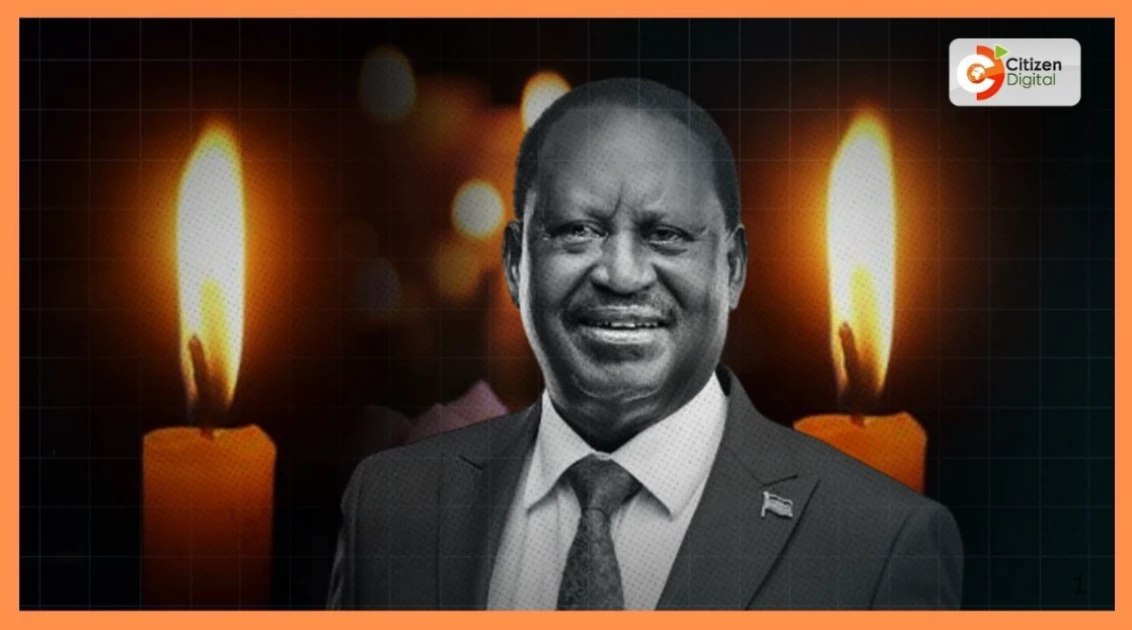
Raila Odinga's family calls for political ceasefire ahead of first anniversary

Audio By Vocalize
The family of the late former Prime Minister Raila Odinga has
called for a political ceasefire ahead of the first anniversary of his death,
inviting Kenyans and leaders across the political divide to set aside their
differences and honour his memory.
Speaking on Wednesday during the handover and dedication of
Raila’s mausoleum at Kang’o ka Jaramogi in Bondo, Siaya County, East African
Legislative Assembly (EALA) MP Winnie Odinga said the October 15 memorial
should bring together people from different political parties, ethnic
communities and countries who shared different chapters of her father’s life.
Winnie said the family was not asking those attending the
memorial to abandon their political beliefs, but urged them to leave political
rivalry outside the commemoration.
“On October 15th, we have invited people of different
political inclinations, from different tribes and communities, from
neighbouring countries and beyond, to join us in celebrating the memory of
Baba,” she said.
“These people shared different chapters of Baba’s life,
they’re welcome to honour him with us together. We may hold different political
convictions, we may disagree strongly about the direction of our country, but
you are welcome here. Nobody is being asked to surrender their beliefs at the
gate.”
Winnie said the family wanted the anniversary to remain a day
of remembrance and celebration, warning political leaders against turning the
occasion into a contest over crowds, popularity or political influence.
“As his family, we call for a political ceasefire in his
honour,” she said.
“Please let the 15th be a day of remembrance and celebration;
it should not become a political showground or competition over who owns the
crowd, who receives the loudest cheers, or who can embarrass another guest.”
Winnie said an event meant to honour Raila should not become a
source of anxiety for political leaders who may hold opposing views.
“An invitation to remember your friend and leader should not
become a reason to fear humiliation,” she said.
She said Raila understood that political convictions and
personal relationships could coexist, recalling instances when members of his
family would remain angry with people they believed had wronged him, only to
discover that he had already reconciled with them.
“Dad (Raila) understood that strong convictions and human
relationships could live together, although those of us around him sometimes
needed a little more time to catch up,” Winnie said.
“You’d be very annoyed with someone on his behalf, defending
him, refusing to even greet them, preparing a very strong argument, and then
discover he had already had tea with them in another place. Now you’re the one
who is causing problems, when he had already moved on, you’re still working
with yesterday’s instructions.”
She cited Raila’s relationship with the late retired President
Daniel arap Moi as perhaps the clearest example of the late former Orange Democratic
Movement (ODM) party leader’s ability to reconcile with political opponents
despite a difficult history.
“For our family, the history was painful. There were years of
detention; years when mum was raising children while wondering whether her
husband would come back; years of absence that no later conversation could give
back,” she said.
Raila was detained without trial for nearly eight years
following the 1982 attempted coup and became one of the prominent figures in
Kenya’s struggle for multiparty democracy.
Winnie said the eventual reconciliation between Raila and Moi
demonstrated that acknowledging past injustices did not have to prevent people
from moving forward.
“Yet, in time, Baba and Moi found a way to speak again. They
made peace and they worked together. Imagine entering that conversation with
everything that you remember – 8 years in solitary confinement, no mattress,
not even a blanket – and you still go and shake the hand of that person,” she
stated.
Winnie said her father’s experience offered a lesson in how
Kenyans could deal with political and personal differences without allowing
past disagreements to permanently define relationships.
“For me the lesson is that you can remember what happened,
hold firmly to what you believe, and still leave the door open,” she said.
Raila died on October 15, 2025, aged 80, while receiving
medical treatment in India. He was later buried at Kang’o ka Jaramogi in Bondo,
where the mausoleum dedicated to him and his father, Kenya’s first Vice
President Jaramogi Oginga Odinga, now stands.
President William Ruto on Wednesday formally unveiled and dedicated Raila’s mausoleum at Kang’o ka Jaramogi, in a ceremony attended by
members of the Odinga family, government officials and other dignitaries.
The family-led memorial on October 15 will form part of a
month-long programme marking Raila’s first death anniversary.
The main public commemoration is scheduled for Migwena
Cultural Sports Ground in Bondo and is open to mourners from across the country
and beyond.
“Nobody is being asked to surrender their beliefs at the
gate,” Winnie added.
Join the Discussion
Share your perspective with the Citizen Digital community.
No comments yet
This discussion is waiting for your voice. Be the first to share your thoughts!