
Protests, call for crackdown on illicit brew in Kirinyaga
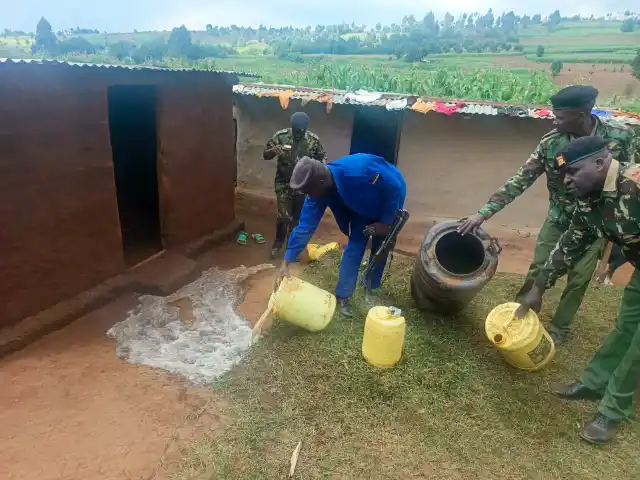
A file photo of police raiding an illicit brew den.

Audio By Vocalize
The residents lamented that many young people have become addicted to the brew, with some reportedly abandoning work, neglecting their families and going for days without eating.
Speaking in Kiandegwa, the women identified Unit 5 as a major hotspot for the sale of the illicit alcohol, alleging that some bar owners are involved in its production and distribution.
They cited the death of a local man who allegedly died after consuming the brew on Monday, saying his body was at the mortuary.
The residents also raised concerns over the disposal of empty alcohol bottles in rice farms, saying the broken glass poses a danger to farmers and workers.
Led by Simon Mwaniki, Grace Wanjiku and Lucy Kariuki, the residents said that the alcohol is sometimes taken directly to young people working in rice fields or drying harvested rice.
"You give a youth work to dry rice and within five minutes you will find him talking anyhow after drinking the take-away alcohol they are being given. Kiandegwa Unit 5 is where this deadly alcohol is made by some bar owners," Kariuki said.
Wanjiku questioned why the alleged illicit alcohol outlets continued operating despite their proximity to Kiandegwa Police Station, which she estimated to be about 500 metres away.
"Who will protect our children? They are not eating but dying slowly, like the case of a man who died after drinking on Monday. He is at the mortuary as we are speaking," she said.
The residents further accused the National Environment Management Authority (NEMA) of failing to address the alleged dumping of empty bottles in rice farms.
Mwaniki said he had sustained injuries from discarded bottles, adding that two of his livestock had also been injured.
The residents said the problem extended beyond Kiandegwa Unit 5 to neighbouring areas, including Unit 6, K One, Siberia, Ng'ang'a and Matithi-ini.
They lamented that young people were spending money earned from rice harvesting on alcohol, undermining household incomes and family welfare.
"We are all affected, from Kiandegwa Unit 5, Unit 6, K One, Siberia, Ng'ang'a and Matithi-ini, and we need help as a society," Josephine Wambui said.
The residents also accused local administrators of discouraging them from speaking publicly about the alleged illicit alcohol trade.
They called on Interior Cabinet Secretary Kipchumba Murkomen to intervene, demanding action against those involved in brewing and selling the alcohol.
"There was a time a local administrator defended deadly alcohol at a burial in Mutithi village and we were very shocked. We have to speak out so that Interior Cabinet Secretary Kipchumba Murkomen can come out and help us," Josphat Kariuki said.
Muriithi Mwangi said the problem was affecting families across Kirinyaga County, warning that its effects were being felt across generations.
"Every family is affected by the deadly alcohol. If your brother is not affected by alcohol, your uncle is affected. If your children are not affected, your brother's children are affected. It is so serious," he said.
Wambui urged security agencies to take action against those suspected of producing and distributing the illicit brew, warning that residents would continue speaking out if the authorities failed to act.
The villagers further claimed that some bars in Kiandegwa Unit 5 operate from early morning, alleging that operators sometimes close their front entrances while continuing to serve customers.
They want chiefs, police and other security agencies to investigate the allegations, take action against those found responsible and prevent further deaths and harm to residents.
Join the Discussion
Share your perspective with the Citizen Digital community.
No comments yet
This discussion is waiting for your voice. Be the first to share your thoughts!